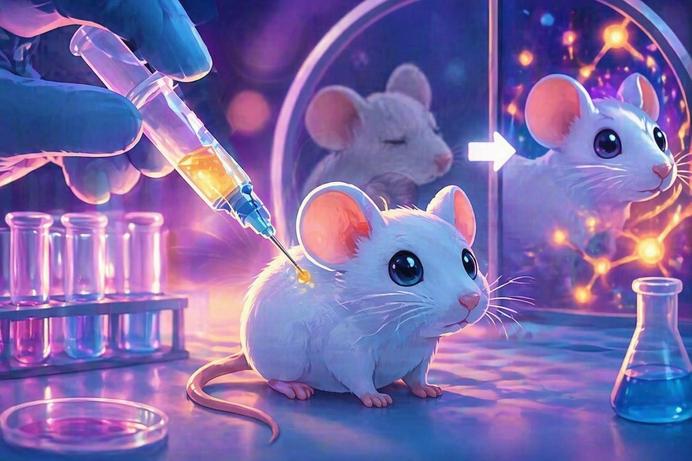
Scientists Discover That Injecting Mice With Fatty Stuff Makes Them See Better, Obviously
Researchers found injecting a specific fatty acid improved vision in old mice, because apparently the solution to aging eyes is just more of the right kind of oil.
Aging, that relentless party crasher, has long been known to dim the lights in our eyes. But researchers from the University of California, Irvine, along with collaborators from the Polish Academy of Sciences and the Health and Medical University in Potsdam, Germany, are now exploring the radical notion that maybe we could, you know, turn them back on.
Their study, published in *Science Translational Medicine* under the thrilling title "Retinal polyunsaturated fatty acids supplementation reverses aging-related vision decline in mice," focuses on a gene called Elongation of Very Long Chain Fatty Acids Protein 2 (ELOVL2). This gene, a known marker of aging, is central to producing very-long-chain polyunsaturated fatty acids (VLC-PUFAs) and the omega−3 fatty acid docosahexaenoic acid (DHA) in the retina. When ELOVL2 activity drops with age, so do levels of these crucial molecules, and vision gets worse.
In a move of stunning scientific pragmatism, the team decided to skip the middleman. Instead of trying to revive the aging ELOVL2 enzyme, they simply injected older mice with a specific polyunsaturated fatty acid. Lo and behold, the mice's visual performance improved. "It's a proof-of-concept for turning lipid injection into a possible therapy," said Dorota Skowronska-Krawczyk, PhD, an associate professor at UC Irvine. She also noted, with the dry satisfaction of someone who has just proven a point, "What is important is that we didn't see the same effect with DHA."
The research also identified genetic variants in the ELOVL2 enzyme linked to faster progression of age-related macular degeneration (AMD), potentially allowing doctors to spot high-risk patients earlier. Skowronska-Krawczyk is now convinced ELOVL2 is "one of the top aging genes we should look at" for anti-aging therapies.
In a plot twist that suggests this fatty acid might be the Swiss Army knife of aging, collaborative work with UC San Diego indicates that a lack of ELOVL2 also speeds up immune cell aging. This raises the tantalizing, if slightly greasy, possibility that lipid supplementation could one day help not just failing eyesight, but also a failing immune system.
The Good Times
News in your inbox.
One sardonic roundup, delivered on your schedule. Free. Unsubscribe whenever your tolerance for wit runs out.
Already subscribed but we never reach your inbox? Check your spam folder and hit 'Not spam' (or 'Remove from spam') to bust us out of junk-mail purgatory. You'll be helping everyone else too.
Don't open any of our emails for a month and you'll be automatically removed from the mailing list.
Rewrite Article
Select parts to regenerate with a fresh AI pass. Translations will be updated automatically.
Generate AI Image
Creates a sardonic version of the article image using OpenAI.