
It’s a sad truth of journalism that there’s never enough time to cover every fascinating science story that crosses our desk. So each month, we shine a light on the best ones that nearly slipped through the cracks. July’s lineup includes cyborg cockroaches getting scuba gear, a Medici duke cleared of poisoning charges, the best evidence yet for Betelgeuse’s secret companion, and ancient Egyptian princesses who could probably kick your butt in archery.
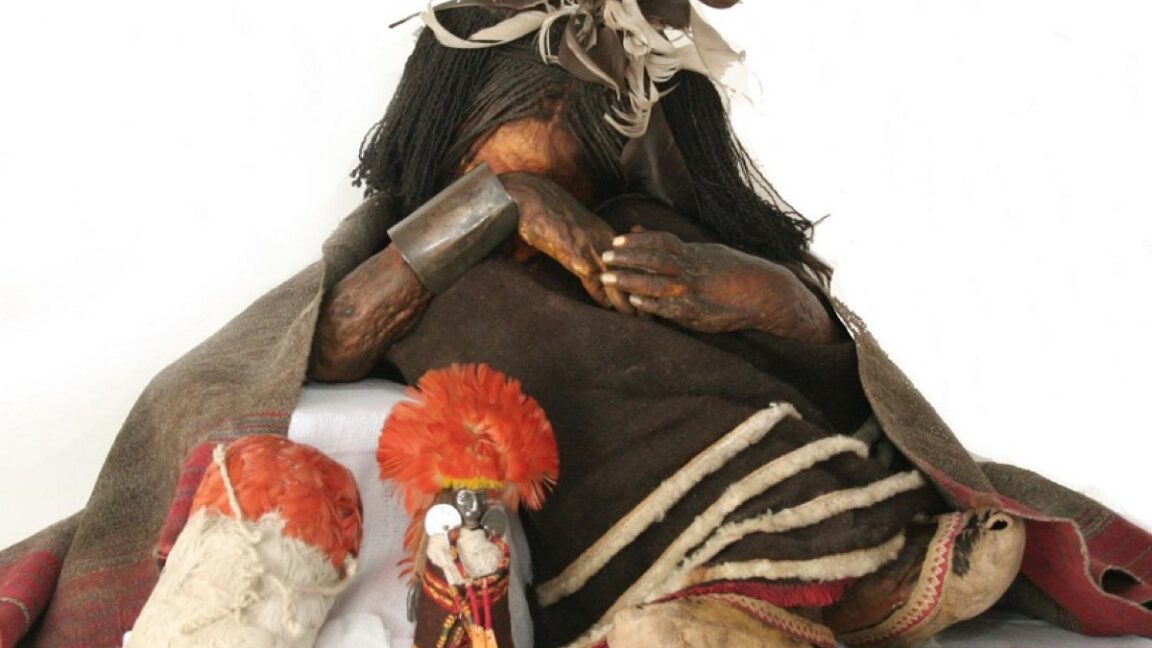
First up, let’s talk sacrifice - Incan style. The Incas practiced a ritual called Capachoca, where children were offered to the mountains and, after death, were believed to become divine intermediaries. Colonial accounts mention strangulation, asphyxiation, and blunt force trauma as common methods. Archaeologists reanalyzed the remains of one such victim, the Boy of Cerro El Plomo, and concluded he died from blunt force trauma - not freezing, as previously thought. The evidence: a left frontal skin lesion and fracture with no signs of healing, consistent with a star-shaped mace, not an accidental fall. His feet showed signs of a long pilgrimage, and his stomach was full - he’d feasted before the ceremony. A dilated esophagus suggested vomiting, possibly triggered by the head injury. Meanwhile, two girls from Cerro Esmeralda, previously thought strangled, showed no neck fractures. The marks on their necks were likely from clothing, not a killer’s hands. The findings appear in Science Advances.
Then there’s the case of the warrior princesses. In the late 19th century, archaeologists excavated the Dahshur pyramid complex and found intact burial chambers with the remains of King Hor, Princess Noub-Hotep, and others. Later excavations added Princess Ita, Princess Khenmet, Princess Itaweret, and Princess Sathathormeryt. A new paper in Frontiers in Environmental Archaeology combined osteological analysis, X-ray imaging, and FTIR spectroscopy to assess the remains. Princess Ita (died aged 24 - 28) had strong upper-body muscle attachments, suggesting habitual mace or dagger use. Princess Khenmet (late 30s or 40s) had strong ligament attachments. Princess Itaweret (20 - 34) had healed broken ribs and foot fractures, with bones consistent with archery. “We found pronounced development in the upper limbs... correlating to repetitive, high-intensity actions like pulling a bowstring or stabilizing a weapon,” said co-author Zeinab Hashesh. So those bows, arrows, and maces in their tombs weren’t just symbolic - they were the princesses’ actual gear.
Now, for the cyborg cockroaches. In 2013, Backyard Brains created the RoboRoach, a DIY kit that turns cockroaches into remote-controlled cyborgs. In 2022, Japanese researchers made a more sophisticated version for search-and-rescue. Now, scientists at Nanyang Technological University in Singapore have built an amphibious model, outfitting cockroaches with a tiny diving suit, per Nature Communications. Cyborg insects use their own muscles, so they’re more efficient than small robots. But disaster zones often have puddles and submerged areas, and cockroaches breathe through spiracles - small openings in their trachea. So the team created a soft waterproof shell containing an oxygen tank: a 3D-printed sponge soaked with manganese dioxide. Before deployment, they inject diluted hydrogen peroxide, which the catalyst breaks down into oxygen, delivered via four tiny plastic tubes to the spiracles. The cyborg roach worked well in test runs, though it only operated in a few inches of water. Future versions will add sensors and navigation, and maybe extend the diving suit to locusts and beetles.
In space news, Betelgeuse - the bright red star in Orion - has been acting up. In 2019, it dimmed mysteriously, sparking supernova speculation. A 2021 study blamed dust from a cold spot. Now, data from the European Southern Observatory’s Very Large Telescope (VLT) has provided the first firm evidence of a faint companion star, Betelgeuse B, according to Astronomy and Astrophysics. Astronomers have sought this companion for nearly a century. The team directly imaged Betelgeuse B with the SPHERE instrument, and it turns out the companion is more massive than expected - two to three times the mass of our Sun. One more observation a year from now should confirm it fully. The big question now: how will Betelgeuse B affect Betelgeuse’s eventual supernova?
History’s most famous malaria case? Grand Duke Francesco de Medici and his wife, Bianca Cappello, died in 1587 after a brief illness at their villa in Poggio. Rumors of arsenic poisoning persisted, despite symptoms matching malaria. Now, a new analysis of Francesco’s remains - and his brother Cardinal Giovanni, who died of malaria in 1562 - found genetic evidence of malaria, per iScience. Yale researchers and a paleopathologist from the University of Pisa analyzed rib bones and identified Plasmodium falciparum in Giovanni and P. malariae in Francesco. So, no poisoning - just a mosquito-borne disease that was common in swampy Poggio.
Finally, sperm whales: the only whales that nap vertically, head-up, for 10 - 15 minutes. They do this to buffer against surface waves, but how do they stay underwater when their heads are full of oil, wax, and air, making them buoyant? According to the Journal of Experimental Biology, sperm whales blow bubbles to regulate buoyancy during naps. Researchers tagged 42 sleeping whales off northern Norway, recording bubble sounds and 3D movements. They found that whales napping near the surface blew bubbles 11 times on average, versus three or four times for those slowly ascending. The question now: are these bubbles a conscious choice? If so, sperm whales might sleep like dolphins, with one brain hemisphere awake. Either way, it’s a bubble-filled mystery.