
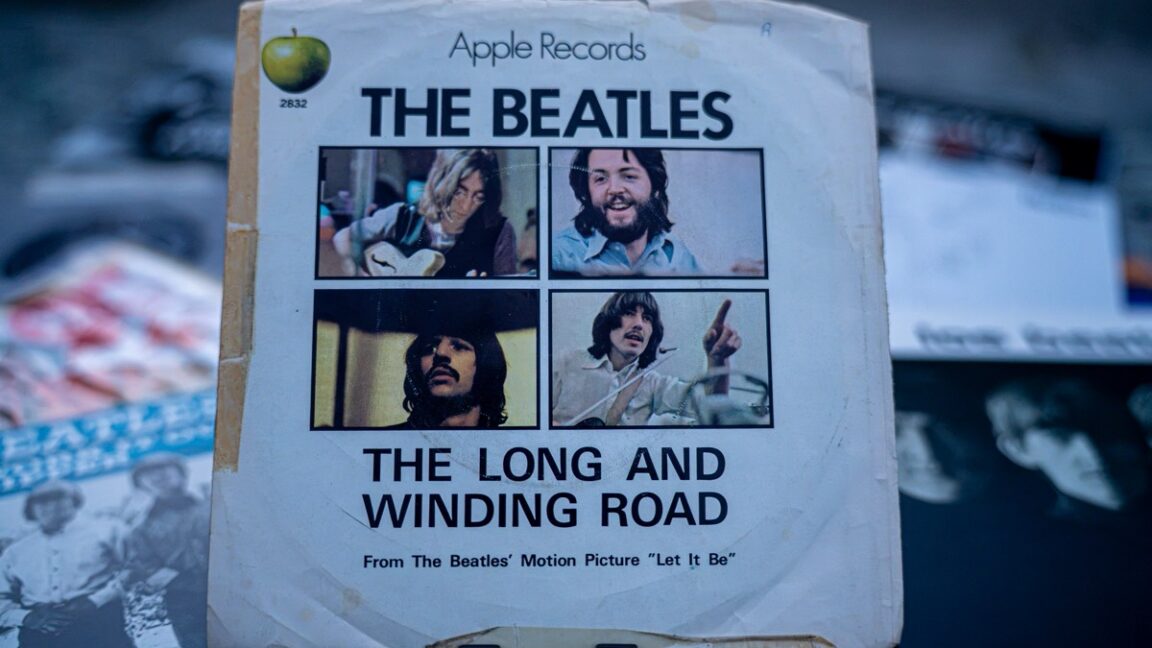
Scientists are a playful bunch, as evidenced by their tendency to sneak pop culture references into their research papers. And according to a new study in PLoS ONE, no band gets more love from the lab coat crowd than The Beatles. Because nothing says 'rigorous scientific inquiry' like a pun on 'The Long and Winding Road.'
Co-author Gabriel Budel of Delft University of Technology in the Netherlands described some of the gems they found: 'The lung and winding road' - a paper on Long COVID that changes one vowel - and 'Here comes the SU(N),' which turns 'Here Comes the Sun' into a quantum computing paper about mathematical groups. Someone was clearly having a very good day at their desk.
This isn't the first time scientists have fessed up to their musical obsessions. Back in 2014, researchers at the Karolinska Institute in Sweden admitted to sneaking Bob Dylan lyrics into their papers, starting with a 1997 Nature review titled 'Nitric Oxide and inflammation: The answer is blowing in the wind.' That led to a 2015 study on Dylan references in biomedical literature, with 'The Times They Are A'Changin'' and 'Blowing in the Wind' leading the pack. Meteorologists and climate scientists were especially fond of Dylan.
Then came a 2017 study comparing Dylan and Beatles lyrics in biomedical papers - Beatles won - and a 2023 analysis of The Clash's 'Should I Stay or Should I Go' in scientific papers, which found 408 references to that song, beating the Beatles' 'The Long and Winding Road' (236) and Dylan's 'The Times They Are A'Changin'' (128).
Now Budel and colleagues have upped the ante with a much broader analysis. They used a large language model to comb through Scopus and Google Scholar for Beatles references - not just exact song titles, but also lyrics and clever wordplay. Their findings: 'The Long and Winding Road' takes the top spot with 798 references, far outpacing The Clash's 561. In fact, they argue The Beatles are the most referenced musical artist in scientific paper titles, based on comparisons with top hits from Michael Jackson and Elvis Presley.
The authors note that Paul McCartney described the song as 'all about the unattainable; the door you never quite reach,' which they find a fitting metaphor for science, 'which often progresses through trial and error toward meaningful, albeit temporary, results.' Plus, many scientific phenomena involve prolonged and unpredictable development, just like waiting for that song to end.
Overall, they found 2,048 exact matches with Beatles song titles in Scopus - over 3,000 if you include wordplay. The distribution follows a power law, or Zipf's law, which co-author Robert E. Kooij, also from Delft, found amusing: 'As network scientists we're used to seeing power laws in earthquakes, in social networks, in wealth. It turns out references to Beatles songs follow one too: a handful of songs are cited constantly and the bulk of them are used once or twice. The Beatles apparently obey the same statistics as the rest of nature.'
The most cited paper with a Beatles reference is the 2017 'Attention is all you need' (89,737 citations), which, ironically, helped invent the architecture behind ChatGPT. The top three most cited exact Beatles references: 'Good day sunshine: Stock returns and the weather' (1,009 citations), 'Seizure prediction: The long and winding road' (954), and 'Th17 cell differentiation: The long and winding road' (599). Beatles references span all subject areas, but medicine and social sciences dominate.
References have steadily increased since 1990, with a notable surge between 1995 and 2005 - coinciding with The Beatles' Anthology project - and again after their music hit streaming platforms like Spotify in late 2015. The authors suggest that academic publishing's rapid digitization and pressure to stand out have pushed researchers toward catchy titles. A 2023 study even suggested that song references in titles grab readers' attention better than jargon.
While 'The Long and Winding Road' might be overused, the authors argue that 'more innovative wordplay still offers appeal. For example, few fans of the White Album will fail to smile upon encountering titles such as 'Happiness is a warm theorem,' or 'Everybody's got something to hide except me and my patented monkey: Patentability of cloned organisms.''
So next time you're reading a scientific paper and stumble upon a Beatles pun, just remember: it's not a distraction, it's a tradition.
PLoS ONE, 2026. DOI: 10.1371/journal.pone.0356147.