Reflecting Pool Gets a Supervillain Name, and It's Not the One You Think
The Reflecting Pool's algae problem has a supervillain name (Scenedesmus), the water looks like modern art, and the $16.4 million renovation is peeling off - but at least one cyclist thinks the paint chips are historic.
Donald Trump has a new nemesis, and it’s got a name worthy of a comic book villain: Scenedesmus. That’s right, the Reflecting Pool on the National Mall has become the country’s most high-profile science experiment, and the results are less "American-flag blue" and more "modern art installation at a sewage plant."
After a week of combat, workers have essentially killed off one type of algae infesting the pool, only to create the perfect conditions for a new type to take over. Scenedesmus, a genus of green algae nicknamed “Skinny Dead Mouse” by scientists, is now flourishing, according to testing run at the request of The Atlantic. The pool currently looks like a strange bit of modern art - some sections are relatively clear, others are an oily sludge, and none of it looks like the patriotic blue it was supposed to be. Baby ducks have swum through it, National Park Service workers have waded in it, and small children have bent over to touch it. But nobody can definitively say whether the water is safe, because the Department of Interior is playing coy with test results and scientists who want to run their own tests are still waiting on permits.
So The Atlantic decided to dig - or dip - a little deeper. Water samples were collected from different areas of the pool and delivered to two scientists by Thursday evening. Hans W. Paerl, a professor at the University of North Carolina at Chapel Hill, detected the distinctive earthy scents of cyanobacterial blooms but found the previous blue-green algae mostly dead, thanks to the endless jugs of hydrogen peroxide workers dumped in. “The guys dealing with peroxide treatment can pat themselves on the back,” he said. “But it doesn’t really solve the overall problem.” In fact, it created a new one: The green algae, perhaps in the absence of the blue-green algae, are absolutely flourishing. “I’ve never seen it bloom quite this thick,” said Greg Boyer, a professor emeritus at SUNY, who analyzed other samples.
Boyer’s tests found little to no blue-green algae, making the water unlikely to be toxic for now. But this is peak season for green algae, and blue-green algae season hasn’t really started yet. That could change by late July. The treatments NPS is using - hydrogen peroxide and nanobubble technology - are more effective against blue-green algae, but the green algae are proving resilient. “They are stressed, but they are definitely not dead,” Boyer said. “If I was going to design a facility to grow algae, I would probably design a facility that had a lot of surface area and was very shallow, so you have sunlight down to the bottom. And put a lot of nutrients in it. And that’s pretty much what the Reflecting Pool is.” The decision to paint the bottom a deep shade of blue raised the water temperature and accelerated the growth. Bottom line? “The water will probably remain green for the foreseeable future,” Paerl said.
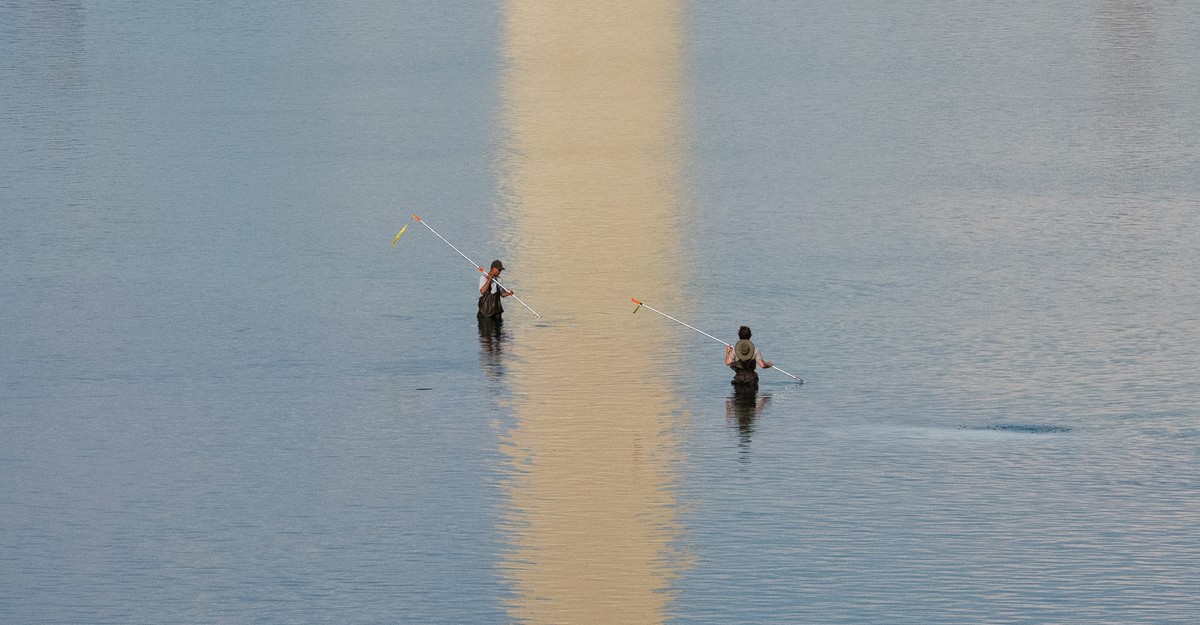
Workers have been vacuuming algae from the bottom, with an email going out to NPS employees asking for volunteers to work 12-hour shifts as part of “critical pre-July 4th operational needs.” The operation is being called a “regional and national priority.” Yesterday evening, several people in khakis and dress shirts were in the pool, wearing waders and vacuuming. As one ended his shift, he said he was “just doing my part.” But another problem has emerged: The sealant at the bottom of the pool, which was the bulk of the $16.4 million renovation project, is beginning to peel off. Tourists and locals are converging on the site to catch a glimpse - or perhaps even a souvenir. “Taking a piece of paint is like taking a piece of the Berlin Wall,” one cyclist said. It’s a piece of history, indeed.
The Good Times
News in your inbox.
One sardonic roundup, delivered on your schedule. Free. Unsubscribe whenever your tolerance for wit runs out.
Already subscribed but we never reach your inbox? Check your spam folder and hit 'Not spam' (or 'Remove from spam') to bust us out of junk-mail purgatory. You'll be helping everyone else too.
Don't open any of our emails for a month and you'll be automatically removed from the mailing list.
Rewrite Article
Select parts to regenerate with a fresh AI pass. Translations will be updated automatically.
Generate AI Image
Creates a sardonic version of the article image using OpenAI.