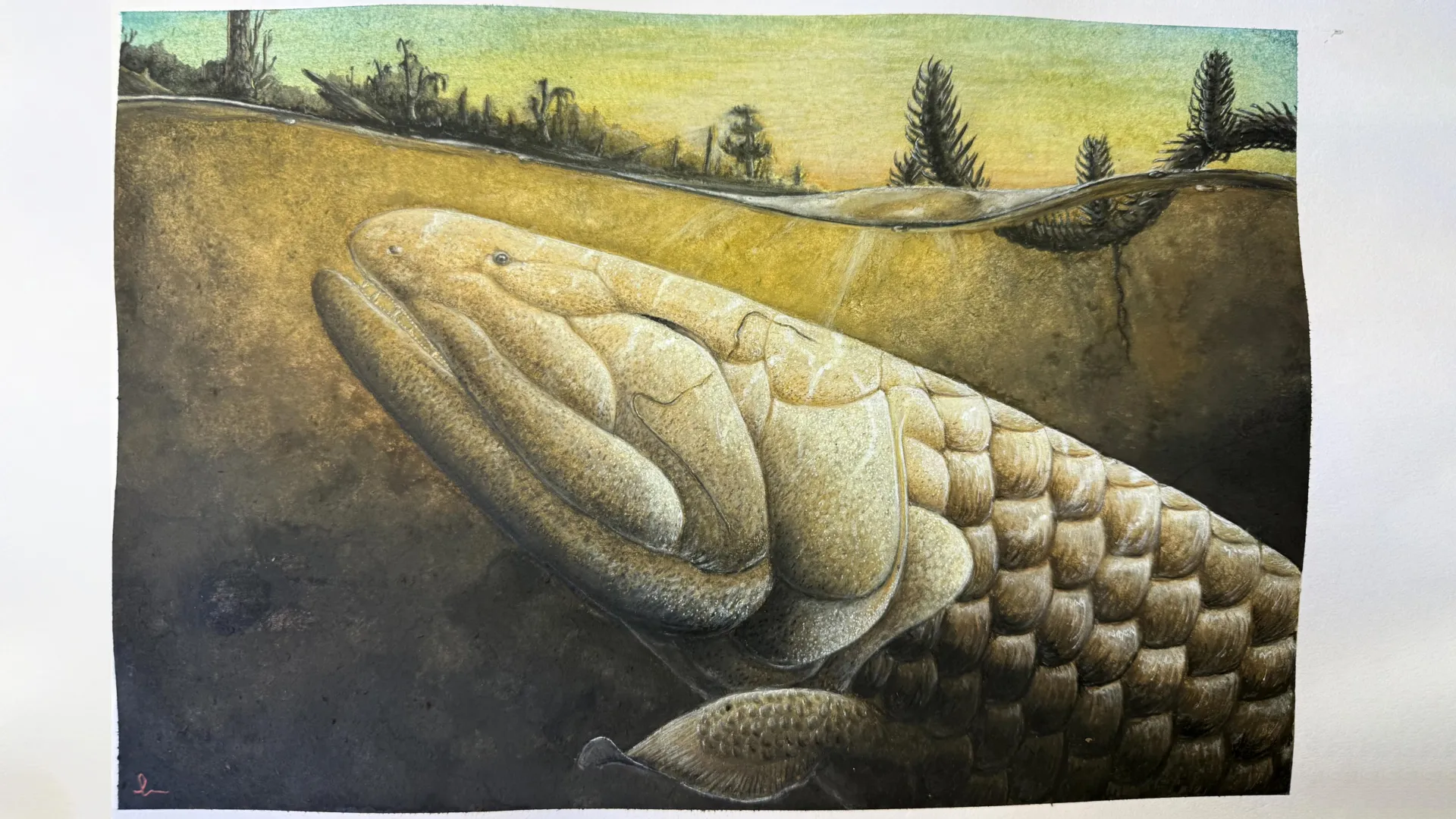
Researchers at Flinders University have used advanced neutron imaging technology to peer inside the skull of Koharalepis jarviki, a large predatory fish that lived during the Devonian Period (the “Age of Fishes”) more than 380 million years ago. The only known specimen, discovered in Antarctica’s Lashly Mountains, belongs to the Canowindridae family - a group that highlights the ancient land-bridge friendships between Australia and Antarctica.
“This precious fossil belongs to a group called the Canowindridae which highlights the ancient links between Australia and Antarctica,” says Dr. Alice Clement, a Flinders University Research Fellow and coauthor of the study published in Frontiers in Ecology and Evolution. The team used non-destructive scanning to reveal hidden structures, including internal bones of the skull that give insights into the fish’s braincase and neuroanatomy.
Lead author Corinne Mensforth, a PhD candidate at the Flinders Palaeontology Lab, notes that Koharalepis is the only fossil in its family to preserve those internal bones. The scans showed its brain resembled those of fishes straddling the water-to-land transition, and the fish had openings in the top of its skull for extra air intake and an organ that detects light and circadian rhythms - likely adaptations for shallow, oxygen-scarce waters.
Growing to about 1 meter, Koharalepis was an ambush predator that, despite its relatively small eyes, “must have relied heavily on its other senses to capture its prey,” says Mensforth. Emeritus Professor John Long, who first described the fossil in 1992, notes that modern imaging allowed the team to understand the fish’s behavior, adaptations, and relationships to other tetrapod-like fishes - and how fish first left the water to live on land roughly 385 million years ago.
The study, “New data on the sarcopterygian Koharalepis jarviki (Tetrapodomorpha; Canowindridae) from the Late Devonian of Antarctica, revealed via synchrotron and neutron tomography” (2026), was supported by the Australian Research Council and published in Frontiers in Ecology and Evolution. The research adds another piece to the puzzle of how vertebrates evolved from aquatic creatures into animals that eventually walked (and, later, complained about traffic).
The Good Times
News in your inbox.
One sardonic roundup, delivered on your schedule. Free. Unsubscribe whenever your tolerance for wit runs out.
Already subscribed but we never reach your inbox? Check your spam folder and hit 'Not spam' (or 'Remove from spam') to bust us out of junk-mail purgatory. You'll be helping everyone else too.
Don't open any of our emails for a month and you'll be automatically removed from the mailing list.
Rewrite Article
Select parts to regenerate with a fresh AI pass. Translations will be updated automatically.
Generate AI Image
Creates a sardonic version of the article image using OpenAI.