
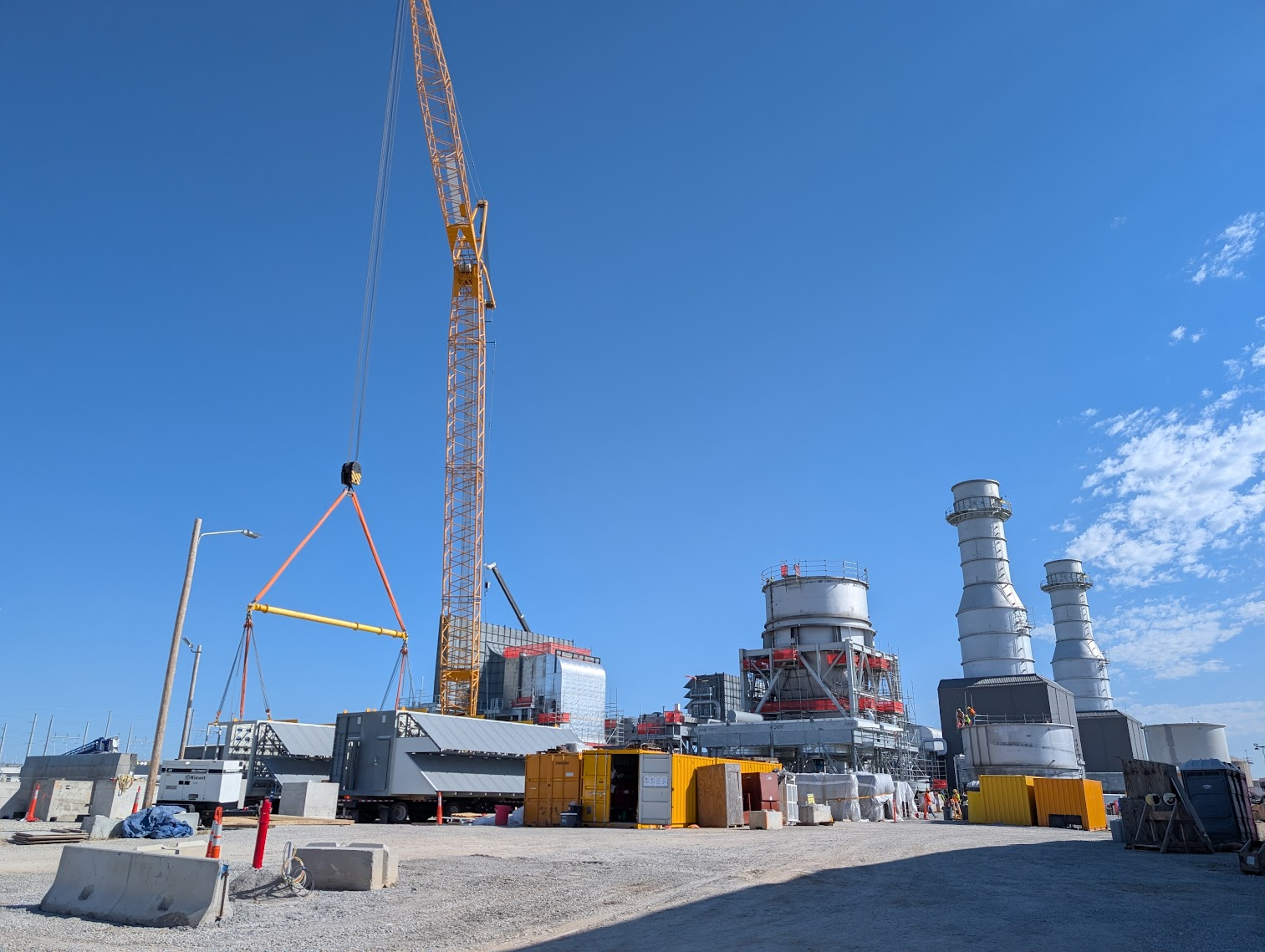
In 2021, Winter Storm Uri reminded much of the country that electricity doesn't just appear when you flip a switch. Utilities scrambled as demand for power and natural gas spiked, transmission lines strained, fuel supplies faltered, and equipment malfunctioned. In Nebraska, the Omaha Public Power District (OPPD) resorted to rolling blackouts to keep the grid from collapsing entirely. Afterwards, the Southwest Power Pool, which manages regional grid reliability, told its members to keep more power capacity in reserve for future emergencies.
Fast forward a few years, and the data center boom, electrification, and other industrial growth have handed utilities a double-edged sword: a flood of new customers and a demand spike that's less "boom" and more "oh no." OPPD, which serves about 419,000 customers across eastern Nebraska, is now running dangerously low on the energy capacity it can promise to new and expanding economic development projects. The shortage threatens the region's ability to, well, develop economically, attract companies, add jobs, and grow - minor concerns, surely.
And OPPD is not alone. Utilities and grids across the country are grappling with aging power plants and infrastructure, relentlessly rising demand, and climate change straining the grid in real time. Meanwhile, communities in Nebraska are opposing the very renewable energy developments that could help solve some of these problems. Because why make things easy?
OPPD currently projects it has less than 100 megawatts of available power capacity for new or expanding large customers over the next few years. For context, a large data center could require as much as 1,000 megawatts, and manufacturing facilities can range from a few megawatts to over 100 megawatts. That figure could shift depending on customer commitments and new generation coming online, and OPPD insists it has enough capacity for typical residential and commercial growth. But essentially, any new or expanding development requiring 2 megawatts or more might have to wait in line. OPPD president and CEO Javier Fernandez - who will be leaving the utility at the end of the year, according to a recent internal announcement - put it bluntly: "We are bending over backwards. We're trying to figure out creative solutions. How do we bridge this? Can we buy capacity from other utilities? Literally, no one has excess capacity. Everyone is in the same boat as we are, so now the pinch, so to speak, it's, well, growth has to slow down, maybe?"
Economic development leaders are worried that if power capacity in Nebraska's largest metropolitan area remains limited, the Omaha area and the state as a whole will be at a competitive disadvantage for new businesses, jobs, and tax revenue. This comes as the state is projected to face a $208 million deficit next year, and state income tax revenues this past year were $703 million lower than in 2022. So, no pressure.
At the same time, OPPD is doing long-term planning to determine its energy and system needs over the next 10 years. To meet demand, the utility and its board must decide how much to expand OPPD's energy portfolio. On the low end, it could add about 1,000 megawatts, but initial planning results suggest it might more than double its portfolio. For context, OPPD's portfolio currently contains 4,583 megawatts of energy capacity. And while more generation capacity is coming online over the next few years, demand projections remain high. Companies with nearly 2,000 megawatts of economic development projects are planning to come to the area and are actively in OPPD's queue through 2031, according to a September presentation. There are about 5,000 megawatts worth of other potential projects on the radar considering the area.
Fernandez acknowledged that not all of those projects will actually materialize. Nevertheless, if the utility builds too small, the Omaha metro could end up back in the same shortage for economic development. If it builds too big and big-customer usage doesn't materialize, OPPD's ratepayers will likely have to eat the costs. Nailing the projections and actually building new generation - such as renewable energy and natural gas sources - will be a big challenge. Two OPPD board members said it would be helpful if state and local leaders were on the same page with clear economic development plans to guide priorities for how much energy the region will need.
OPPD declined to comment on what portion of its queue is made up of data centers, manufacturers, or other types of customers. According to a March presentation, a chart of the utility's current peak demand shows industrial customers represent 32 percent, residential customers make up 41 percent, and commercial customers are 27 percent. By 2035, industrial customers are expected to make up 52 percent. "Clearly, data centers have been a very, very big force on that increase," Fernandez said. "The biggest question my board is likely going to have to answer is going to be how big of a plan we approve. And that is going to be informed by … state, counties, cities, chambers: How much do you want us to grow?"
In September, Heath Mello, the Greater Omaha Chamber's president and CEO, sent a letter to OPPD's board calling for the utility to plan further out than 2036 and strongly consider building for more growth. Paul West, chair of the chamber's board, said the chamber hopes to recruit and expand industries like manufacturing. Economic development could help solve big problems - the state's budget shortfall, high property taxes, and brain drain. But energy is one of the top two reasons the chamber loses deals to other locations. And any new manufacturing will have to compete for power with potential data center customers considering the region. This matches a trend being seen across the U.S., said Larry Gigerich, chair of the Site Selectors Guild.
Utilities like OPPD have an obligation to serve all customers, but state and local governments can incentivize and disincentivize the kind of growth they want to see, Fernandez said. The competition for electricity with data centers is "causing manufacturing companies now to be more proactive and to use their voice more directly with utilities versus the way they have done it for decades," Gigerich said. "Now it's a true competition, and we can't generate enough new power fast enough to meet everybody's needs."
Projecting demand is one thing. Getting electricity-generating projects built is quite another. To meet growing demand and keep costs low, OPPD is looking at building more natural gas and renewables. Both options come with their own challenges. The current popularity of natural gas has constrained the equipment supply chain, meaning it could take the utility much longer to build. And while renewables face some upfront cost increases, they remain the lowest-cost energy source to operate. However, OPPD has struggled to bring these projects online because some communities in the state have turned them away. The tension has been building for years as misinformation has spread and projects were kept secret by developers. Residents across the state have rejected clean energy proposals over concerns about fire risks and potential damages to prime agricultural land and local infrastructure.
Fernandez said that some community leaders have rejected renewable generation only to ask for more power capacity to attract new economic development. "Everyone is saying no, and then we end up in a really bad place," he said. With demand for power growing, something has to give, otherwise OPPD might not be able to generate the power it needs to help Nebraska grow. "If Omaha doesn't grow, if Omaha doesn't prosper, the rest of the state very likely won't," Fernandez said. "What the state wants versus what the city wants versus what the chambers want - well, they all want different things. But the one common denominator that I keep hearing is jobs and income."