NASA's Psyche Mission Snaps a Blurry Selfie With Mars, Because Why Not on the Way to an Asteroid
NASA's Psyche mission snaps a dust-veiled, overexposed crescent of Mars from 3 million miles away, because even asteroid-bound spacecraft need a practice selfie.
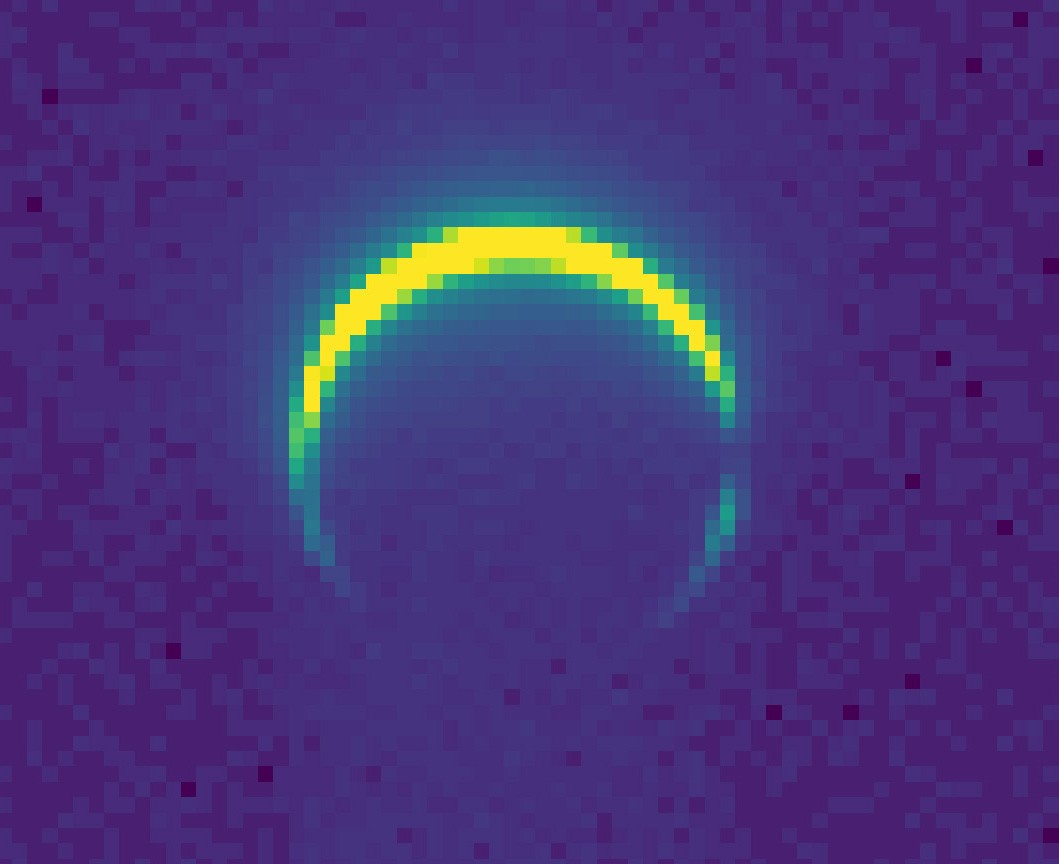
NASA's Psyche mission, currently en route to a metal-rich asteroid that has nothing to do with the word "psyche" in the pop-psychology sense, decided to stop and take a picture of Mars on May 3, 2026. The spacecraft was about 3 million miles (4.8 million kilometers) away from the Red Planet at the time, which is roughly the distance you'd need to be to appreciate it as a thin crescent rather than a full-on planetary photobomb.
The spacecraft is approaching Mars for a gravity assist on May 15, a maneuver that will give it a speed boost and adjust its trajectory toward asteroid Psyche, where it's expected to arrive in 2029. Because why take the scenic route when you can borrow some momentum from a planet?
From this "high-phase angle" - NASA-speak for "the planet looks like a crescent Moon, but redder and dustier" - the Sun is conveniently out of frame, hovering "above" both Mars and Psyche. No stars are visible in the background because they're too dim compared to the sunlight bouncing off Mars, which is basically the cosmic equivalent of trying to see a candle next to a spotlight.
The image was captured by the multispectral imager's panchromatic filter with an exposure time of just 2 milliseconds. Even at that blink-and-you'll-miss-it speed, the crescent was so bright that parts of the image are oversaturated. The light comes from sunlight reflected off Mars's surface and scattered by dust particles in its atmosphere. Because Mars's dustiness varies as unpredictably as a teenager's mood, scientists couldn't nail down the expected brightness before this image was taken.
The dust in Mars's atmosphere causes sunlight to scatter, making the crescent appear to stretch farther around the planet than it would if Mars were as barefaced as our Moon. Notably, on the right side of that extended crescent, there's a gap - coinciding with the planet's icy north polar cap, which is currently in winter. Mission specialists hypothesize that seasonal clouds and hazes may be forming there, blocking the dust's ability to scatter sunlight like it does elsewhere. So basically, Mars's winter hat is messing with the photo.
The Psyche imager team will be taking and analyzing more such images leading up to the close approach on May 15. These images are primarily intended to calibrate the cameras and test their performance in flight, as a warm-up for the real show: approaching asteroid Psyche in 2029.
The Good Times
News in your inbox.
One sardonic roundup, delivered on your schedule. Free. Unsubscribe whenever your tolerance for wit runs out.
Already subscribed but we never reach your inbox? Check your spam folder and hit 'Not spam' (or 'Remove from spam') to bust us out of junk-mail purgatory. You'll be helping everyone else too.
Don't open any of our emails for a month and you'll be automatically removed from the mailing list.
Rewrite Article
Select parts to regenerate with a fresh AI pass. Translations will be updated automatically.
Generate AI Image
Creates a sardonic version of the article image using OpenAI.