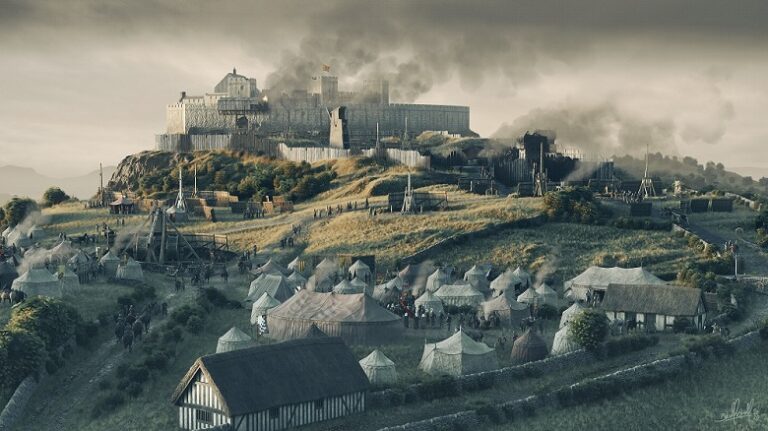
Medieval Siege Victim Takes Record for Only Known Trebuchet Casualty
A medieval skeleton found at Stirling Castle is the only known trebuchet casualty in history - proof that even in the 14th century, being in the wrong place at the wrong time was a hazard.
In the annals of medieval warfare, one unlucky soul has secured a grim distinction: Skeleton 150, found beneath Stirling Castle's chapel, is the only known trebuchet casualty in history. University of Bradford paleopathologist Jo Buckberry presented this finding at the 25th European Meeting of the Paleopathology Association, and honestly, it's not the kind of record you'd want to brag about.
Skeleton 150 was in terrible shape, even for a dead guy. His skull had broken in 61 separate places, and another 60 jagged bits of bone were distributed across his ribs. His right shoulder was broken, and his right leg above the knee was basically shattered. Buckberry and her colleagues threw everything they could, metaphorically speaking, at the jigsaw puzzle of broken bones: forensics, microscopes, X-rays, and micro-CT scans. All pointed to a single moment of crushing impact by something heavy and fast-moving. The pattern of injuries suggests the man's right shoulder and the back of his head caught the brunt of the impact, while his ribs probably cracked under the weight of something heavy slamming him into the ground and pinning him there.
The bones had broken when they were fresh, so it was clearly not a case of "oops, we dropped a big rock on the corpse." The force required ruled out trampling by a horse or being run over by a cart, and even a fall from the castle walls wouldn't have done the job. "The most similar cases I was finding were car crashes and people hit by trains," Buckberry told Science.org's Andrew Curry. Assuming Stirling Castle hadn't been attacked by time-travelers, though, that raised new questions: "What is large and moving very quickly in 1304?"
Big rocks flung by trebuchets, that's what. A trebuchet works a bit like the world's deadliest see-saw; a counterweight drops, launching a projectile from a sling. A typical trebuchet of the time could launch a 90-kilogram projectile a few hundred yards, hitting at between 200 and 300 kilometers per hour, with an impact of a little over 200 kilojoules of energy. Trebuchets were meant to take out walls, not people, but Skeleton 150 just got terribly unlucky.
Skeleton 150 was one of nine people found in graves beneath the castle's medieval chapel in 1997. Five had died violent deaths: a middle-aged woman with two heavy blows to the head and a war-hammer strike, a teenage boy stabbed and struck, and others. Radiocarbon dating placed them around the Scottish Wars of Independence in the early 1300s, when Stirling Castle changed hands five times between 1296 and 1304. At least one was an English knight, Sir John de Stricheley, who died in 1341.
Skeleton 150 was most likely a Scottish defender killed during the siege of 1304, when King Edward I of England laid siege with what Historic Environment Scotland describes as "possibly the largest array of siege engines ever assembled by the kingdom of England." Edward had conquered most of Scotland after defeating William Wallace at the Battle of Falkirk in 1298, and only Stirling Castle remained. He ordered Scottish nobles to send troops and horses, and every church to strip lead from their roofs - thirty-nine carts of lead arrived, along with "all the iron and great stones of Glasgow."
Thirteen siege engines bombarded the castle for three months. As the siege wore on, Edward ordered the largest trebuchet ever built, dubbed the War Wolf (or Loup de Guerre). When Sir William Oliphant, the castle's defender, saw it and tried to surrender, Edward refused, wanting to use his new toy. The War Wolf flung a 140-kilogram projectile straight through the curtain wall, compared to an arrow piercing paper. But Skeleton 150 probably wasn't a War Wolf casualty - that single shot came on the last day, and thirteen other engines had been firing for months before. He was probably dead and hastily buried by the time the castle fell.
The Good Times
News in your inbox.
One sardonic roundup, delivered on your schedule. Free. Unsubscribe whenever your tolerance for wit runs out.
Already subscribed but we never reach your inbox? Check your spam folder and hit 'Not spam' (or 'Remove from spam') to bust us out of junk-mail purgatory. You'll be helping everyone else too.
Don't open any of our emails for a month and you'll be automatically removed from the mailing list.
Rewrite Article
Select parts to regenerate with a fresh AI pass. Translations will be updated automatically.
Generate AI Image
Creates a sardonic version of the article image using OpenAI.