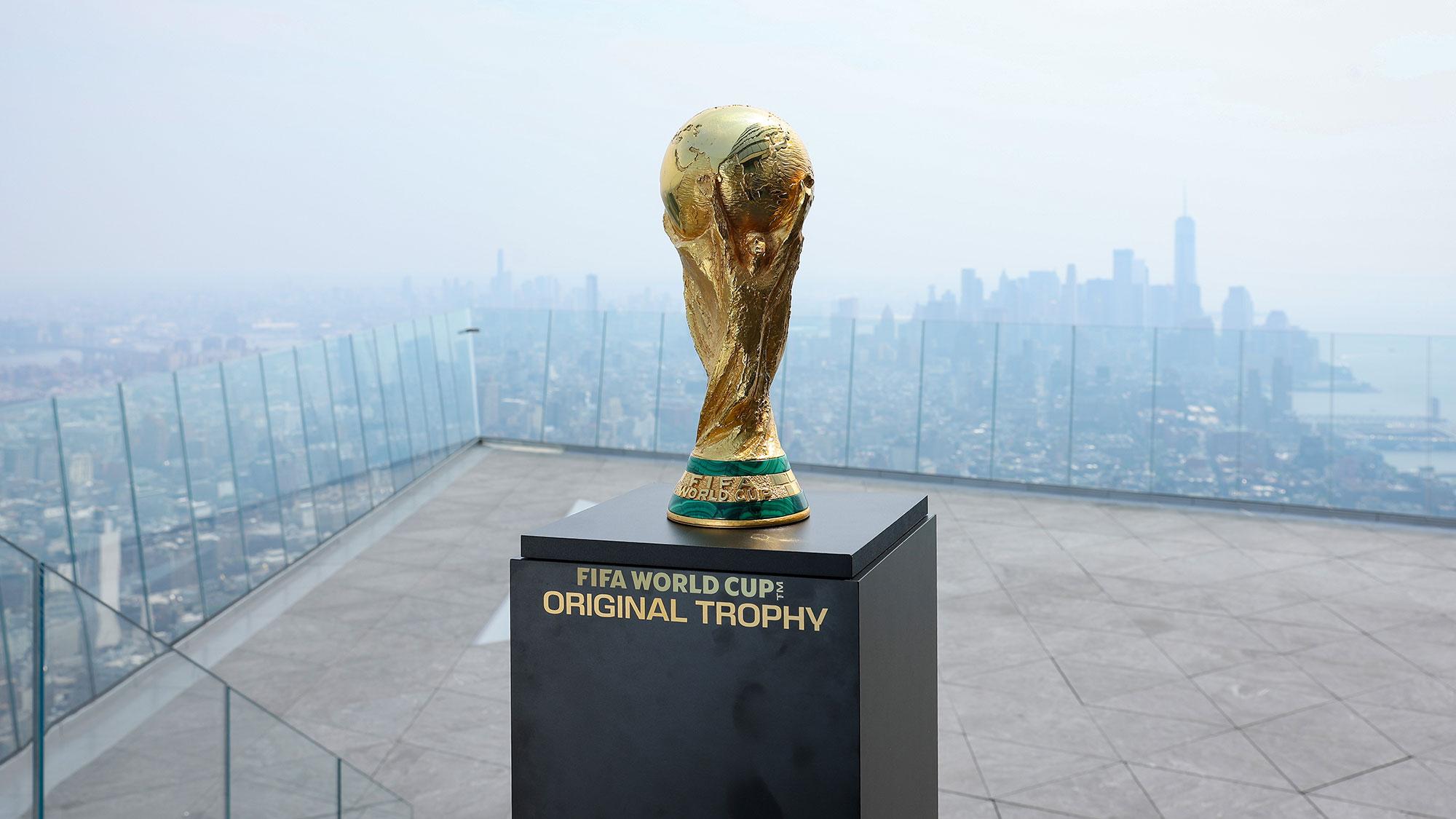
The biggest game in soccer is set for Sunday, when Argentina and Spain will meet in the World Cup final just outside New York City. There’s just one problem: wildfire smoke now threatens the match, and FIFA, the sport’s governing body, appears to have no plan in place to protect player or fan health. Because why plan for something that’s been happening with increasing regularity?
Wildfire smoke from Canada has blanketed large swaths of the Midwest and East Coast in recent days, impacting more than a dozen states. New Yorkers have been watching their air turn orange and hazy this week. On Thursday, the state issued an alert as the air quality index climbed to “unhealthy” and “very unhealthy” levels. Officials advised: “Avoid spending time outdoors, if possible.” Good luck with that if you’re a soccer star or a fan in an open-air stadium.
As of Friday morning, air quality near the stadium remained in the unhealthy range, though it’s forecast to improve to “moderate” by Sunday’s kickoff. Smoke patterns could still change. If concerns continue, there’s no way to close off the stadium where Lionel Messi and Lamine Yamal are slated to square off. Fans and players would almost certainly be exposed to smoke, which can cause burning throat, coughing, or headache, and is particularly dangerous for children, older individuals, and people with asthma.
Players have practiced outdoors during air quality events - the Spanish team held a practice Thursday in New Jersey. “These are high-level athletes who are moving a lot of air through their lungs,” Dr. Courtney Howard, an emergency physician, told the Associated Press. “They shouldn’t be practicing outside if the air quality levels are at hazardous ranges.”
FIFA does not appear to have any contingency plans for wildfire smoke. Neither FIFA nor New York City health officials responded to Grist’s request for comment. In a previous statement, FIFA detailed protocols for extreme heat, including mandatory water breaks, but didn’t mention air quality. “Climate-related risks,” the organization wrote, “are assessed as part of overall tournament planning.” Apparently, wildfire smoke didn’t make the cut.
Other leagues have standardized adjustments. The National Women’s Soccer League, for instance, adds hydration breaks at an AQI of 101 and cancels games when it tops 200. Major League Baseball rescheduled a game in Philadelphia, and Major League Soccer canceled a game in Chicago due to smoke. But FIFA? They’re rolling the dice.
The World Cup is in its fifth and final week, and despite games in wildfire-prone regions, FIFA’s bet that the air would stay clear has paid off so far. It may get lucky again this weekend, says Nicholas Watanabe, a professor at the University of South Carolina. But that doesn’t excuse not being ready.
“FIFA seems unprepared for these wildfires,” Watanabe said. “At the same time, it looks like the worst of the pollution will dissipate before the final, so FIFA will dodge a bullet.”
Some question whether enough is being done. FIFA has already been criticized for its extreme heat policies. “If we have to have a hydration break every 15 minutes, then we shouldn’t be playing the game,” said Trinity Rodman, who played in the smoke-affected NWSL game. A professional cyclist recently questioned whether the Tour de France should be held in summer, as it’s been plagued by wildfires and heat. “I would change the whole calendar,” said Tadej Pogačar.
The power to make changes rests with governing bodies, not athletes. Watanabe hopes this close call is a wakeup call. “Hopefully,” he said, “this is a wakeup call to FIFA and all other sport leagues of the need for regulations and a comprehensive plan to deal with climate risks.”
The Good Times
News in your inbox.
One sardonic roundup, delivered on your schedule. Free. Unsubscribe whenever your tolerance for wit runs out.
Already subscribed but we never reach your inbox? Check your spam folder and hit 'Not spam' (or 'Remove from spam') to bust us out of junk-mail purgatory. You'll be helping everyone else too.
Don't open any of our emails for a month and you'll be automatically removed from the mailing list.
Rewrite Article
Select parts to regenerate with a fresh AI pass. Translations will be updated automatically.
Generate AI Image
Creates a sardonic version of the article image using OpenAI.