
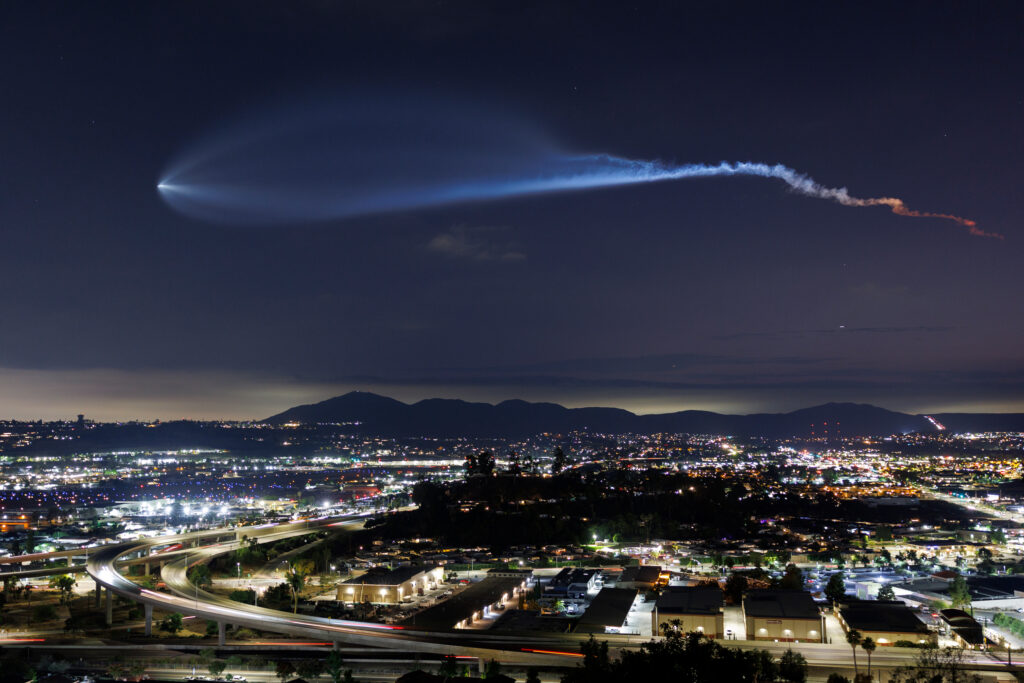
For millennia, the night sky has served as humanity's GPS, calendar, and inspirational wallpaper, all rolled into one cosmic package. But now, a surge of commercial satellite launches is threatening to turn the celestial commons into a corporate billboard, complete with atmospheric pollution and cultural erasure, scientists warn.
A 2025 paper led by a NASA scientist found that metal particles from disintegrating satellites can alter temperatures and wind flows in the upper atmosphere, with ripple effects on surface climate. Because nothing says "progress" like tweaking the planet's thermostat from 250 miles up.
More than 15,000 active and inactive satellites now orbit Earth, up from under 1,000 at the turn of the century. Hundreds are overhead at any given hour over North America and Europe. And several companies want to launch huge fleets over the next 10 to 20 years, pending regulatory approval and the continued existence of venture capital.
Four companies are pursuing Federal Communications Commission licensing: Reflect Orbital wants mirrored satellites to sell strips of sunlight on Earth. Blue Origin, Starcloud, and SpaceX propose deploying hundreds of thousands of data-processing satellites, pushing the AI race into near-Earth orbit. All this, plus space tourism rides costing millions and this week's first public sale of SpaceX stock, suggests commercial space is part of a tech investment bubble subject to markets and quarterly earnings expectations.
The proposed fleets would require thousands of launches and re-entries per year, each leaving a trail of soot, greenhouse gases, and other pollutants that can deplete ozone and change atmospheric chemistry. Because the best way to solve Earth's environmental problems is clearly to create new ones in space.
The FCC oversees radio frequencies and communications licenses for satellite networks, making it the first regulatory hurdle. Researchers and space governance experts say current agreements like the Outer Space Treaty don't adequately address stewardship, equity, and collective responsibility.
"We are teetering on the precipice of how the uses of space are changing, and that threatens our ability to use space," said astronomer John Barentine, who co-founded the Center for Space Environmentalism in 2025. The center filed formal comments with the FCC calling the deployments "a massive industrialization of orbit that poses severe collision risks" and warning that mirroring sunlight to Earth could threaten ecosystems and disrupt astronomical research.
Reflect Orbital said its technology could help provide clean, on-demand energy without increasing fossil fuel use, with plans for phased testing and environmental studies. SpaceX, Blue Origin, and Starcloud didn't answer questions about environmental impacts, instead referring to FCC filings and claiming their constellations could provide more broadband and computing power while reducing environmental impacts on Earth - without citing supporting scientific evidence.
The Center for Space Environmentalism argues that the FCC should require full environmental reviews under the National Environmental Policy Act. Barentine noted that people have assumed space is so vast that human actions couldn't meaningfully change it - remarkably similar to how people once thought about Earth's atmosphere and oceans before countries adopted science-based international rules.
Right now, international rules and diplomatic efforts are not slowing the space race and, in some ways, encourage it. "Who gives these people the right to do this?" Barentine asked. Absent any mechanism to prevent them, they've simply claimed the right.
A 2020 paper described the brightening of night skies as a human rights violation and a form of cultural erasure, disrupting millennia-old traditional practices. Prakash Kashwan, an associate professor of environmental studies at Brandeis University, said the rush to commercialize space risks repeating an extractive model that has shaped the past 200 years of environmental calamities. "We need to more strongly assert the collective common stake that humanity has in outer space," he said.
P.J. Blount, an assistant professor of space law at Durham University, said the current proposals are part of the search for "the next killer app in space," following asteroid mining and space tourism. Since the 1980s, U.S. policy has supported commercial space activities, with a shift during President Donald Trump's first administration toward "light-touch regulation." That means approval of pending proposals is likely, but whether they are financially viable remains to be seen. "All of it is a land grab," he said.
The 1967 Outer Space Treaty states that nations shall not appropriate space by occupation or use, but the language remains ambiguous. In 2015, Congress passed a law stating that the U.S. interprets the treaty to mean its citizens can extract and commercially dispose of resources. The U.N. committee on outer space use has a working group to address resource rights, but it is not discussing the current rush of applications for megaconstellations - perhaps because dealing with the present is less fun than arguing about the future.