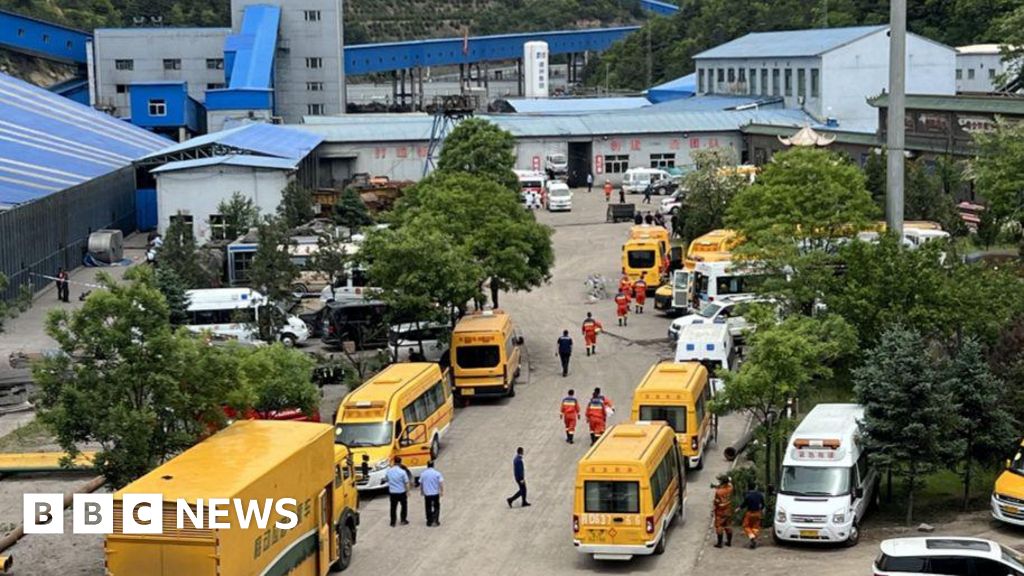
In a development that will surprise absolutely no one who has followed China's coal industry for more than five minutes, a gas explosion at the Liushenyu Coal Mine in Shanxi Province has killed at least 90 people. The mine, operated by Tongzhou Group, had the audacity to be listed as a "severe safety hazard" in 2024 and has already racked up two administrative penalties in 2025 for safety issues. But hey, who's counting?
The blast occurred at 19:29 local time on Friday, with 247 workers reportedly on duty. Twenty-seven people remain hospitalized, one in critical condition, mostly due to inhaling poisonous gas - though authorities are being coy about which specific gas decided to ruin everyone's day. Levels of carbon monoxide, a highly toxic and odorless gas, were found to have "exceeded limits," which is a bit like saying the Titanic had a minor water ingress issue.
Injured miner Wang Yong provided a harrowing account: he didn't hear the explosion but saw a plume of smoke, smelled sulfur, and watched colleagues collapse before blacking out himself. He lay unconscious for about an hour before waking up, reviving the person next to him, and escaping together. So, heroic survival story, but also a reminder that working in a coal mine is basically a game of Russian roulette with geology.
Chinese President Xi Jinping has called for no effort to be spared in rescue and treatment, plus an investigation to hold those responsible accountable - a familiar refrain that usually results in a few low-level officials being made examples of while the systemic issues remain untouched. Officials running the mine have already been detained, which is about as predictable as the sun rising in the east.
The Ministry of Emergency Management has dispatched 345 personnel from six rescue teams. Shanxi province produces over a quarter of China's coal, and despite tightened safety standards since the early 2000s - when deadly accidents were routine - disasters still happen. For context, a 2023 open-pit mine collapse in Inner Mongolia killed 53, and a 2009 explosion in Heilongjiang killed over 100. So, progress, but the kind of progress where you're still falling off a cliff, just slightly slower.
China remains the world's largest coal consumer and greenhouse gas emitter, even as it frantically installs renewable energy capacity. The incident occurred just days after high-profile visits by US President Donald Trump and Russian leader Vladimir Putin, proving that even diplomacy can't stop a poorly maintained mine from doing what it does best.
The Good Times
News in your inbox.
One sardonic roundup, delivered on your schedule. Free. Unsubscribe whenever your tolerance for wit runs out.
Already subscribed but we never reach your inbox? Check your spam folder and hit 'Not spam' (or 'Remove from spam') to bust us out of junk-mail purgatory. You'll be helping everyone else too.
Don't open any of our emails for a month and you'll be automatically removed from the mailing list.
Rewrite Article
Select parts to regenerate with a fresh AI pass. Translations will be updated automatically.
Generate AI Image
Creates a sardonic version of the article image using OpenAI.