Black Hole Shreds Giant Star in 'Snack Prep' Event, Astronomers Say - Plus a Mystery
Astronomers catch a black hole shredding a massive star in a 'snack prep' event, releasing 400 billion suns' worth of energy - and then a mysterious helium signal appears, because of course it does.
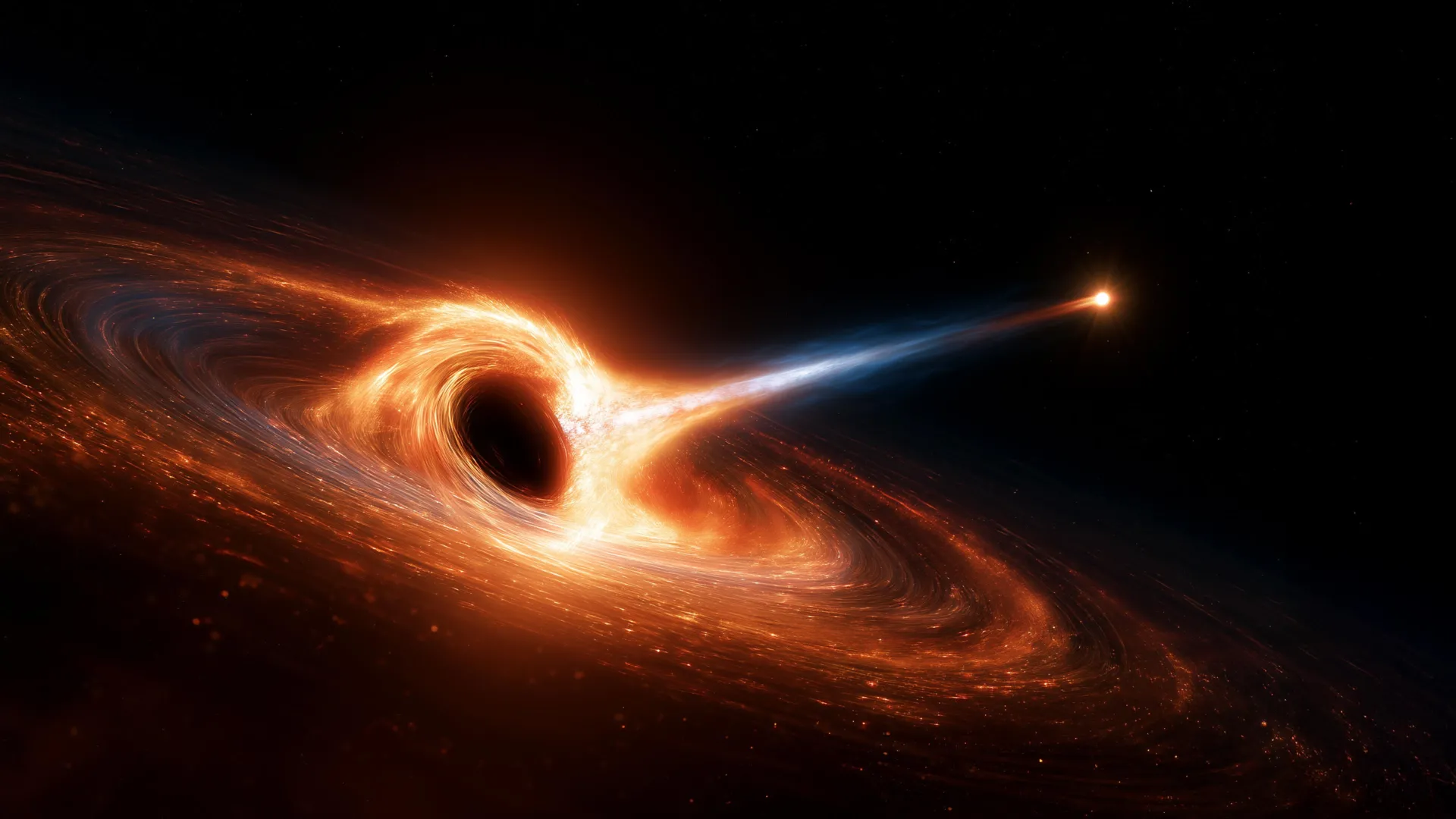
Astronomers have witnessed a black hole tear apart and methodically consume a massive star in what scientists are helpfully comparing to 'preparing a snack for lunch.' The cosmic carnage, presented at the AAS conference in Phoenix, Arizona, involved a star being 'torn up' by the black hole's immense gravity, which then fed on the debris piece by piece.
Daniel Perley, Associate Professor of Astrophysics at Liverpool John Moores University and lead author of the paper in the Monthly Notices of the Royal Astronomical Society, described the event as 'a black hole merging with a massive companion star, shredding it into a disk that feeds the black hole.' He called it 'rare and awe-inspiring,' which is astronomer-speak for 'we're not entirely sure what just happened, but it was spectacular.'
The destruction unleashed one of the most powerful cosmic events ever recorded, briefly releasing energy equivalent to roughly 400 billion times the output of Earth's Sun - enough to make even the most dramatic supernovae look like a polite cough. While black holes have been observed snacking on stars before in events known as Tidal Disruption Events, researchers had never seen one quite like this.
Anna Ho, assistant professor of astronomy at Cornell University and coauthor, detected the event using the Zwicky Transient Facility at Palomar Observatory in California, right after its light arrived at Earth. The object, formally designated AT2024wpp and nicknamed 'the Whippet,' was initially suspected to be a Luminous Fast Blue Optical Transient (LFBOT), a rare and poorly understood type of cosmic event linked to stellar destruction. Within a day, observations from the Liverpool Telescope in the Canary Islands and NASA's Swift satellite confirmed the LFBOT characteristics - it was extremely blue and emitting X-rays, like a cosmic mood ring.
Distance measurements from R. Michael Rich at UCLA and Yu Jing Qin at Caltech showed the transient was far more energetic than an ordinary supernova. Combined with its exceptionally high temperature, the data led researchers to conclude they were witnessing a star being ripped apart and swallowed by a black hole - no fabrication needed, just a lot of math.
'Even though we suspected what it was, it was still extraordinary,' Perley added, noting it was 'many times more energetic than any similar event and more than any known explosion powered by the collapse of a star.' He emphasized that such events not only help identify black holes but also provide 'a new way to identify where black holes occur and how they form and grow.'
The event generated a powerful shock wave traveling outward through dense gas at one-fifth the speed of light, but after about half a year, the shock suddenly 'fizzled out,' likely upon reaching the boundary of a bubble created by gas the star had expelled earlier. Material pulled from the star formed a hot disk around the black hole, producing X-rays and a powerful 'wind' that collided with previously expelled material, creating the bright blue optical and ultraviolet emission seen in the first days, along with radio and millimeter signals.
Now for the strange part: Observations from the Keck Observatory, Magellan Observatory, and the Very Large Telescope revealed no recognizable chemical signatures during the first month. As the event faded, weak signatures of hydrogen and helium appeared - and the helium was moving along our line of sight at over 6,000 kilometers per second, suggesting a densely bound structure may have survived the initial blast and is now hurtling toward us.
Researchers speculate the signal could be a 'stream' of material released by the star's core during the shredding, or - more intriguingly - material from a third member of the system being blasted by the black hole's winds and X-rays. Because nothing says 'mysterious cosmic event' like a possible third wheel.
Materials provided by Liverpool John Moores University. Note: Content may be edited for style and length.
The Good Times
News in your inbox.
One sardonic roundup, delivered on your schedule. Free. Unsubscribe whenever your tolerance for wit runs out.
Already subscribed but we never reach your inbox? Check your spam folder and hit 'Not spam' (or 'Remove from spam') to bust us out of junk-mail purgatory. You'll be helping everyone else too.
Don't open any of our emails for a month and you'll be automatically removed from the mailing list.
Rewrite Article
Select parts to regenerate with a fresh AI pass. Translations will be updated automatically.
Generate AI Image
Creates a sardonic version of the article image using OpenAI.