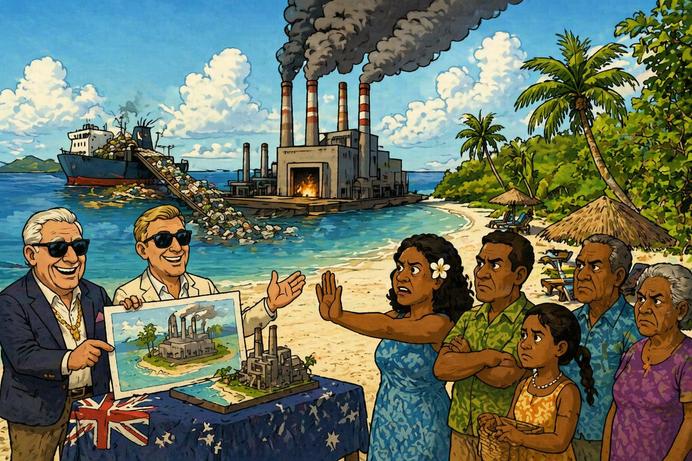
Australian Billionaires Offer to Turn Fiji's 'Beach Paradise' into a Pacific Ashtray
Australian billionaires propose turning Fiji into a regional incinerator, a plan locals call 'waste colonialism' that would raise national emissions by 25% to solve a problem that wasn't theirs.
An Australian billionaire's plan to build a $630m waste-to-energy incinerator in Fiji has been condemned by villagers and the country's UN ambassador as "waste colonialism" that risks spoiling a "beach paradise." Traditional landowner Inoke Tora boarded a bus to the capital, Suva, on Tuesday with a petition opposing the project, which is forecast to consume 900,000 tonnes of non-recyclable rubbish each year.
The fashion entrepreneur behind the Paris-born Kookai label, Rob Cromb, and Australian billionaire Ian Malouf, who made his fortune in rubbish disposal, want to build a port and waste incinerator within 15km (9 miles) of Fiji's tourism gateway Nadi. The duo have told Fiji's government the project could meet 40% of the small country's electricity needs, cutting its reliance on diesel. However, an environmental impact statement lodged by their company TNG shows it would also raise Fiji's national emissions by 25%.
Residents say the emissions will spoil Fiji's eco-tourism reputation and pose a safety risk with hotels and schools nearby. Fiji's ambassador to the UN, Filipo Tarakinikini, wrote on social media that the Vuda coast north of Nadi "must not become the Pacific's ashtray," warning that ash residue and dioxins would contaminate the food chain. He likened the plan to send up to 700,000 tonnes of non-recyclable rubbish to Fiji each year to "waste colonialism."
"Dial-a-Dump" founder Malouf spent seven years trying to get a similar waste-to-energy incinerator approved in Sydney before it was rejected as a risk to human health in 2018. Stephen Bali, then mayor of Blacktown in Sydney who led opposition to that project, urged Fiji to seek independent scientific data, noting the irony of "gathering up rubbish from Australia, driving it in a diesel truck to port, putting it on a diesel ship to Fiji to be offloaded."
Malouf did not respond to requests for comment. His business partner Cromb, who bought Kookai in 2017, said he maintains business links to Fiji, where he was born, because Kookai manufactures clothes there. In a statement, Cromb said energy-from-waste systems "are widely used in jurisdictions with some of the world's highest environmental protections" and that the project would manage waste generated in Fiji, reduce landfill, and support the country's energy needs, claiming "It is not a project intended to import waste from overseas."
However, the plan for a port and incinerator lodged with Fiji's government showed it would feed in local waste as well as waste shipped from Australia and across the region. Opponents have told the government it would be a breach of a 1998 convention signed by Australia to ship hazardous waste to a Pacific island country.
Fiji's tourism minister Vilame Gavoka said tourism across Nadi could be jeopardised, noting such facilities elsewhere are located away from businesses and densely populated areas. Fiji's permanent secretary for environment and climate change, Michael Sivendra, said the project is under review. Resident Eremasi Matanatabu, a food company manager, said concern over building a waste business in the bay where the first Fijians arrived is widespread, predicting, "It will stick out like a big sore thumb."
The Good Times
News in your inbox.
One sardonic roundup, delivered on your schedule. Free. Unsubscribe whenever your tolerance for wit runs out.
Already subscribed but we never reach your inbox? Check your spam folder and hit 'Not spam' (or 'Remove from spam') to bust us out of junk-mail purgatory. You'll be helping everyone else too.
Don't open any of our emails for a month and you'll be automatically removed from the mailing list.
Rewrite Article
Select parts to regenerate with a fresh AI pass. Translations will be updated automatically.
Generate AI Image
Creates a sardonic version of the article image using OpenAI.