
While some major fossil fuel producers are still clinging to the idea that pumping more oil and gas is a great idea (despite the small side effects of war, economic chaos, and ecological collapse), over 50 countries met in Santa Marta, Colombia for the first Conference on Transitioning Away From Fossil Fuels. They began sketching out plans to shift toward renewable energy systems designed for stability and abundance rather than, you know, scarcity and conflict.
France, where fossil fuels still power about 60% of the world’s seventh-largest economy, unveiled a pilot roadmap to phase out coal by 2030, oil by 2045, and gas by 2050, while electrifying sectors like heating and transport. Colombia’s draft roadmap to largely ditch fossil fuels by 2050 emphasizes that transitioning could deliver $280 billion in economic benefits. That’s a lot of pesos, or euros, or whatever.
The countries represented generate about one-third of global economic activity. They broadly agreed to align their trade and finance policies with their transition plans, potentially creating significant economic momentum toward the faster decarbonization needed to avoid cooking the planet like a well-done steak.
Ralph Regenvanu, Vanuatu’s minister for climate change adaptation, described the conference as a climate diplomacy track running parallel with the United Nations Framework Convention on Climate Change, but on a faster train with friendlier passengers. Because everyone knows the UN climate talks could use a little less bureaucracy and a little more “let’s get this done.”
Participants and observers noted that the meeting was a rare space where fossil fuels themselves - not just their emissions - were discussed as the root cause of overlapping crises, from conflict and displacement to economic instability. At past UNFCCC talks, those connections were often downplayed, especially in official documents. Because nothing says “diplomacy” like ignoring the elephant in the room.
The conference was convened by the Netherlands and Colombia during the closing days of COP30 in Belém, Brazil, late last year, as frustration grew over a small number of countries blocking any detailed discussions of phasing out fossil fuels. A follow-up meeting is set for early 2027 in Tuvalu, in the Pacific. Mark your calendars.
Organizers noted that a special science panel associated with the conference is critical because media ecosystems are overloaded with climate and energy disinformation. Because apparently, you can’t trust everything you read on the internet. Shocking.
Until a few decades ago, coal miners were celebrated as heroes of prosperity, while kids grew up with “Put a Tiger in Your Tank” ads promising open-road freedom. Fossil fuels were synonymous with progress. But in a more crowded, connected world, that same system is now driving instability and climate degradation. Resisting the transition away from fossil fuels, they noted, seems like longing for horse-and-buggy transport. Which, to be fair, had a much lower carbon footprint.
For the countries in Santa Marta, it’s not a question of whether to change, but how to change without repeating past mistakes. Veteran policy makers shared space with a younger cohort of advocates for whom renewable energy systems are a baseline assumption, not an aspirational goal. Many are from developing countries and experience the risks of fossil fuels as immediate rather than theoretical. They challenge the fossil fuel industry’s misleading narrative that their products are needed to alleviate poverty. Because nothing says “helping the poor” like polluting their air and water.
“War right now is one of the largest contributors to the climate crisis,” said Faotu Jeng, founder of Clean Earth Gambia. Jeng noted that military emissions are not accurately accounted for under the Paris Agreement. In the run-up to the 2015 global climate pact, highly militarized and economically powerful countries, including the United States, indicated they would veto language related to military emissions. But those numbers add up: researchers estimate that global militaries account for about 5% of global emissions, and rising weapons spending threatens global climate targets.
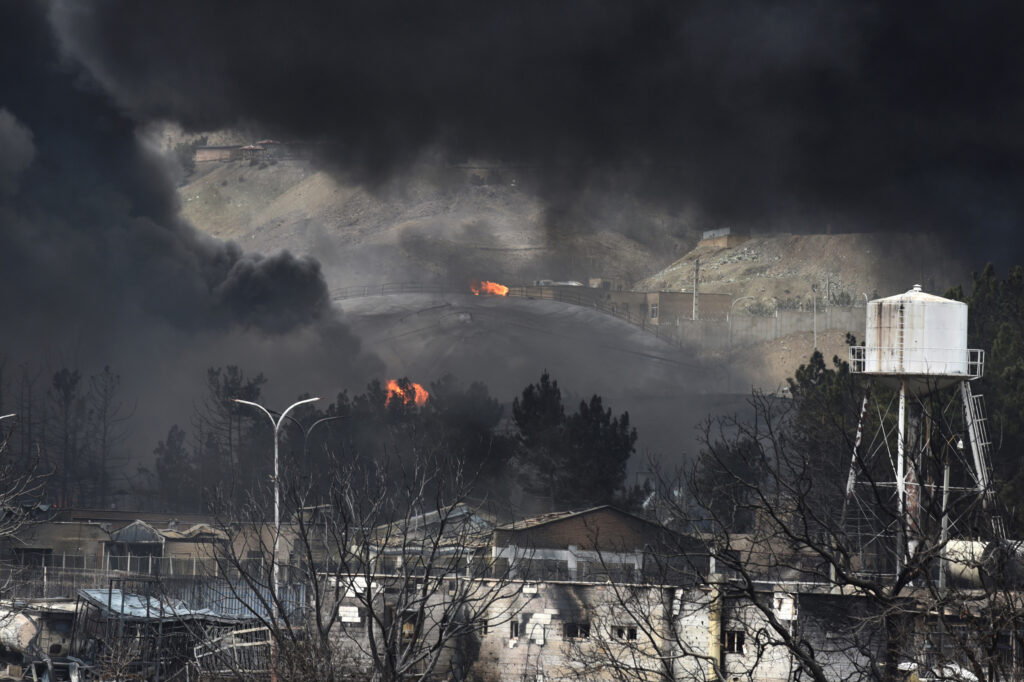
Recent conflicts have driven big emissions spikes from jet fuel, tanks, supply convoys, blazing oil and chemical fires, scorched forests, and the carbon cost of rebuilding shattered infrastructure. Russia’s invasion of Ukraine has generated more than 300 million tons of carbon dioxide emissions - about equal to Spain’s annual emissions. The war in Gaza has resulted in about 30 million tons, equivalent to the annual emissions of smaller countries. And the U.S. and Israeli attack on Iran had a 5 million-ton carbon footprint in just the first few weeks, equal to the combined total of a dozen low-emission countries. War: not just deadly, but also terrible for the planet.
Participants focused directly on recognizing how the links between fossil fuels, conflict, and instability work in the real world. Somali peace and development leader Ilwad Elman described how climate, war, and economic disruption are not experienced as separate crises, but as overlapping pressures that reinforce one another. She said people live with that pressure every day, and impacts like drought can determine whether families can stay on their farms or are forced to move, reshaping local economies and intensifying competition for resources.
“You don’t debate whether something is climate or conflict or economic instability,” she said. “You feel it all the same. You feel it as pressure, pressure on land, pressure on water, pressure on movements, pressure on people, and that pressure doesn’t stay contained.”
Former President of Ireland Mary Robinson, a founding member of The Elders, said in a statement that the Santa Marta discussions helped clarify that transitions are needed “out of fossil fuels, into renewable energy for all, and into a world that cares for nature.” She added that all must be grounded in justice, and that now is the time for a growing coalition to “drive these transitions forward with the fierce urgency they demand.”