
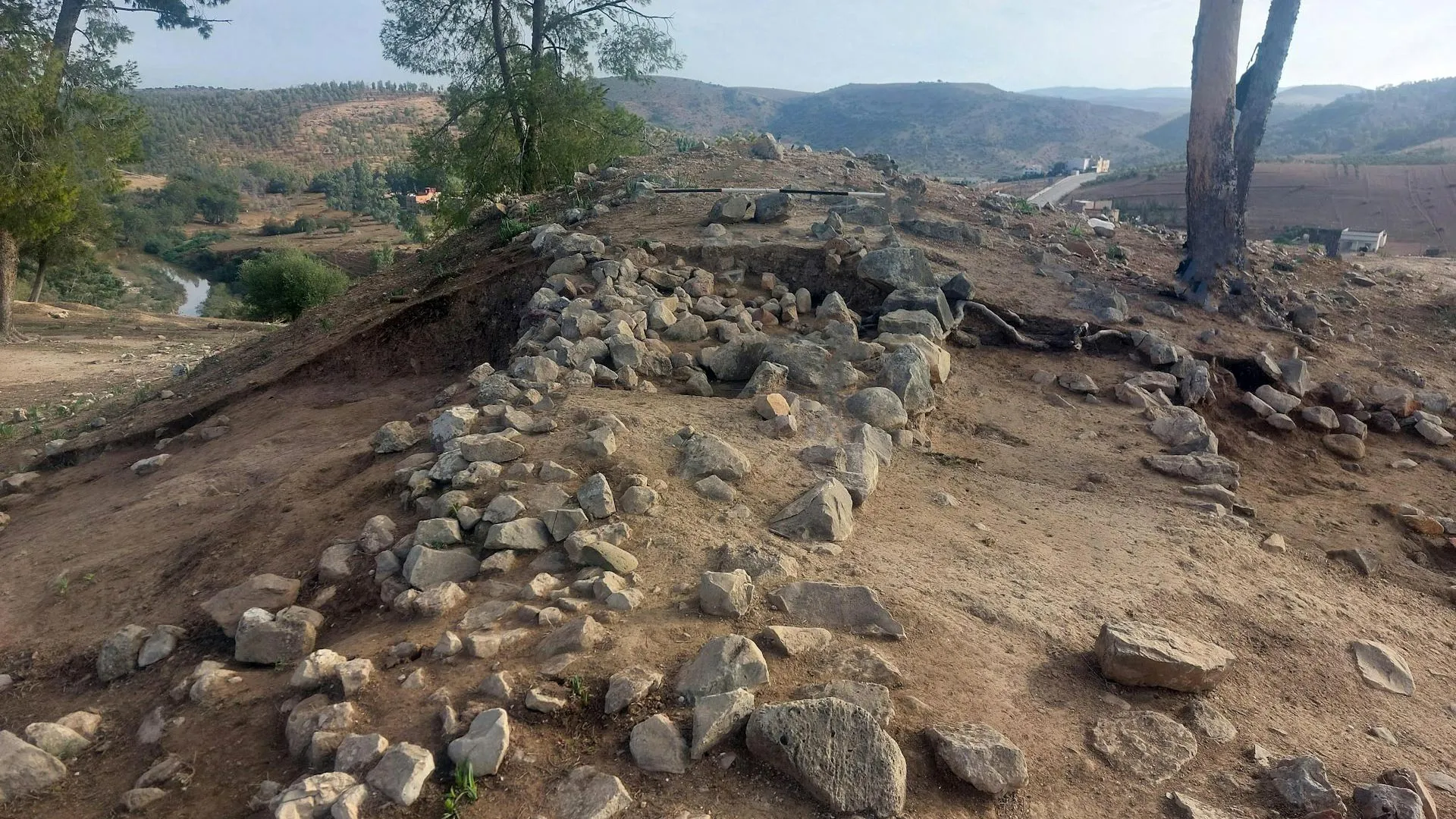
Archaeologists working in the hills of north-west Morocco have unearthed a 4,000-year-old wall that is forcing textbooks to make room for a new chapter - or at least a lengthy footnote - in North African history. The structure, located at Oued Beht overlooking the river that gives the site its name, suggests that communities in the region were busy shaping their environment and networking across the Mediterranean long before anyone thought to write it down.
The Oued Beht Archaeological Project had already revealed what is likely the earliest and largest agricultural complex ever discovered in Africa outside the Nile Valley, dating to around 5,400 to 4,900 years ago. New excavations in 2023, conducted with the participation of the study's authors, have now deepened that understanding by uncovering the earliest known large-scale construction of a probably defensive nature in north Africa beyond the Nile Valley - a wall dating to about 4,000 to 3,500 years ago.
What exactly these wall-like structures were defending against remains unclear. The researchers suggest they likely relate to increasing competition over land, resources, and possibly control of movement through the landscape, rather than to "invaders." In other words, the ancient equivalent of a homeowner's association dispute, but with more earthworks and fewer passive-aggressive emails. Constructions like these indicate that communities felt the need to protect themselves or assert power over strategic locations.
The discovery pushes back the evidence for organized defensive architecture in the Maghreb and suggests that societies in this region at the time were more complex and structured than previously believed - a polite way of saying everyone had underestimated them for decades.
The study also reveals that the ridge of Oued Beht became a focal point again in the medieval period, during the 11th to 13th centuries AD. The same defensive structure was rebuilt, a hamlet or farm was established on a nearby hilltop, and people were buried in a cemetery between the two areas. Because if there's one thing humans love, it's reusing a good defensive position and then adding a cemetery for good measure.
Together, these findings provide rare archaeological insights into rural communities during both prehistoric and medieval times, helping to understand how societies developed and maintained themselves in a region too often left out of the history books. For a long time, the later prehistory of north Africa's Maghreb region - the Mediterranean countries of Morocco, Algeria, and Tunisia - has been poorly understood. Compared with neighboring areas such as Iberia in south-western Europe or Athens in the eastern Mediterranean, archaeological evidence was often fragmentary. In the last few years, this has changed completely, much to the delight of archaeologists and the mild inconvenience of history textbook publishers.
Excavations at Oued Beht have revealed a large concentration of human activity spread across at least ten hectares. The earliest major phase dates to the mid-fourth and early third millennia BC, or the Final Neolithic period. Environmental evidence from plant and animal remains indicates a farming community cultivating crops such as barley and wheat. They also exploited wild plants and kept livestock - because even ancient people understood the value of a diversified portfolio.
The site was also an important center of craft production. Thousands of polished stone axes and other tools have been discovered, along with finely made pottery, sometimes decorated with painted patterns. It remains uncertain whether prehistoric Oued Beht functioned as a permanent village, a seasonal center, or something less familiar, but it was clearly a major focus in the landscape of north-west Morocco.
The presence of potentially ancient earthworks and walls had been noted since the 1930s. The French archaeologist Armand Ruhlmann first documented a configuration of three walls, with the fourth side protected by the natural scarp of the ridge, describing a defensive éperon barré (barred spur). Their precise nature and date remained uncertain until now - proving that sometimes it takes nearly a century to confirm what someone casually mentioned in the 1930s.
New excavations have clarified the existence of a multi-phase ditch, rampart, and wall built across a narrow section of the Oued Beht ridge between the river and a ravine. This cut off and protected the ridge's southern tip. Radiocarbon dating of deposits associated with these structures provided the timelines in the study. They place its original construction at a time equivalent to the Bronze Age of the remaining western Mediterranean, making it the earliest confirmed defensive construction in north Africa outside Egypt.
This structure raises important questions about the society that built it. Building an embankment and ditch system required planning, coordination, and the mobilization of labor - suggesting a community capable of organizing complex construction initiatives. In other words, they had project managers. During the earlier Neolithic phase, activity at Oued Beht focused on the larger and more open northern area of the site. By the period of the new study, focus had shifted to the narrower, more defensible southern ridge. This may reflect a shift in settlement strategies - possibly because someone realized that living on a hill with a wall is generally safer than living in an open field.
The second millennium BC was a dynamic period across the Mediterranean. In southern Iberia, Argaric societies (about 2200 - 1550 BC) in today's Europe were developing complex, often hilltop settlements. They were characterized by planned architecture, advanced metallurgy (especially bronze production), and marked social hierarchies visible in burial practices. These communities often constructed fortified sites and strategically located settlements controlling surrounding territories. Increasing evidence suggests that communities in north-west Africa were connected to wider Mediterranean networks, including today's Spain and Portugal. The discoveries at Oued Beht indicate that the Maghreb was not isolated - it participated in broader processes shaping the western Mediterranean, because apparently even ancient people understood the value of networking.
The defensive system at the site may reflect wider transformations in social organization and regional interaction. There may have been growing competition over resources, control of movement, and more formalized leadership structures - because nothing brings people together like a shared wall and a mutual enemy, or at least a mutual suspicion.
The discoveries at Oued Beht highlight how much remains to be learned about the deep history of north Africa. The defensive wall shows that communities here were able to coordinate large construction projects and points to social transformations that are only very tentatively beginning to be recognized. The medieval remains demonstrate that the ridge was used again many centuries after the prehistoric settlement had been abandoned. Oued Beht was not simply a single-period settlement but a landscape repeatedly selected by different communities across millennia - proving that good real estate never goes out of style.
As research continues, this location may become key to understanding how societies in the Maghreb evolved from early farming communities to the medieval rural world. And if we're lucky, someone will finally write a textbook that includes them.