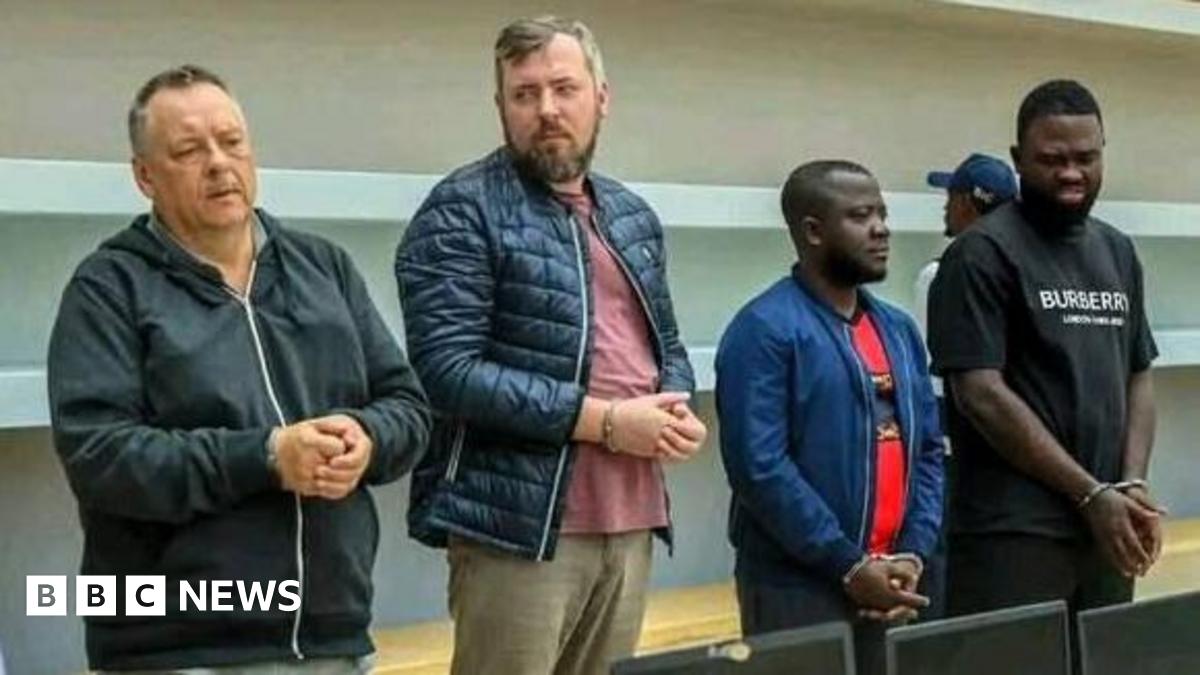
Two Russian nationals have been handed prison sentences by a court in Angola's capital, Luanda, after being found guilty of terrorism and spying - charges they presumably hoped to avoid by denying them. Political consultant Igor Ratchin got 11 years, while translator Lev Lakshtanov received eight. They were arrested last August on accusations of stirring up anti-government protests, running a disinformation campaign, and trying to interfere in next year's presidential election. Because nothing says 'friendly cultural exchange' like allegedly plotting to overthrow the government.
The indictment, seen by the BBC, alleged the pair were part of a political influence operation linked to Africa Politology, which Angolan authorities describe as a Russian political network that emerged from the now-defunct Wagner mercenary group. Prosecutors claimed Africa Politology aimed to spread anti-Western narratives and influence Angolan politics ahead of the elections. The defendants denied any connection to Wagner or the Russian state, insisting they were just trying to set up a Russian cultural centre in Luanda. Sure, and the Kremlin's cultural attachés usually operate via covert payments and secret meetings.
Two Angolans - sports journalist Amor Carlos Tomé and political activist Francisco Oliveira - were also on trial for similar charges. Tomé received a two-year suspended sentence; Oliveira was acquitted. Prosecutors immediately appealed the verdict, so Tomé gets to enjoy Angola's hospitality a bit longer pending the appeal outcome.
The court found Ratchin and Lakshtanov guilty on four of 11 charges: criminal association, espionage, terrorism, and illegal retention of currency - a mixed bag of serious crimes and what sounds like a banking oversight. Their lawyer, Elizeu Nguiniti, declined to comment but told the court he disagreed with the verdict while respecting the decision. That's the legal equivalent of 'no hard feelings, but you're wrong.'
Prosecutors alleged the Russians paid local journalists and experts over $24,000 to spread pro-Russian and anti-government content aimed at provoking political change. They also cited publications, notes, and photos from the 2025 protests found on the defendants' devices, plus alleged contacts with senior Angolan political figures. Many Angolan activists, however, insist the protests were organic - because nothing says 'grassroots movement' like Russian money.
During the trial, Lakshtanov argued that his nearly four decades living and working in Angola made him an unlikely terrorist. Ratchin claimed he was just a businessman surprised by his arrest, and that payments were for services rendered - presumably cultural services with a side of espionage.
The trial itself had a rocky start: the prosecutor refused to read the indictment aloud, arguing the defendants already knew the charges. The defence countered that since the trial was public, everyone - including journalists - should hear the allegations. The prosecutor held firm, suggesting transparency is optional.
The indictment was already under fire for relying on assumptions and containing misspellings and factual errors. The BBC spotted several, but prosecutors apparently weren't taking editing suggestions.
Additional reporting by Ilya Barabanov and BBC Russian's Investigations Team.
The Good Times
News in your inbox.
One sardonic roundup, delivered on your schedule. Free. Unsubscribe whenever your tolerance for wit runs out.
Already subscribed but we never reach your inbox? Check your spam folder and hit 'Not spam' (or 'Remove from spam') to bust us out of junk-mail purgatory. You'll be helping everyone else too.
Don't open any of our emails for a month and you'll be automatically removed from the mailing list.
Rewrite Article
Select parts to regenerate with a fresh AI pass. Translations will be updated automatically.
Generate AI Image
Creates a sardonic version of the article image using OpenAI.