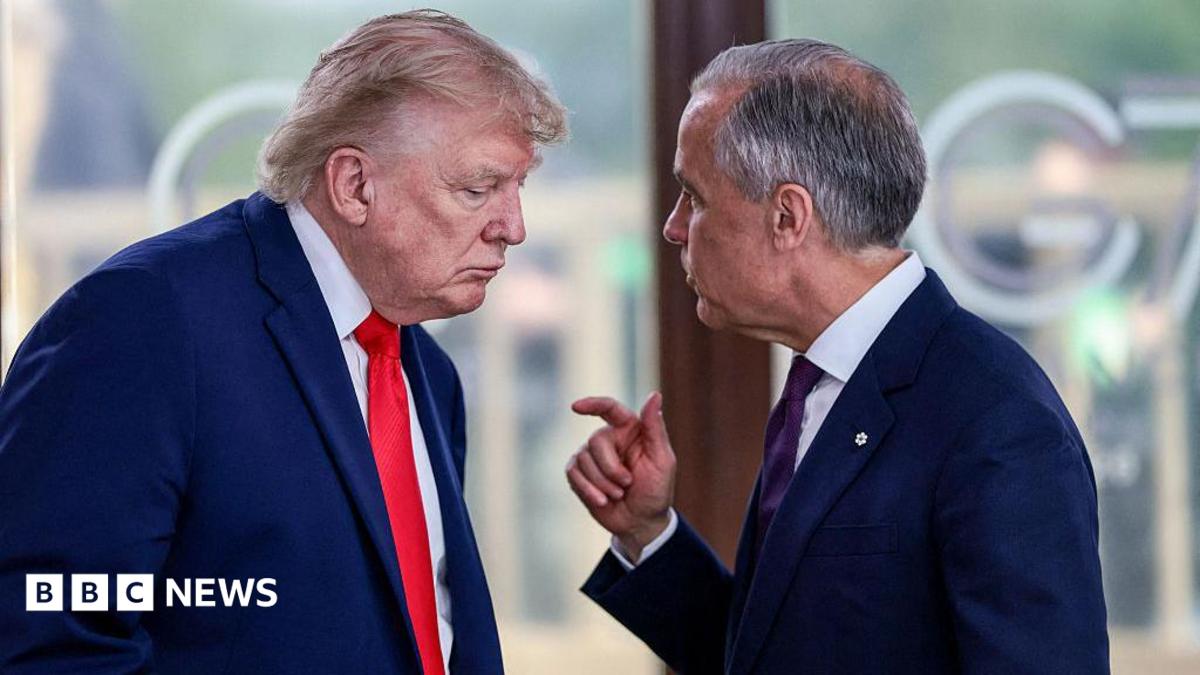
Trump Slaps 50% Tariffs on Canada; Carney Promises to 'Intensify' Talks Like They Weren't Already Intense
Trump slaps 50% tariffs on Canadian wine, hockey sticks, and cement, sparing potash and fish. Carney vows to 'intensify' talks, because what could possibly go wrong with 30 days to negotiate?
US President Donald Trump has imposed a 50% tariff on a wide range of Canadian goods, citing 'unequal treatment' of American cars, dairy, and alcohol. The targeted goods include everyday items like wine and hockey sticks, as well as industrial goods such as cement. However, key exports like energy, potash, critical minerals, and fish are spared, presumably because even trade wars need loopholes.
Prime Minister Mark Carney responded with characteristic Canadian politeness, vowing to 'intensify' trade talks in the coming weeks. The White House said the duties will take effect in 30 days, marking a major escalation in tensions between the North American neighbours. The new duties apply to all covered goods, regardless of whether they were included under the USMCA, the free trade agreement that Trump himself negotiated.
Carney took to X (formerly Twitter) to call this 'the latest in a series of unilateral US trade actions' that violate the USMCA, and also cited 'threats to Canadian sovereignty' - a possible nod to Trump's ongoing flirtation with the idea of making Canada the 51st state. Monday's tariffs build on existing trade barriers, including US tariffs of 15% to 50% on Canadian steel, aluminum, and copper, plus a 35% tariff on softwood lumber and a 25% tax on non-US car parts. Canada, for its part, has a 25% counter-tariff on American steel, aluminum, and vehicles.
Interestingly, the tariffs come after Trump threatened to levy duties over Canadian wildfire smoke drifting into US cities, but the executive orders make no mention of wildfires. Instead, they list long-standing trade irritants: cars, dairy, and alcohol. On cars, Trump accuses Canada of charging a tax on US vehicles not covered under USMCA, calling it 'unreasonable' that Canada doesn't charge the same tax to other countries. Commerce Secretary Howard Lutnick has previously suggested Canada should 'come second' to the US, which is about as diplomatic as a moose in a china shop.
Dairy has been a perennial problem, with Canada's supply management system imposing tariffs upwards of 300% on imports exceeding quotas. And the enduring boycott of US booze by most Canadian provinces has become a major sore point, with premiers saying they'll lift it only if the US removes tariffs on Canadian metals and automobiles.
Canadian negotiators have been working to secure a deal, but the US chose not to renew the USMCA earlier this year, preferring to tweak the deal Trump himself signed. The treaty continues on a rolling basis with annual reviews. In a twist, the US Supreme Court struck down Trump's previous use of the International Emergency Economic Powers Act for tariffs, ruling he exceeded his authority. So this time, the White House is using Section 338 of the 1930 Tariff Act, which covers trade discrimination rather than national emergencies.
Candance Laing of the Canadian Chamber of Commerce called the tariffs a 'regrettable decision,' while Chris Swonger of the Distilled Spirits Council warned of 'further retaliation.' Both sides have 30 days to make 'meaningful progress' - or, as history suggests, to dig in deeper.
The Good Times
News in your inbox.
One sardonic roundup, delivered on your schedule. Free. Unsubscribe whenever your tolerance for wit runs out.
Already subscribed but we never reach your inbox? Check your spam folder and hit 'Not spam' (or 'Remove from spam') to bust us out of junk-mail purgatory. You'll be helping everyone else too.
Don't open any of our emails for a month and you'll be automatically removed from the mailing list.
Rewrite Article
Select parts to regenerate with a fresh AI pass. Translations will be updated automatically.
Generate AI Image
Creates a sardonic version of the article image using OpenAI.