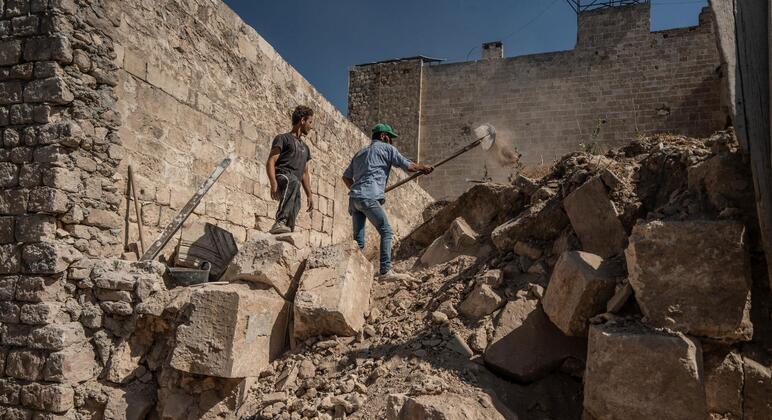
In Syria, communities are rolling up their sleeves - and often skipping the sleeves entirely - to clear rubble and rebuild neighborhoods shattered by over a decade of conflict. The war killed hundreds of thousands, displaced millions, and left infrastructure damage estimated at over $100 billion. Because nothing says 'rebuilding a nation' like manually hauling twisted metal out of what used to be a living room.
Joelle-Seme Park, a UNDP staffer who recently toured recovery projects, described the scene in Rural Damascus: piles of broken concrete and twisted metal blocking everything, roads closed, water and sewage networks in shambles, power and essential services struggling to return. Entire communities remain disconnected - which is a polite way of saying 'cut off from everything that makes life livable.'
Park's key insight: until rubble is removed, life cannot fully restart. Groundbreaking, we know. But here's the twist - communities are leading the effort, yet they can't do it alone. Clearing debris requires equipment, planning, coordination, and sustained support. You know, the boring stuff.
Enter the REVIVE project, a UNDP initiative helping communities take those first steps. It's clearing 570,000 tonnes of debris across Aleppo, Deir-ez-Zor, Homs, and Rural Damascus. That's a lot of rubble. The project also rehabilitates roads, water and sewage networks, provides explosive ordnance risk education (because, surprise, landmines don't disappear), and supports debris recycling that turns rubble into construction materials. Waste not, want not.
Park noticed a consistent pattern: once rubble is removed, life returns. Movement resumes, access is restored, families come home. The work also provides something desperately needed - income. Over 1,300 people have participated in cash-for-work activities tied to debris removal, supporting over 6,000 family members. One woman at a debris recycling facility in Aleppo told Park she had no income before the project; now she can feed her kids, niece, and nephew, and they're back in school. Take that, economic collapse.
But it's not just about money. There's pride in helping restore a neighborhood. A community volunteer in Aleppo said that after debris removal, locals rebuilt a park and streetlights, letting children and women enjoy the space after school without fear. Because who doesn't want to play in a park that was recently a war zone?
What struck Park most was the determination - people removing debris from their homes with their bare hands. In Syria, clearing rubble isn't just about demolition; it's about reopening roads, reconnecting services, supporting livelihoods, and helping communities regain a sense of normal life. Or at least, a new normal where the rubble is recycled into something useful.
The Good Times
News in your inbox.
One sardonic roundup, delivered on your schedule. Free. Unsubscribe whenever your tolerance for wit runs out.
Already subscribed but we never reach your inbox? Check your spam folder and hit 'Not spam' (or 'Remove from spam') to bust us out of junk-mail purgatory. You'll be helping everyone else too.
Don't open any of our emails for a month and you'll be automatically removed from the mailing list.
Rewrite Article
Select parts to regenerate with a fresh AI pass. Translations will be updated automatically.
Generate AI Image
Creates a sardonic version of the article image using OpenAI.