Spain's Wildfire Says 'Adiós' to NASA's Deep Space Network, Temporarily
A wildfire in Spain temporarily shuts down NASA's Madrid tracking station, leaving the Deep Space Network with one functional giant dish until repairs finish in 2028.
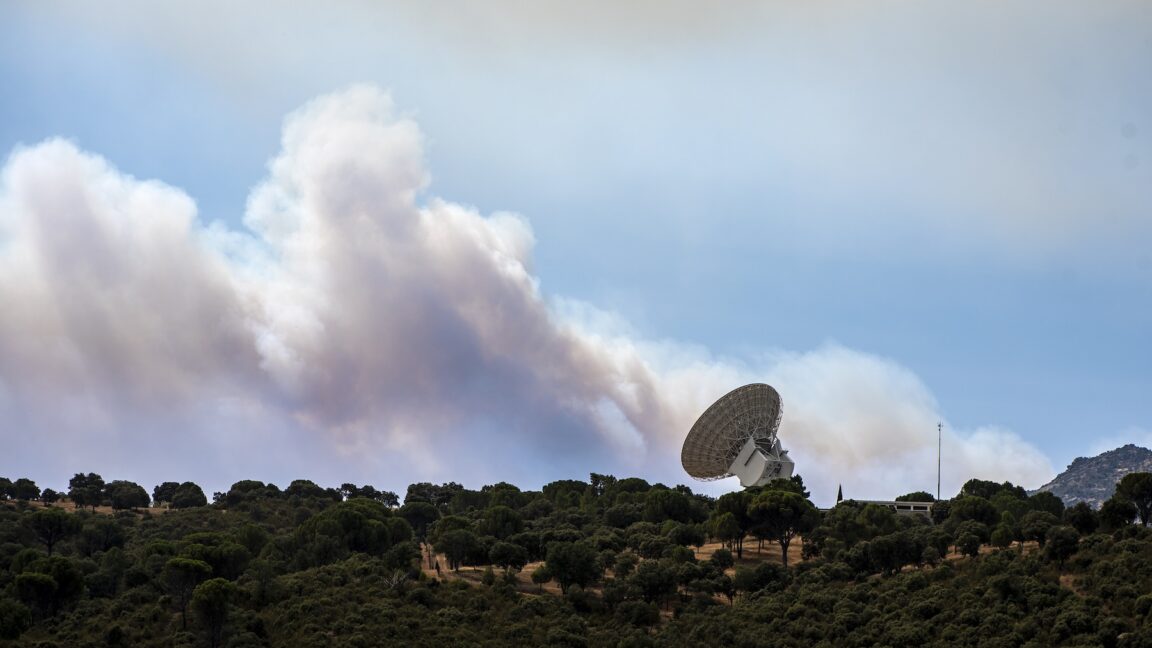
A fast-moving wildfire, one of many raging across Spain, decided to make a dramatic entrance at NASA's Madrid Deep Space Communications Complex on Friday, forcing an evacuation and temporarily suspending operations at one of the agency's most important tracking stations. The station, part of NASA's Deep Space Network, usually works in concert with facilities in California and Australia to provide global coverage as Earth rotates, bringing planets, stars, and deep space probes in and out of view. The network supports over 40 missions from the Moon to the edge of the Solar System, including Artemis, the James Webb Space Telescope, and NASA's twin Voyager spacecraft. A NASA spokesperson confirmed the Spain station, located in the hills nearly 40 miles (65 kilometers) west of central Madrid, was evacuated "due to ongoing wildfires in the region." Photos and video showed flames and smoke plumes rising over the ground station's antenna array, anchored by a 230-foot-diameter (70-meter) radio dish and a collection of smaller 112-foot (34-meter) antennas. "Any potential damage will be assessed when it is safe to do so," the spokesperson said. In the meantime, NASA has seamlessly transitioned support for mission operations to the Goldstone Deep Space Communications Complex in California, ensuring continuity of service and uninterrupted support for spacecraft communications. NASA typically runs the Deep Space Network using a "follow the Sun" model, where control centers at each site can remotely operate the entire network during local daytime hours. A NASA status website showed no activity at the Madrid site Friday afternoon, while antennas in California and Australia were communicating with spacecraft like Voyager 2 and Juno. "The safety and well-being of our personnel is our highest priority," NASA said. A separate deep space tracking station owned by the Spanish government and the European Space Agency, the Cebreros tracking station, was also evacuated due to wildfires. Reuters reported that Spanish authorities ordered more than 19,000 people to evacuate from towns in the mountains west of Madrid. Over 2,000 personnel and 10 aircraft were deployed to combat the wildfires. A summer heat wave and chronic drought conditions have made conditions ripe for wildfires across Spain and France. Without the Madrid location, the Deep Space Network is down to one operational 70-meter radio antenna in Australia. The 70-meter antenna in California has been offline since last year due to an accident that "over-rotated" the structure, damaging cables and water lines and flooding the base with 200,000 gallons of water containing glycol. The cleanup and repair is projected to cost between $4.1 million and $4.6 million, and the antenna is expected to remain offline into 2028. The good news for DSN is that the next Artemis mission to the Moon is still at least a couple of years away, with Artemis III now flying in low-Earth orbit and Artemis IV, the program's first planned lunar landing, targeted for no earlier than 2028.
The Good Times
News in your inbox.
One sardonic roundup, delivered on your schedule. Free. Unsubscribe whenever your tolerance for wit runs out.
Already subscribed but we never reach your inbox? Check your spam folder and hit 'Not spam' (or 'Remove from spam') to bust us out of junk-mail purgatory. You'll be helping everyone else too.
Don't open any of our emails for a month and you'll be automatically removed from the mailing list.
Rewrite Article
Select parts to regenerate with a fresh AI pass. Translations will be updated automatically.
Generate AI Image
Creates a sardonic version of the article image using OpenAI.