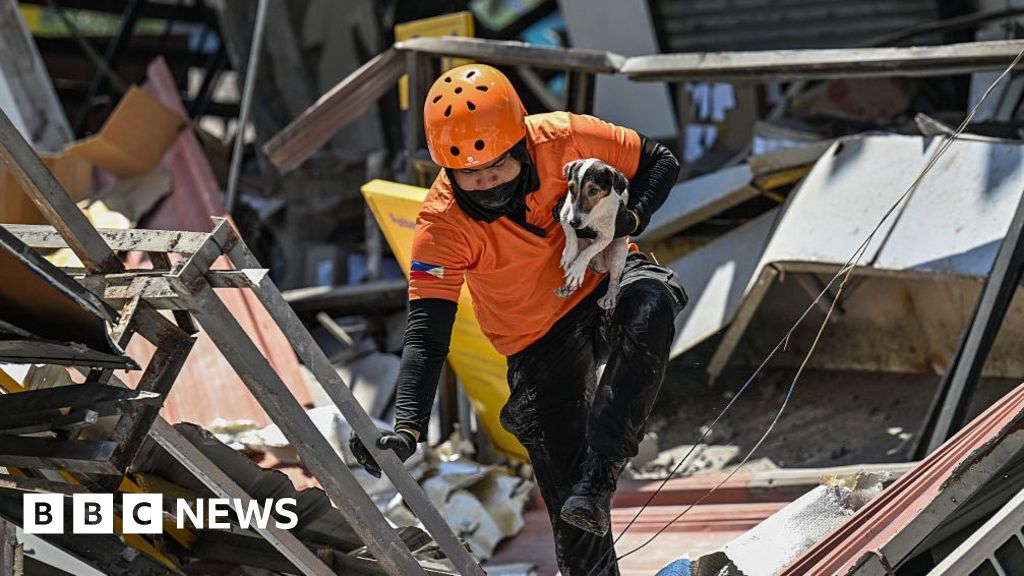
The southern Philippines is experiencing what might generously be described as a 'sequel nobody asked for' - hundreds of aftershocks rattling the region after a magnitude 7.8 earthquake left at least 37 dead and 487 injured.
Officials fear the death toll, currently sitting at 37, could rise as emergency responders finally reach coastal cities and towns on Mindanao island. The scale of devastation is becoming clear: collapsed buildings, cracked roads, and landslides have turned infrastructure into a cruel obstacle course. Large swathes of the island remain without electricity or telephone connectivity - because apparently the universe decided that losing cell service was the cherry on top of a catastrophic sundae.
The Monday morning quake triggered tsunami warnings across Indonesia, south of Mindanao, and along Japan's Pacific coast, displacing tens of thousands of people who are now rethinking their real estate choices.
"We hope the death toll does not increase further, but we are expecting it to move. Our priority today is search and rescue," Bernardo Alejandro, assistant secretary of the agency supervising disaster response, told DZMM radio. Close to 2,000 homes and 6,000 public schools have been damaged so far, because nothing says 'educational setback' like a building that's suddenly horizontal.
The Philippines sits on the Pacific Ring of Fire - a geological hotspot that regularly reminds residents that 'Ring of Fire' is not a Johnny Cash tribute band but a very aggressive tectonic neighbor. Monday's quake was caused by movement on the Cotabato Trench, a fault line that previously generated a magnitude 7.9 earthquake in 1976, killing about 5,000 people. So, basically, the trench has a track record.
The quake sowed panic in otherwise sleepy parts of Mindanao. Mobile phone and CCTV cameras captured buildings crumbling and children screaming as the ground shook - because of course the most terrifying moments are now also viral content.
Construction worker Ramel Pato was bringing his three children - aged 9, 12, and 13 - to school in Polomolok town when the earthquake struck. "When I was about to leave their school, I felt powerful shaking," Pato told the BBC, recalling surviving a less powerful quake in 1998 when he was seven. His advice: don't panic, because panicking is apparently optional.
Public school teacher Cesar Sundo, who lives in Lebak town, described the earthquake as feeling like "being vigorously rocked on a hammock for more than two minutes... and the shaking was getting stronger by the second." His students, mostly 13-year-olds, were shouting and crying while thousands waited on school grounds until they were advised to go home. "We were literally saved by our flag ceremony," Sundo said, noting that the morning assembly had them outside when the quake hit.
Science minister and veteran seismologist Renato Solidum confirmed that many students survived because they were attending that Monday morning assembly. "They were lucky to be outside. They were able to stay put and sit down," Solidum told DZMM. Because sometimes the best disaster preparedness plan is just being in the right place at the right time - or rather, not being inside a collapsing building.
One viral video showed a branch of beloved fast-food chain Jollibee in General Santos City collapsing as onlookers watched in horror. The chain issued a statement saying all its staff in earthquake-hit areas are safe - presumably because Jollibee's fried chicken is not worth dying for, no matter how good it is.
President Ferdinand Marcos Jr said he had mobilized the entire government machinery to respond, which sounds reassuring until you remember it's the same machinery that handles everything else. His transportation and health secretaries have flown to Mindanao from Manila to oversee the response, while aftershocks - some quite strong - continued hitting even as doctors treated the injured.
Access to some towns, like Jose Abad Santos in Davao Occidental on Mindanao's east side, remains difficult. Mayor Jason John Joyce told DZMM that landslides have buried the town's only highway, leaving half of it accessible by road. "Relief goods have to be flown in to far-flung barangays (villages)," he added, because apparently even getting aid to people is an Olympic-level logistical event.
The Good Times
News in your inbox.
One sardonic roundup, delivered on your schedule. Free. Unsubscribe whenever your tolerance for wit runs out.
Already subscribed but we never reach your inbox? Check your spam folder and hit 'Not spam' (or 'Remove from spam') to bust us out of junk-mail purgatory. You'll be helping everyone else too.
Don't open any of our emails for a month and you'll be automatically removed from the mailing list.
Rewrite Article
Select parts to regenerate with a fresh AI pass. Translations will be updated automatically.
Generate AI Image
Creates a sardonic version of the article image using OpenAI.