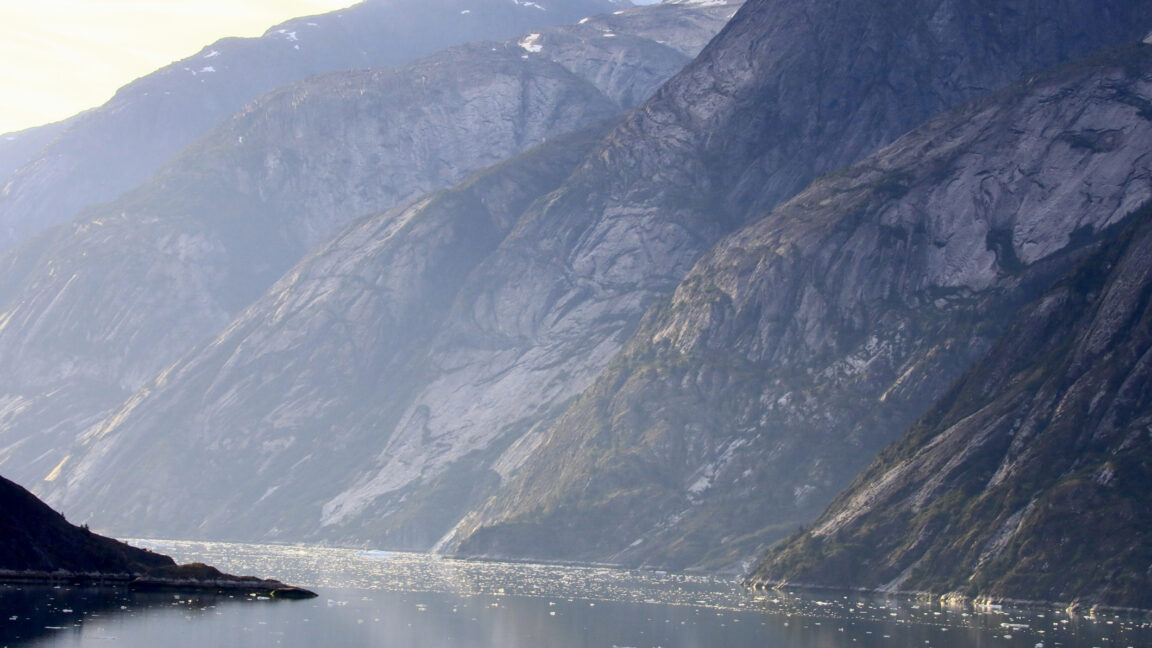
A 63.5 million cubic meter rock slide in Alaska created the second-highest tsunami ever recorded - but since it happened at 5:26 AM, mostly just scared some kayakers and lifted a boat.
At 5:26 AM local time on August 10, 2025, a 63.5 million cubic meter wedge of rock decided it was done being part of a mountain above Alaska's Tracy Arm fjord. It plunged into the deep waters at the terminus of the South Sawyer Glacier, generating an initial 100-meter-high breaking wave that tore across the fjord at speeds exceeding 70 meters per second. When that wave hit the opposite shoreline, it surged up the steep rocks to a height of 481 meters above sea level - making it, according to University of Calgary researcher Aram Fathian, "the second highest tsunami ever recorded on Earth." The good news: nobody died. The bad news: that's mostly because it happened at 5:26 AM, and Tracy Arm is a popular tourist destination.
Earthquake-generated tsunamis typically produce runup heights of a few tens of meters. Landslide tsunamis, like this one, are more localized but also way more violent - because when millions of tons of rock suddenly fall into a narrow fjord, the water doesn't have anywhere to go except up, violently. Since 1925, scientists have documented 27 such events with runups exceeding 50 meters. The reigning champion remains the 1958 Lituya Bay tsunami, which reached 530 meters.
The root cause of the Tracy Arm event? A glacier that used to hold the rock in place, but has been retreating due to warming climate. The team used high-resolution satellite images to evaluate glacial thinning and found that industrial-era warming raised summertime temperatures by 1.1°C since about 1875, driving up snowline elevations by roughly 169 meters. Between 2013 and 2022 alone, the glacier ice bracing the failure site thinned by 100 to 130 meters. Without millions of tons of ice pressing against the rock, the slopes were left too steep to support their own weight.
There were warning signs - just not visible ones. Retrospective analysis of satellite imagery showed no visible tension cracks. But deep within the rock, surfaces were already grinding. Regional seismometers registered localized repeating earthquakes beginning as early as August 5. By August 9, these mini earthquakes were happening once every hour. In the six hours before the failure, the gaps shrank to 30-60 seconds. About an hour before the landslide, the signals merged into a continuous, grinding slip. Then the rock fell.
The impact of 63.5 million cubic meters of rock hitting the fjord released forces equivalent to a magnitude 5.4 earthquake, recorded by sensor stations worldwide. The sloshing water established a 66-second long-period seiche that reverberated for 36 hours.
"It could easily turn into a catastrophic disaster," Fathian says. During the summer, more than 20 boats navigate the Tracy and Endicott arms every day, including up to six large cruise ships. Had the landslide occurred a few hours later, the outcome could have been tragic. Even at 5:26 AM, the tsunami terrified the few people present. About 55 kilometers away on Harbor Island, kayakers saw water flowing past their tents 20 minutes after the landslide; the surge took some gear and one kayak. In No Name Bay, observers on a motor vessel reported a 2-2.5-meter cresting wave. Farther away, 85 kilometers from the source, the crew of a small cruise boat in Fords Terror saw a surge lift their vessel three meters despite a falling tide. At the mouth of the fjord, a National Geographic Venture cruise ship carrying around 150 people was anchored in dense fog; the captain noted currents, white water, and debris, but the jagged, shallow seabed sapped the wave's energy. "It was a miraculous kind of luck we had that nobody got hurt," Fathian claims.
But that luck may not last. Climate change is accelerating the retreat of tidewater glaciers and thawing permafrost, causing structural integrity of landscapes to fail worldwide. "These conditions exist in many locations: Canada, Alaska, New Zealand, Greenland, Norway, and many other places," Fathian says. Meanwhile, the number of cruise ship passengers visiting Alaska has increased from roughly 1 million in 2016 to 1.6 million in 2025. "Some of these cruise ships carry up to 6,000 passengers. This is literally a floating city," Fathian says. "Imagine one of these ships getting hit by a mega tsunami wave."
The researchers hope their study will provide scientific tools to predict such events in advance. "Tracy Arm was not on the radar - it was not on anyone's hazard or risk map," Fathian explains. The goal is a better understanding of precursory warning signals detectable with seismological techniques - like the mini earthquakes recorded a few days prior. "These signals could be promising for developing early warning systems," Fathian says. "Hopefully this kind of data ends up on desks of policymakers and regulators to come up with practical and appropriate measures."
The Good Times
News in your inbox.
One sardonic roundup, delivered on your schedule. Free. Unsubscribe whenever your tolerance for wit runs out.
Already subscribed but we never reach your inbox? Check your spam folder and hit 'Not spam' (or 'Remove from spam') to bust us out of junk-mail purgatory. You'll be helping everyone else too.
Don't open any of our emails for a month and you'll be automatically removed from the mailing list.
Rewrite Article
Select parts to regenerate with a fresh AI pass. Translations will be updated automatically.
Generate AI Image
Creates a sardonic version of the article image using OpenAI.