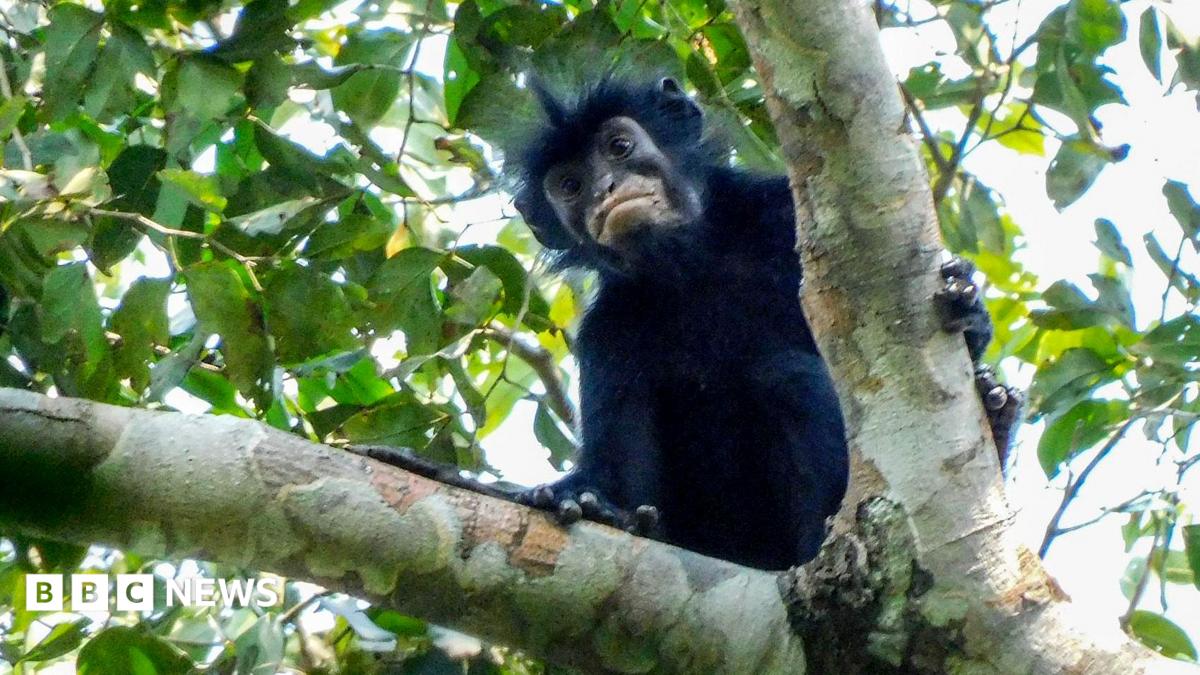
A monkey with strikingly pinkish-orange lips and a black face has been confirmed as a new species, officially joining the exclusive club of African monkeys discovered in the last 75 years - which, it turns out, has only five members.
Conservationists first spotted this black-furred primate lurking in the high canopy of Lomami National Park in the Democratic Republic of Congo back in 2008, but all they got was one blurry photo. Ten years later, another sighting prompted an international team to actually go find the thing, study it, and reveal it as a previously unknown species.
Junior Amboko, a PhD student at Florida Atlantic University, led the search involving audio recordings, photography, and genetic studies - published in the journal PLoS One. "It was an amazing feeling," Amboko told BBC News, to look into the face of an animal that so few people knew existed, except apparently the locals who already called it Likweli.
The monkeys are "kind of shy," Amboko noted, which explains why only people in eight out of 52 villages near their habitat had ever seen them. The research team - from DRC, the US, and Germany - gave the animal the Latin name Colobus congoensis, honoring the country's natural diversity. It belongs to the colobus group, which Prof Kate Detwiler from Florida Atlantic University describes as "really important African monkeys that don't have thumbs" and act as "herbivores of the canopy" critical for seed processing and germination.
Their bright facial markings might be a visual signal for mating or identification, and they have a distinctive "roaring" call - so you often hear them but don't see them, which is basically the monkey version of a ghost story. The animals are hunted for meat, so the researchers hope that official species status will bring protection.
They still have plenty of questions about this secretive species and plan a detailed survey to estimate population and behavior - because apparently, discovering a new monkey is just the beginning of the paperwork.
The Good Times
News in your inbox.
One sardonic roundup, delivered on your schedule. Free. Unsubscribe whenever your tolerance for wit runs out.
Already subscribed but we never reach your inbox? Check your spam folder and hit 'Not spam' (or 'Remove from spam') to bust us out of junk-mail purgatory. You'll be helping everyone else too.
Don't open any of our emails for a month and you'll be automatically removed from the mailing list.
Rewrite Article
Select parts to regenerate with a fresh AI pass. Translations will be updated automatically.
Generate AI Image
Creates a sardonic version of the article image using OpenAI.