NASA Telescopes Create Colorful ‘Craft’ From Nearby Nebula, Because Why Not
NASA's telescopes combine forces to create a cosmic collage of the Tarantula Nebula, revealing that the universe is even more complicated - and colorful - than we thought.
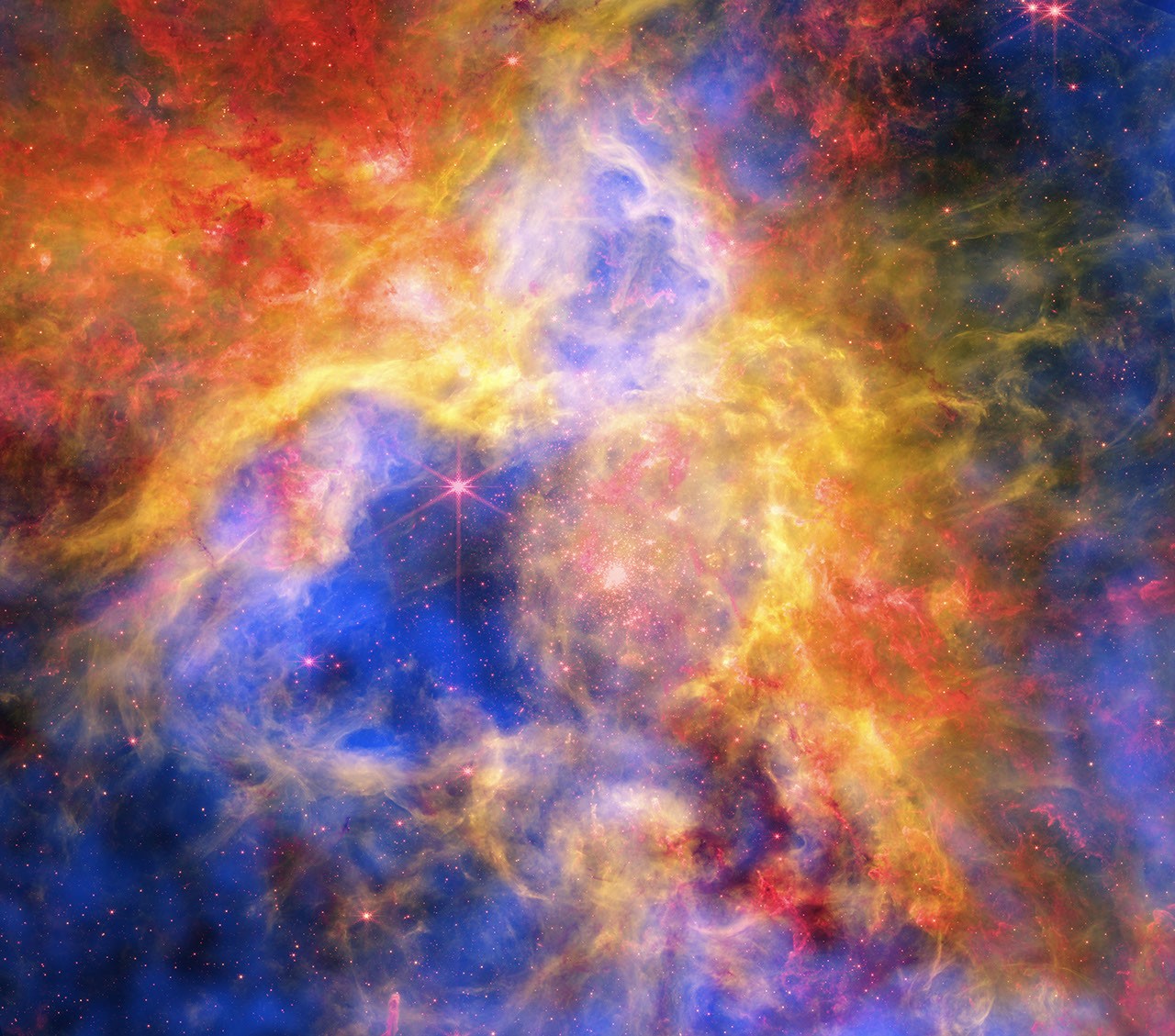
NASA's space telescopes have outdone themselves again, producing a vibrant new image of the Tarantula Nebula that looks like a cosmic collage made of layered cellophane. Because apparently, the universe wasn't already pretty enough without our help.
The image, which combines data from three of NASA's finest - Chandra, Hubble, and Webb - reveals new details about 30 Doradus, or the Tarantula Nebula, a star-forming region located in the Large Magellanic Cloud, a small neighbor galaxy to the Milky Way about 160,000 light-years from Earth. It's got thousands of young stars embedded in a honeycomb-like structure of gas and dust, which sounds like a great place to set up a cosmic Airbnb.
The composite image shows X-rays from Chandra in blue, revealing gas blown away by winds from young, massive stars and heated to millions of degrees by shock waves - basically, the universe's version of sonic booms. The red layer from Webb shows thousands of young stars and cool dust that will eventually form new stars and planets - think of it as the cosmic nursery's raw materials. The green layer from Hubble uncovers hydrogen gas that's warmer than what Webb sees, plus some individual stars, because why not have all the wavelengths?
The research paper, published in the Astrophysical Journal, reveals that the Tarantula Nebula is not behaving as expected. Astronomers had estimated that energy from stellar winds should heat gas to produce X-rays, but there's much less X-ray-emitting gas than predicted. So, where did the energy go? The team, led by Jennifer Rodriguez of The Ohio State University, investigated with data from Chandra, Hubble, Webb, and the retired Spitzer Space Telescope, and found three possible culprits.
First, up to half of the hot gas is leaking through the shell walls and escaping the nebula - apparently, even cosmic gas can't resist a good escape. Second, there's stirring and mixing between cold and hot gas, lowering the overall temperature - like adding ice to your drink, but on a galactic scale. Third, the nebula might be losing energy through conduction, where hot and cooler gas touch and equalize temperature, like a cosmic frying pan on a burner. In the densest regions, this direct contact could be siphoning off the heat.
So, the Tarantula Nebula is tamed by a combination of leaks, mixing, and conduction, resulting in this colorful, complex display - proof that even in space, things don't always go as planned, but they sure look pretty.
The paper's authors include Jennifer Rodriguez (lead), Laura Lopez (Ohio State), Lachlan Lancaster (Columbia University), Anna Rosen (San Diego State University), Omnaraynai Nayak (Space Telescope Science Institute), Sebastian Lopez (Ohio State), Tyler Holland-Ashford (NASA Goddard), and Trinity Webb (Ohio State). NASA's Marshall Space Flight Center manages the Chandra program, while the Smithsonian Astrophysical Observatory's Chandra X-ray Center handles operations from Cambridge and Burlington, Massachusetts.
The Good Times
News in your inbox.
One sardonic roundup, delivered on your schedule. Free. Unsubscribe whenever your tolerance for wit runs out.
Already subscribed but we never reach your inbox? Check your spam folder and hit 'Not spam' (or 'Remove from spam') to bust us out of junk-mail purgatory. You'll be helping everyone else too.
Don't open any of our emails for a month and you'll be automatically removed from the mailing list.
Rewrite Article
Select parts to regenerate with a fresh AI pass. Translations will be updated automatically.
Generate AI Image
Creates a sardonic version of the article image using OpenAI.