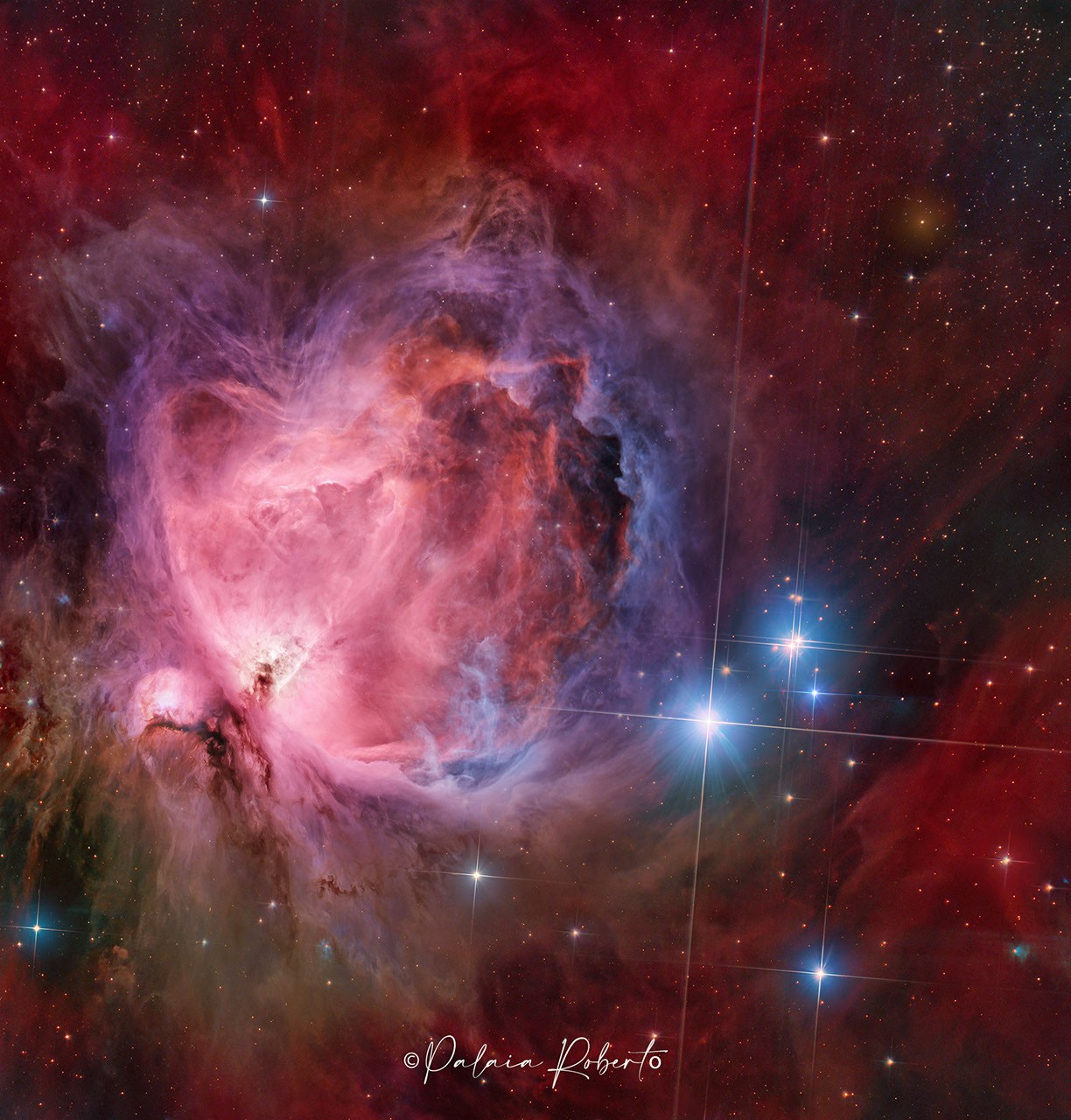
NASA Reminds Us the Orion Nebula Exists, Still 1,500 Light-Years Away
NASA's APOD features M42, the Orion Nebula, again - because some cosmic wonders are worth repeating, especially when they're 1,500 light-years away and visible to the naked eye.
In a development that will surprise absolutely no one who has ever looked up, NASA's Astronomy Picture of the Day has once again featured M42, the Great Nebula in Orion - an immense, nearby starbirth region that remains one of the most famous of all astronomical nebulas. The agency's daily dose of cosmic humility comes with a brief explanation written by a professional astronomer, presumably to remind us that the universe is vast and our problems are small.
The featured deep image, rendered in assigned colors highlighted by hydrogen emission, shows wisps and sheets of dust and gas with particular clarity. This glowing gas surrounds hot young stars at the edge of an immense interstellar molecular cloud only 1,500 light-years away - a distance that is simultaneously mind-boggling and, in galactic terms, practically next door.
For those who prefer their astronomy accessible, the Great Nebula can be found with the unaided eye near the easily identifiable belt of three stars in the popular constellation Orion. Yes, you can see it without a telescope, which is convenient for those of us who left our Hubble in our other pants.
Beyond its visual appeal, the Orion Nebula houses a bright open cluster of stars known as the Trapezium and contains many stellar nurseries. These nurseries are packed with hydrogen gas, hot young stars, proplyds, and stellar jets spewing material at high speeds - because even in space, youth is messy.
Also known as M42, the Orion Nebula spans about 40 light-years and is located in the same spiral arm of our Galaxy as the Sun. So the next time you gaze at Orion's Belt, remember: you're looking at a cosmic nursery, and the universe is still churning out stars like it's going out of style. Tomorrow's picture: open space. Because apparently, even NASA needs a day off.
The Good Times
News in your inbox.
One sardonic roundup, delivered on your schedule. Free. Unsubscribe whenever your tolerance for wit runs out.
Already subscribed but we never reach your inbox? Check your spam folder and hit 'Not spam' (or 'Remove from spam') to bust us out of junk-mail purgatory. You'll be helping everyone else too.
Don't open any of our emails for a month and you'll be automatically removed from the mailing list.
Rewrite Article
Select parts to regenerate with a fresh AI pass. Translations will be updated automatically.
Generate AI Image
Creates a sardonic version of the article image using OpenAI.