
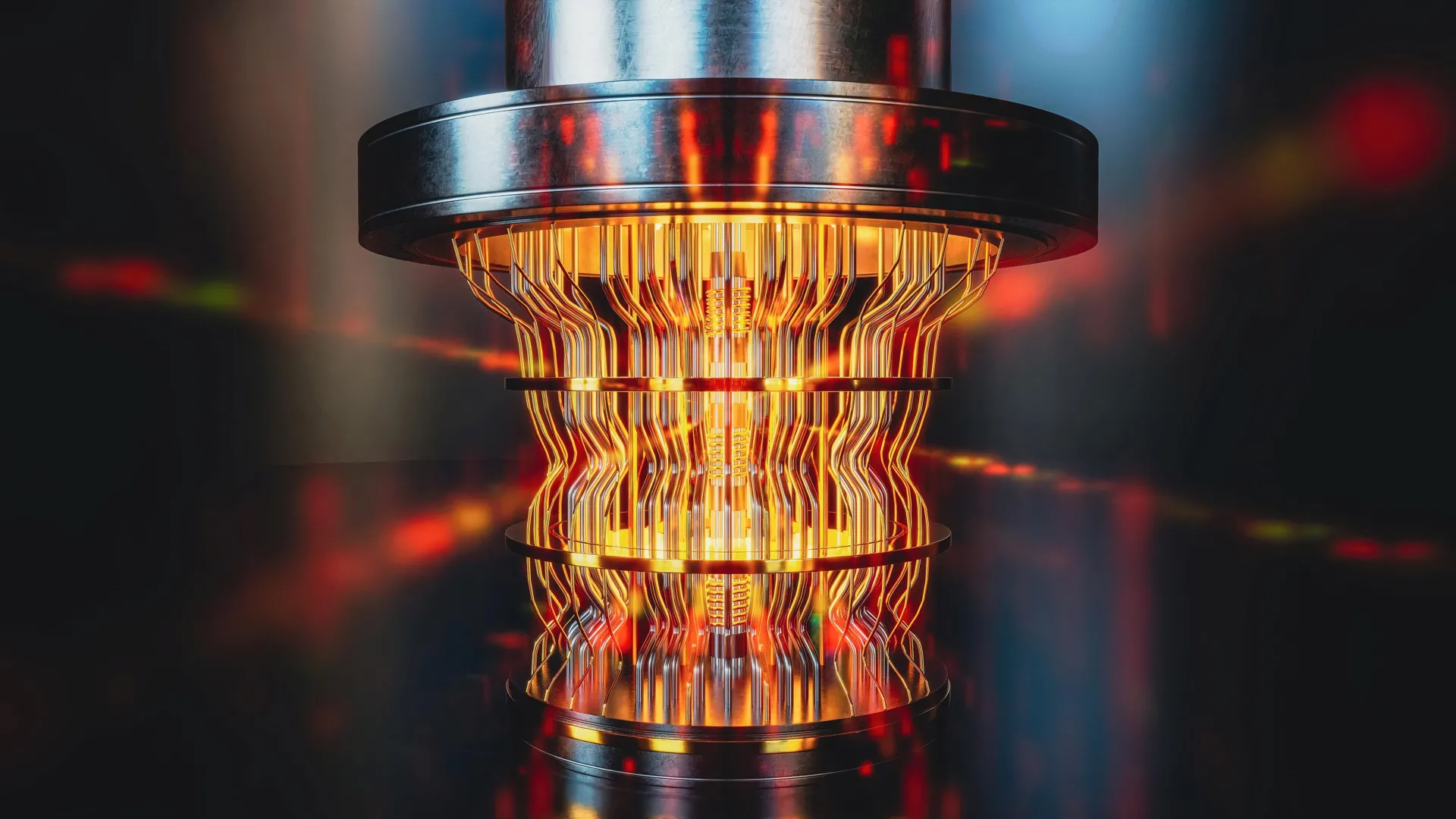
Silicon spin qubits have long been the promising overachievers of quantum computing: they can be manufactured using the same semiconductor methods that churn out today’s computer chips, which is the tech equivalent of showing up to a black-tie event in a suit you already own. The catch, of course, is that when you try to control multiple qubits at once, their operations become less accurate - a bit like herding cats, if the cats were subatomic and had a tendency to phase-shift unexpectedly. Building practical, large-scale quantum computers requires controlling many qubits simultaneously while keeping errors to a minimum, which has been the field’s longstanding “yes, but how?” problem.
Researchers at the RIKEN Center for Emergent Matter Science and their collaborators have now made important progress toward solving this. In a study published in Nature Physics, the team demonstrated highly accurate control of several silicon spin qubits operating simultaneously. Their experiments used an array of five qubits connected to a shared microwave control line - because apparently even quantum bits appreciate the efficiency of a good shared resource. By identifying a major cause of errors during simultaneous operation, the scientists developed a technique to reduce those errors and maintain precision, proving that you can, in fact, have your qubits and control them too.
Leon Camenzind, a RIKEN research scientist and co-first author who supervised the experiments, explained the significance: “This shows that high-fidelity control can be maintained even when several qubits are operated at the same time and represents an important step toward scaling up silicon-based quantum processors.” Which is scientist-speak for “we made it work, and that’s a big deal.”
Unlike conventional computers, which store information as bits representing either 0 or 1, quantum computers use quantum bits, or qubits, that can exist in combinations of both states - because why choose one when you can be indecisive in a fundamentally useful way? Silicon spin qubits store this information using the spin of individual electrons confined within silicon. Performing reliable quantum calculations requires extremely precise control over these electron spins, which is easier said than done when you’re dealing with the quantum equivalent of a room full of toddlers.
Microwave signals provide that control, but operating multiple qubits simultaneously can create unwanted effects that interfere with their accuracy. The researchers traced much of this problem to a phenomenon called the AC Stark shift. This effect occurs when microwave control signals alter a qubit’s effective energy levels, producing changes in the phase of its quantum state. Those phase shifts can disrupt the intended operation of individual qubits, particularly when several are being controlled at once - a classic case of too many cooks in the quantum kitchen.
To counteract the problem, the team created a calibration method that compensates for these unwanted shifts. Rather than separately calibrating every possible combination of qubits - which would be a combinatorial nightmare - the technique relies on calibrations performed between pairs of qubits. This makes the approach more practical for systems containing larger numbers of quantum bits. “Rather than requiring an entirely separate calibration procedure for every possible combination of qubits, our method uses calibrations between pairs of qubits to compensate for the unwanted phase shifts,” explains Yi-Hsien Wu, the first author who carried out the experiments as part of his PhD research. In other words, they found a way to avoid doing the same tedious task ad infinitum, which is a win for efficiency and for Wu’s sanity.
The researchers combined their calibration technique with an improved device design and carefully adjusted microwave control pulses. Their results showed that exceptionally high accuracy could be maintained even when multiple qubits were operating simultaneously. When the five qubits were tested individually, each achieved single-qubit gate fidelity well above 99.99%, with the highest approaching 99.999%. Fidelity describes how closely a quantum operation matches its intended result - think of it as a quantum report card, and these qubits are straight-A students.
The team then tested how well the system performed when several qubits were active together. With as many as three qubits operating simultaneously, fidelity remained above 99.99%. Even when all five qubits were controlled at once, accuracy stayed at approximately 99.9%, approaching the levels needed for practical fault-tolerant quantum computing. That’s the quantum equivalent of successfully juggling five balls while riding a unicycle - impressive, and only slightly terrifying.
Although the calibration method greatly reduced errors, it did not eliminate them entirely - because quantum computing is nothing if not humbling. The researchers found that the remaining loss of accuracy was linked to drive-induced decoherence, an effect caused by the greater microwave power required to operate multiple qubits simultaneously. Unlike the unwanted phase shifts corrected by the new technique, decoherence involves the loss of the delicate quantum coherence needed for reliable operations. According to Camenzind, “This is a limitation, but further improvements to device design could help mitigate this source of error.” So, not perfect, but promising - the quantum computing equivalent of “we’ll fix it in post.”
The findings show that controlling several silicon spin qubits at the same time does not necessarily require a major sacrifice in accuracy. By correcting a key source of errors, the researchers have demonstrated a promising approach for operating more qubits through shared microwave control lines. This is especially important for the development of large quantum processors. Giving every qubit its own independent control system would make increasingly complex devices difficult to manage - like giving every employee in a company their own private email server. Shared control lines could offer a more practical way to expand these systems while maintaining the precision needed for quantum calculations.
“By addressing a key source of control errors through pairwise calibration,” says Camenzind, “our study supports the use of shared control lines as a practical approach to scaling up quantum processors. Combined with silicon’s compatibility with established semiconductor manufacturing, we believe that this advance could help pave the way toward larger quantum processors capable of performing increasingly complex computations.” The broader objective, of course, is to develop quantum computers that can reliably perform calculations despite the errors and disturbances that affect quantum systems. Such machines, known as fault-tolerant quantum computers, will require precise, dependable control over large numbers of qubits. “Our long-term goal is to build a fault-tolerant quantum computer based on silicon spin qubits, and reliable parallel control is an essential step toward that goal,” adds Seigo Tarucha, project manager of a silicon quantum computing project under JST’s Moonshot Goal 6. So, the moonshot is still a moonshot, but at least now it’s a slightly more navigable one.
Materials provided by RIKEN. Note: Content may be edited for style and length.