NASA Releases Photo of Sun Doing a Lazy Figure-8 Over Ancient Scottish Stones
NASA's latest APOD features an analemma - a year-long figure-8 of the Sun - over Scotland's Callanish Stones, proving the Sun is just as indecisive as the rest of us.
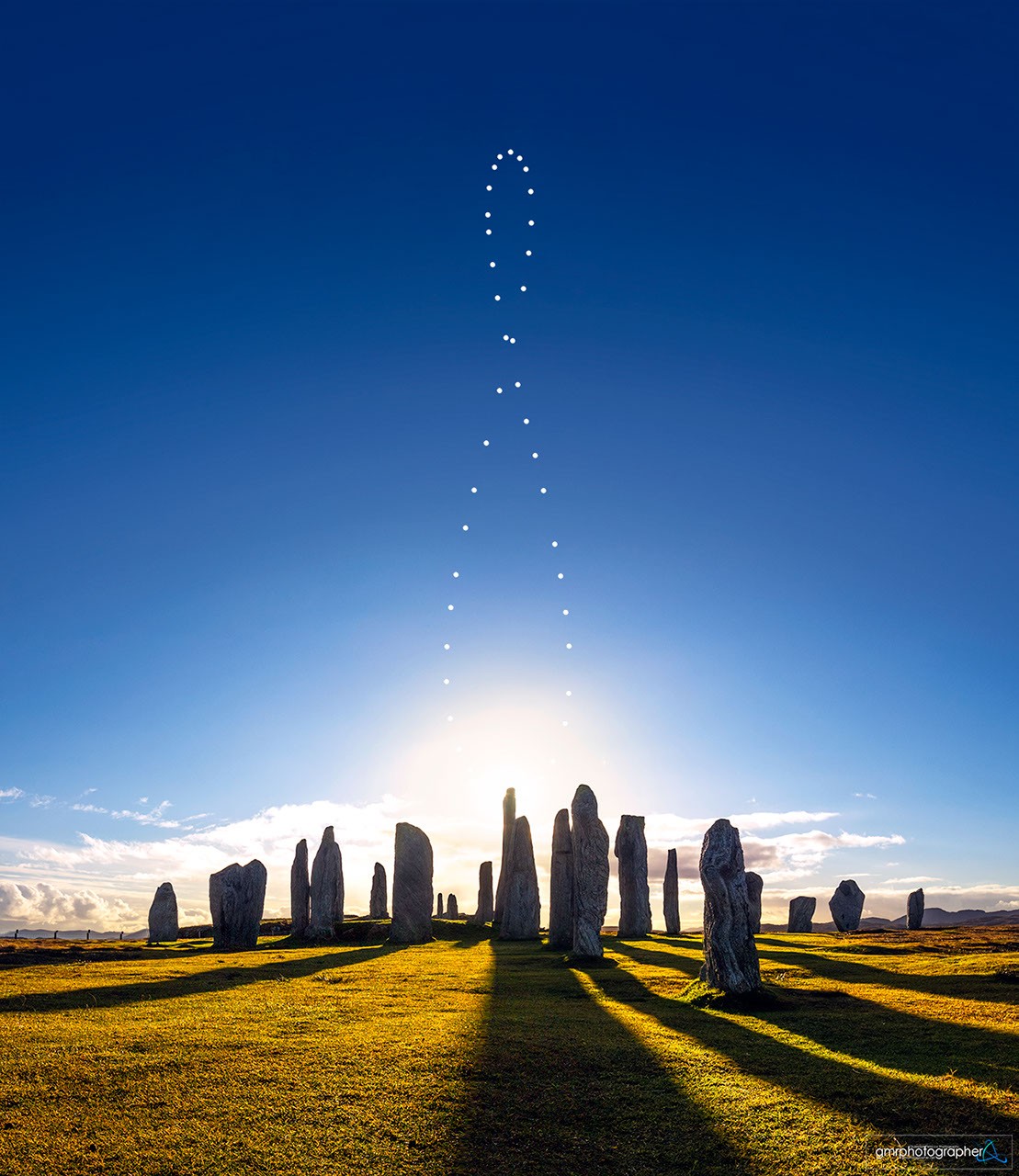
NASA's Astronomy Picture of the Day has once again delivered a cosmic Rorschach test, this time in the form of an analemma - a composite image of the Sun taken from the same spot at the same time over the course of a year - hovering over the Callanish Stones in the Outer Hebrides, Scotland.
For those unfamiliar with the analemma, it's the answer to a question you didn't know you had: if you went outside at the same time every day and photographed the Sun, how would its position change? The answer, apparently, is that it traces a figure-8, like a bored celestial body pacing around the room.
The featured image was composed from photos taken every few days at noon near the village of Callanish. In the foreground sits the Callanish Stones, a stone circle built around 2700 BC during humanity's Bronze Age. Whether the stones' placement had any astronomical significance remains unknown, which is the archaeological equivalent of a shrug emoji.
The figure-8 shape of all analemmas comes down to two things: the tilt of Earth's axis and the ellipticity of Earth's orbit around the Sun. At the solstices, the Sun sits at the top or bottom of the analemma. This particular image was taken near the December solstice, so the Sun appears near the bottom - presumably because even the Sun needs a break in December.
Equinoxes, meanwhile, correspond to analemma middle points, not the intersection point - a distinction that will impress exactly no one at parties. In two days there will be an equinox, when day and night are equal across the entire planet, and many cultures will celebrate a change of season with traditions that predate the analemma's discovery by several thousand years.
In related administrative news, APOD's main NASA site is moving from apod.nasa.gov to science.nasa.gov/apod. Tomorrow's picture: open space, which is technically everywhere and nowhere, much like NASA's budget.
The Good Times
News in your inbox.
One sardonic roundup, delivered on your schedule. Free. Unsubscribe whenever your tolerance for wit runs out.
Already subscribed but we never reach your inbox? Check your spam folder and hit 'Not spam' (or 'Remove from spam') to bust us out of junk-mail purgatory. You'll be helping everyone else too.
Don't open any of our emails for a month and you'll be automatically removed from the mailing list.
Rewrite Article
Select parts to regenerate with a fresh AI pass. Translations will be updated automatically.
Generate AI Image
Creates a sardonic version of the article image using OpenAI.