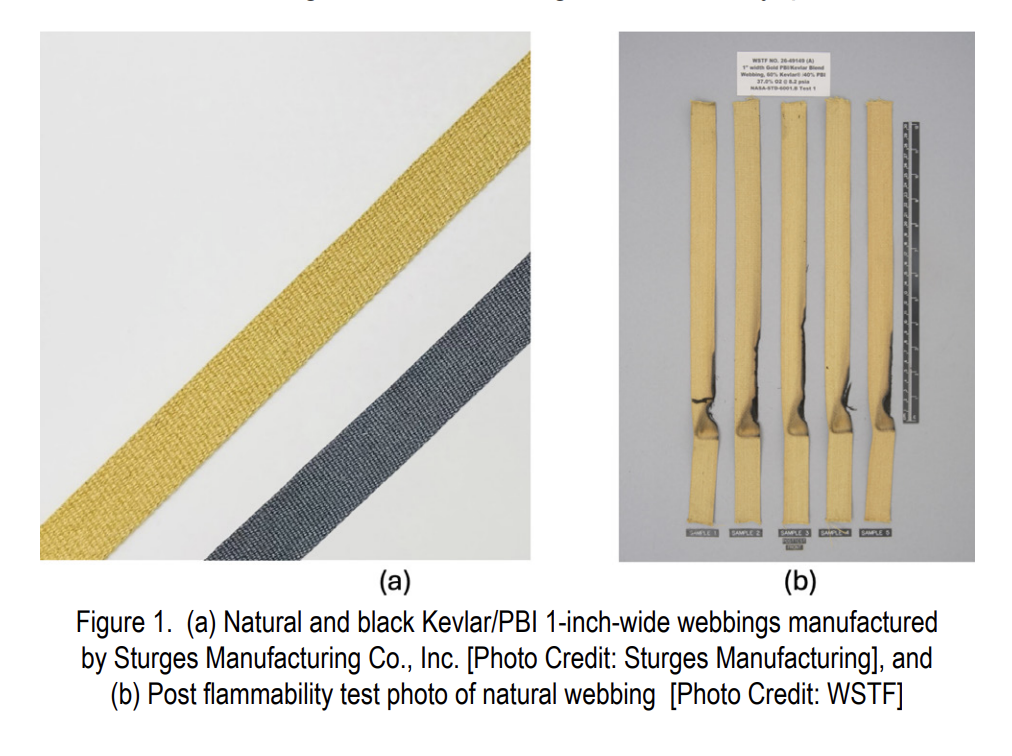
In a thrilling development for anyone who has ever wondered what kind of fabric might hold up in a highly flammable, oxygen-rich lunar habitat, NASA has released the results of flammability tests on some very special webbings. The agency, ever vigilant about the risk of things catching fire in space, has identified a material that could be used for all sorts of softgoods - think crew mobility aids, restraint nets, and those oh-so-handy storage bag handles - without turning into a torch.
The winning fabric is a natural-colored webbing made of 60% Kevlar® and 40% polybenzimidazole (PBI), courtesy of Sturges Manufacturing Company, Inc. It passed NASA-STD-6001B Test 1 with flying colors (specifically, gold) at a rather cozy 37% oxygen and 8.2 psia. The black version, meanwhile, managed a slightly less impressive 35% oxygen, which just goes to show that color matters even in space. Offgassing data for the natural webbing are also provided, because nothing ruins a mission like your straps emitting mysterious fumes.
Why all this fuss? Future crewed missions to the Moon and Mars plan to use elevated oxygen environments (37% oxygen, 8.2 psia) to cut down on prebreathe time before spacewalks. But more oxygen means more fire risk, and standard meta-aramid or nylon webbings apparently can't handle the heat. The NASA Engineering and Safety Center (NESC), along with the Mars Campaign Office and Johnson Space Center, has been tasked with finding textiles that won't immolate. This is the first phase: testing commercial-off-the-shelf (COTS) materials that might just be flame-resistant enough.
The tests were conducted at White Sands Test Facility (WSTF), where they determined the maximum oxygen concentration (MOC) for each webbing. The test involved a J-configuration, which sounds technical and is, but the key point is the cut edge wasn't exposed to the flame, and the igniter hit the front surface - including the lateral free edge. We should note that flammability after wear and tear wasn't assessed, because apparently they expect you to replace your webbing before it gets too frayed.
The available webbing widths range from ¼ to 8 inches, so there's a size for every occasion. But before you go strapping your lunar habitat together with this stuff, keep in mind that these results are just for the individual textile. The final flammability of a finished product depends on all the other components, and variations in dimensions, weave type, yarn size, density, treatments, color, fiber blend, edge finish, hook-and-loop additions, and general wear and tear could change the flammability characteristics. So, don't go assuming your gold webbing will save your bacon if you add a zipper.
In short, NASA has found a promising webbing that might not burst into flames in an oxygen-rich environment, which seems like a solid first step. Now, if only they could do something about the prebreathe time.
The Good Times
News in your inbox.
One sardonic roundup, delivered on your schedule. Free. Unsubscribe whenever your tolerance for wit runs out.
Already subscribed but we never reach your inbox? Check your spam folder and hit 'Not spam' (or 'Remove from spam') to bust us out of junk-mail purgatory. You'll be helping everyone else too.
Don't open any of our emails for a month and you'll be automatically removed from the mailing list.
Rewrite Article
Select parts to regenerate with a fresh AI pass. Translations will be updated automatically.
Generate AI Image
Creates a sardonic version of the article image using OpenAI.