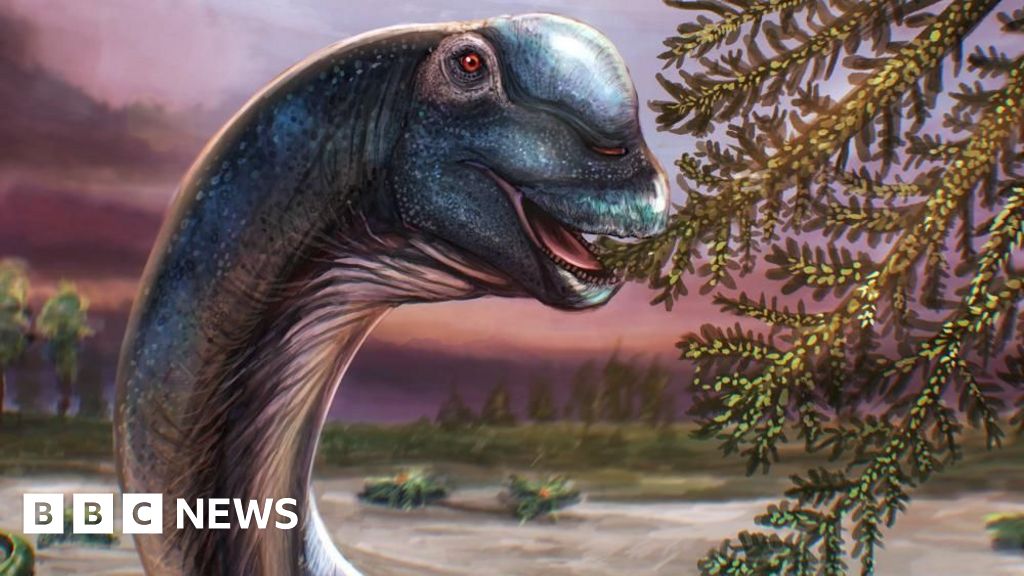
Meet the Nagatitan: A 27-Tonne Dinosaur That Makes T. Rex Look Like a Snack
Scientists name a 27-tonne, 27-metre-long dinosaur after a mythical serpent, making it the largest ever found in South-East Asia and proving that being a dinosaur kid can pay off.
Scientists have officially identified a new giant dinosaur from fossils found in Thailand, and it is absolutely enormous - the kind of enormous that makes you grateful these things aren't still wandering around.
The nagatitan, the largest dinosaur ever discovered in South-East Asia, tipped the scales at 27 tonnes (that's nine adult Asian elephants in a trench coat) and stretched 27 metres (88 feet) from snout to tail, making it longer than a diplodocus. Like its distant cousin, it was a sauropod - one of those long-necked herbivores that probably spent most of its day eating and wondering if it was being watched.
A team of researchers from the UK and Thailand identified the species from fossils found beside a pond in north-eastern Thailand a decade ago. They say the discovery helps explain how shifting ancient climates allowed dinosaurs to reach such ludicrous sizes.
The dinosaur's full name is Nagatitan chaiyaphumensis: "naga" for a mythical serpent in South-East Asian folklore, "titan" for the gods of Greek mythology, and "chaiyaphumensis" meaning "from Chaiyaphum" - the province where the fossils were unearthed. Because nothing says "I'm a serious scientist" like naming your find after a snake god.
It lived between 100 and 120 million years ago - about 40 million years before the tyrannosaurus rex showed up to ruin everyone's day - and was roughly twice the size of that famous predator. Imagine a T. rex looking up at something and thinking, "Yeah, I'm not messing with that."
Thitiwoot Sethapanichsakul, a Thai doctoral student at University College London (UCL), was the lead author of the study published in Scientific Reports. He called the nagatitan "the last titan" of Thailand, since the fossils were found in the country's youngest dinosaur-bearing rock formation.
"Younger rocks laid down towards the end of the time of the dinosaurs are unlikely to contain dinosaur remains because the region by then had become a shallow sea. So this may be the last - or most recent large sauropod we'll find in South-East Asia," he said.
Sethapanichsakul, a self-confessed "dinosaur kid," said in a UCL press release that the study also "fulfils a childhood promise of naming a dinosaur." We can only assume the promise was made to a very patient stuffed animal.
The nagatitan is the 14th dinosaur to be named in Thailand. Palaeontologist Dr Sita Manitkoon, from Mahasarakham University, noted that the country has a high diversity of dinosaur fossils and is "possibly the third most abundant in Asia in terms of dinosaur remains."
The nagatitan roamed Earth when atmospheric carbon dioxide levels were rising alongside high global temperatures - a situation that sounds uncomfortably familiar. Study co-author Professor Paul Upchurch of UCL said it "seems a little odd that sauropods were able to cope with higher temperature conditions," given that large bodies retain heat and are harder to cool down. He told Reuters it was "likely that the high temperatures had an impact on the plant fodder that was important to sauropods."
So basically, the nagatitan got big, the planet got hot, and then it disappeared. We're sure there's a lesson in there somewhere - but we're too busy being relieved that this thing is extinct.
The Good Times
News in your inbox.
One sardonic roundup, delivered on your schedule. Free. Unsubscribe whenever your tolerance for wit runs out.
Already subscribed but we never reach your inbox? Check your spam folder and hit 'Not spam' (or 'Remove from spam') to bust us out of junk-mail purgatory. You'll be helping everyone else too.
Don't open any of our emails for a month and you'll be automatically removed from the mailing list.
Rewrite Article
Select parts to regenerate with a fresh AI pass. Translations will be updated automatically.
Generate AI Image
Creates a sardonic version of the article image using OpenAI.