Four Endangered Antelopes Take the World's Most Stressful Flight, From Czech Zoo to Kenyan Forest
Four mountain bongos get a VIP welcome in Kenya after a flight from a Czech zoo, part of an ongoing - and occasionally tick-ridden - effort to save one of the world's rarest antelopes.
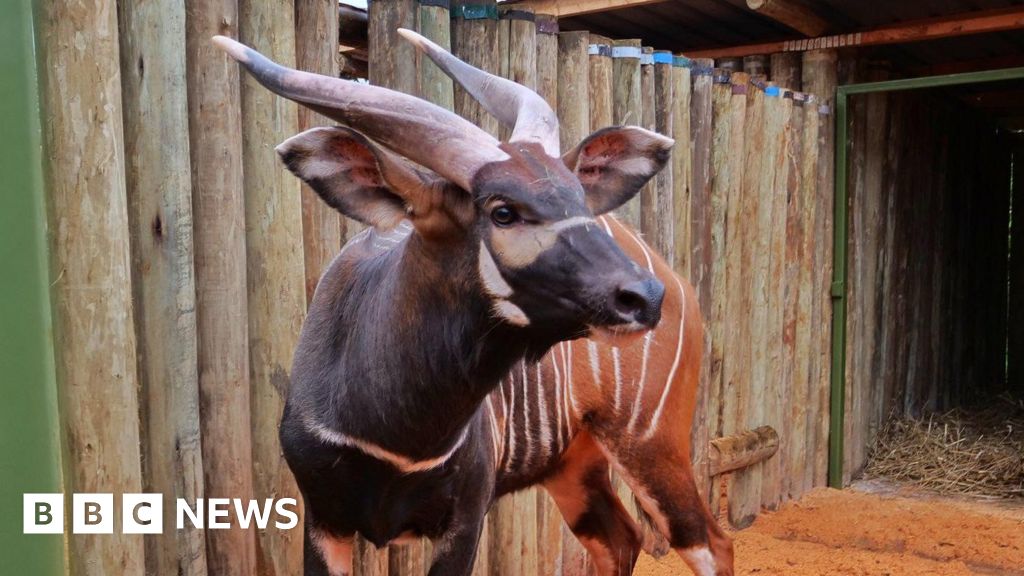
Four mountain bongos - a rare, chestnut-red antelope that looks like it was designed by a committee that really loved stripes and spirals - have finally touched down in Kenya after a journey from a zoo in the Czech Republic. The male antelopes landed at Nairobi's main airport on Tuesday night to a welcome party that included Kenya's foreign and tourism ministers, which is more government officials than most celebrity arrivals get.
The animals have since been moved to a private wildlife reserve in central Kenya, where the Kenya Wildlife Service (KWS) is calling the relocation a "historic homecoming" and a "meaningful step" toward the species' recovery in the wild. The math is grim: from about 500 mountain bongos in the 1970s, fewer than 100 are estimated to remain in the wild today - a number that is actually smaller than the population living in zoos worldwide. KWS director-general Erustus Kanga described the arrival as "a moment of hope, responsibility, and renewed commitment to securing the future of one of the world's rarest large mammals," which is a diplomatic way of saying, 'We really need to get these numbers up.'
Before the bongos can be released into the wild, they go through a series of adaptation phases to build the immunity needed to survive - because apparently the wild is not exactly a spa vacation. Prague Zoo, which sent the animals, said each bongo would undergo "acclimatisation and detailed monitoring" before being gradually integrated into the Mount Kenya Wildlife Conservancy's breeding programme. The goal: strengthen the population's genetic value, which is a fancy way of saying, 'Make more bongos, and make them tougher.'
This is not Kenya's first rodeo with bongo repatriation. Last year, about 17 mountain bongos were flown in from the Rare Species Conservation Foundation in Florida. The first repatriation was in 2004, when 18 mountain bongos arrived. According to that foundation, about 400 mountain bongos live in captivity in North America, with others scattered across European zoos. The KWS posted images of the newly arrived antelopes on Wednesday morning, noting they had reached the conservancy at the foot of Mount Kenya and were "now settling in under close care."
But not every bongo homecoming has been a fairy tale. In 2022, the conservancy told local media that some previously repatriated bongos had successfully integrated into the wild and started breeding - while others had died from tick-borne diseases. Because nature, as always, giveth and taketh away. Still, Kenya has an ambitious national recovery plan led by the KWS: raise the wild mountain bongo population to about 700 by 2050. That's a lot of bongos, but if anyone can pull it off, it's the species that has already survived being flown halfway around the world.
The Good Times
News in your inbox.
One sardonic roundup, delivered on your schedule. Free. Unsubscribe whenever your tolerance for wit runs out.
Already subscribed but we never reach your inbox? Check your spam folder and hit 'Not spam' (or 'Remove from spam') to bust us out of junk-mail purgatory. You'll be helping everyone else too.
Don't open any of our emails for a month and you'll be automatically removed from the mailing list.
Rewrite Article
Select parts to regenerate with a fresh AI pass. Translations will be updated automatically.
Generate AI Image
Creates a sardonic version of the article image using OpenAI.