
Ike Theriot has gone from setting up satellite transceivers in Iraq to helping humanity set foot on the Moon, proving that a career change can be as dramatic as a rocket launch. Theriot, who now serves as the Flight Operations Surface Testing lead in the Exploration Extravehicular Activity Operations Branch at NASA's Johnson Space Center, is the guy responsible for making sure that when astronauts do their moonwalk, they don't trip over their own feet - or worse, float away.
Theriot's job is to integrate flight operations testing across the Artemis program, ensuring that teams have the data, procedures, and experience to prepare astronauts for lunar life. He's currently transitioning from this role to focus on mission development, astronaut training, and mission execution for the next lunar landing. Because apparently, preparing for a moon landing isn't enough; you also have to plan for the actual landing.
He helps develop and execute simulated moonwalks at Johnson and at field locations across the U.S. and internationally. He also helped lead development of the Lunar Grid Reference System, a GPS-like system for the Moon that's now incorporated into flight control systems. Because if you're going to get lost, you might as well do it on a celestial body with no street signs.
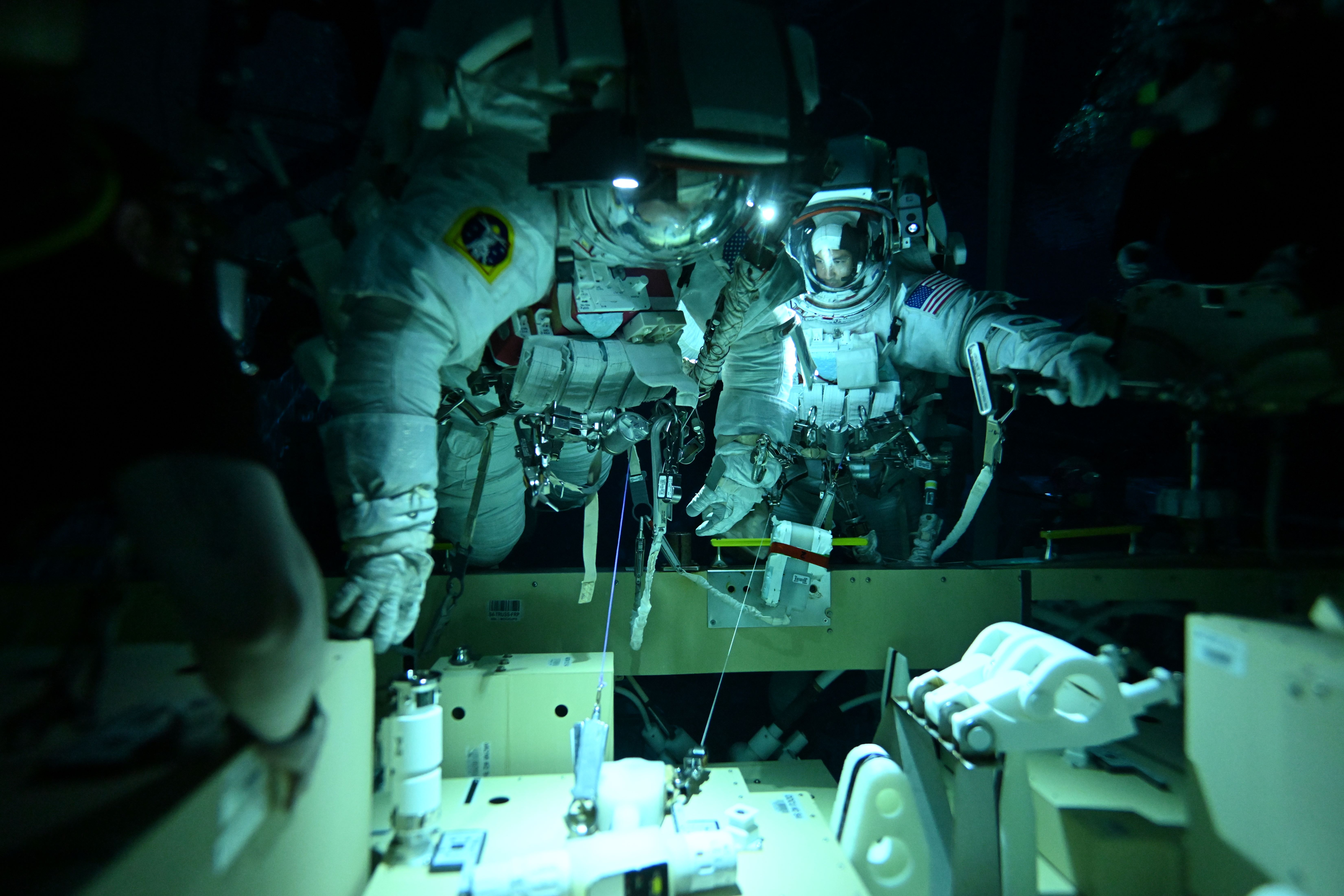
Theriot plans and executes testing in facilities like NASA's Neutral Buoyancy Laboratory, a 40-foot-deep pool that simulates microgravity, and the Space Vehicle Mockup Facility. He often serves as a suited test subject, which means he gets to wear a spacesuit and pretend he's on the Moon while actually being in a pool or a building in Houston. He also trains others to become test conductors and test leads, building the next generation of surface operations experts. It's like a relay race, but with spacesuits and a lot more paperwork.
In the Neutral Buoyancy Laboratory, Theriot has supported International Space Station spacewalk rehearsals and lunar surface testing, helping refine procedures for astronauts in orbit and on the Moon. He's also tested NASA's government reference exploration spacesuit design and Axiom Space's lunar spacesuit, the Axiom Extravehicular Mobility Unit (AxEMU). In the Active Response Gravity Offload System (ARGOS), which offloads body weight to simulate lunar gravity, he practiced geologic sampling operations in the AxEMU, examining a collected sample before stowing it. Because even on the Moon, you have to follow proper sample-handling protocols.
Theriot has also evaluated new lighting configurations during suited test runs, assessing how visibility affects safety and task execution in a simulated lunar environment. Because if you can't see the big rock you're about to trip over, that's a problem.
In addition to his lunar work, Theriot supports International Space Station spacewalks as a certified flight controller and was recently selected as a capsule communicator (capcom). He's begun simulation training for that role, where he'll be the voice between Mission Control and astronauts in low Earth orbit. So if you ever hear a calm voice saying "Don't worry, we've got this" during a spacewalk, that might be Theriot.
Theriot's work extends far beyond NASA facilities, into remote environments that mirror lunar surface operations. During a field campaign at Kamestastin Crater in Labrador, Canada, he trained alongside Artemis II crew members. The crater, formed approximately 36 million years ago, provides terrain similar to the Moon and is accessible only by boat. Because why make it easy? If you want to train for the Moon, you should have to take a boat to get there.
Theriot's interest in space began while deployed overseas with the Army. In Iraq, he was tasked with setting up a satellite transceiver that failed on first power-up. After observing technicians perform field repairs, he began taking online engineering courses in his spare time, studying orbital mechanics, circuit design, cryptography, and space power systems. Later, while deployed to Afghanistan, he spent evenings stargazing and tracking the space station as it passed overhead. Because when you're in a war zone, what better way to relax than to study orbital mechanics?
After leaving the Army, Theriot earned a mechanical engineering degree from the University of Houston and secured an internship at Johnson in 2016, rotating between engineering and flight operations teams. He accepted a full-time position in 2019, just as NASA announced plans to return astronauts to the Moon under the Artemis program. Talk about being in the right place at the right time.
His most valued achievements involve setting others up for growth and success. Several years ago, Theriot created a Field Navigation Exercise at Challenger 7 Memorial Park in Houston to strengthen lunar surface navigation skills. As surface operations planning accelerated, he recognized many had limited field experience. He built the exercise and mentored others to lead it. Because if you're going to navigate on the Moon, you should probably practice in a park first.
More recently, he served as test conductor for a major lunar spacesuit test series in the Neutral Buoyancy Laboratory, spending months refining procedures and coordinating teams. On one occasion, the 19th Field Navigation Exercise and a Neutral Buoyancy Laboratory test run occurred on the same day. Both were led by people he had trained. Theriot took the day off. Because when you've trained your successors well, you can kick back and let them do the work - or at least take a well-deserved break.
Over time, his perspective on leadership has evolved. Early in his career, he believed the hardest challenges were technical. Now, he believes the greater challenge is providing the leadership and guidance that enable technical work to succeed. Because anyone can fix a satellite transceiver, but it takes a real leader to train someone else to fix it while you watch.
For the mission to the Moon and beyond, Theriot hopes the agency demonstrates something larger than exploration alone. "Each day presents a new and interesting challenge, and I can feel myself growing to meet those challenges," he said. "Through the Artemis missions, like the Apollo missions, I hope we can all show the world that impossible things can happen." Indeed, if a former Army guy with a failed satellite transceiver can help put humans on the Moon, then maybe anything is possible - even getting your spacesuit to fit properly.