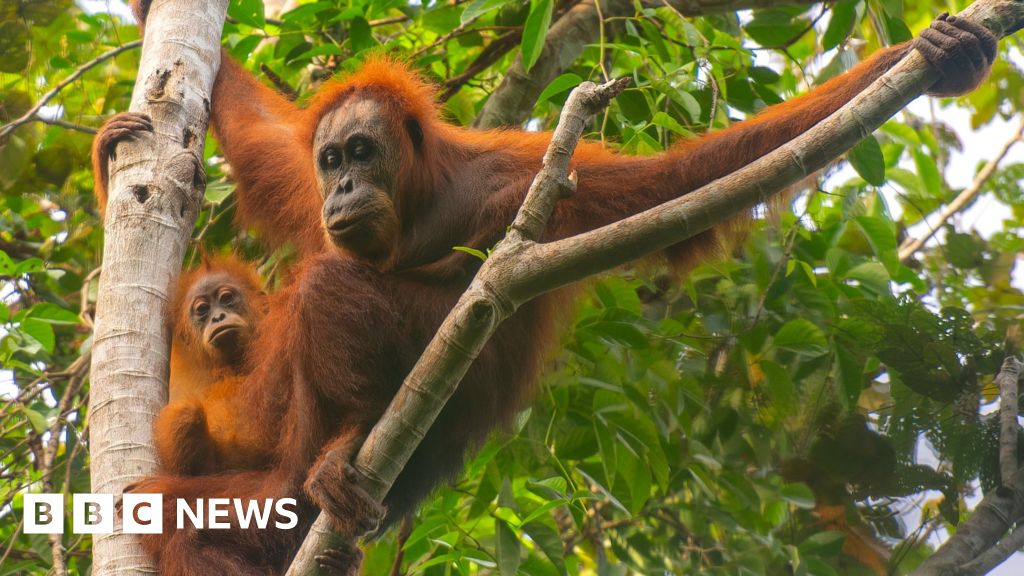
Four days of extreme rain and landslides in Sumatra have pushed the world's most endangered great apes even closer to the edge, according to a new study. Researchers estimate that 58 of fewer than 800 critically endangered Tapanuli orangutans - roughly 7% of the entire species - were killed during the extreme weather event last November. And those are the conservative numbers, not counting rain-induced canopy damage or reduced food availability, because why would you count everything.
Cyclone Senyar ravaged Sumatra in late November, killing more than 1,000 people in Southeast Asia's deadliest natural disaster of 2025. Wildlife experts initially suspected the orangutans had been swept away by floods and landslides after sightings dropped off. Professor Erik Meijaard, managing director of Borneo Futures and an author of the study published Wednesday, had told the BBC in December that the cyclone likely killed about 35 orangutans - a loss he called "a major blow." The comprehensive study now shows nearly double that number perished.
Weeks after the cyclone, humanitarian workers found what they believed to be a Tapanuli orangutan carcass semi-buried in mud and logs in Pulo Pakkat village. "I have seen several dead bodies of humans in the past few days but this was the first dead wildlife," said Deckey Chandra, who was working with a humanitarian team. "They used to come to this place to eat fruits. But now it seems to have become their graveyard." Meijaard saw photos of the carcass and noted the flesh had been ripped off the face. "If a few hectares of forest comes down in massive landslides, even powerful orangutans are helpless and just get mangled," he said. "It must have been hellish in the forest at the time."
Researchers noted Cyclone Senyar was an anomalous event, but human-induced climate change played a significant role, and such extreme rainfall is likely to continue. Studies show the species - only discovered in 2017 - will go extinct if it loses more than 1% of its population annually. "So, then to have an event where about 58 individuals are killed out of 580, that's about 10 to 11% of the population there and seven percent of the whole total population of the species," said Professor Sergei Vich, primatologist at Liverpool John Moore University and another study author. "That's way beyond these animals can withstand. So this is a huge event."
The Indonesian government has temporarily halted major developments in the Batong Toru protected forest - including mining, oil palm, and hydropower expansion - giving researchers a rare chance to assess ecological risks. The study authors warn the devastation proves how vulnerable the species is, calling for "a coordinated response matching the scale of the threat." To protect the remaining orangutans, they added, sustained international support is required. "Through strengthened domestic protection, climate-responsive planning, and global financial and technical assistance, we can still prevent the first modern extinction of a great ape species."
The Good Times
News in your inbox.
One sardonic roundup, delivered on your schedule. Free. Unsubscribe whenever your tolerance for wit runs out.
Already subscribed but we never reach your inbox? Check your spam folder and hit 'Not spam' (or 'Remove from spam') to bust us out of junk-mail purgatory. You'll be helping everyone else too.
Don't open any of our emails for a month and you'll be automatically removed from the mailing list.
Rewrite Article
Select parts to regenerate with a fresh AI pass. Translations will be updated automatically.
Generate AI Image
Creates a sardonic version of the article image using OpenAI.