
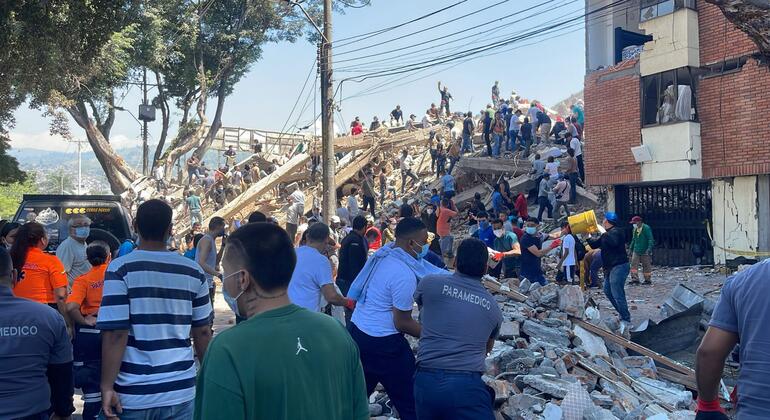
As rescue efforts continue across western Colombia following Monday's 7.4 magnitude earthquake, UN agencies are standing by with a familiar refrain: "we've got everything you need, just ask." The offer comes as official figures show at least 126 dead and 1,495 injured, with numbers expected to rise as crews sift through the rubble.
Jens Laerke, spokesperson for the UN aid coordination office (OCHA), rattled off a sobering inventory: nearly 5,000 homes damaged, 387 destroyed, 61 buildings collapsed, and over 550 educational institutions, 24 health facilities, and more than 350 community centres affected. "Those are official Government figures," he noted, "we know they are being updated as more information comes in."
UN teams are already on the ground, assessing the damage and prepping an emergency response meeting with the Government to figure out what help can be mobilized. María José Torres Macho, the UN Resident Coordinator in Colombia, is apparently eager to get the ball rolling.
The World Health Organization (WHO) chimed in, citing damage to 24 health facilities across six departments, with Valle del Cauca taking the hardest hit - particularly Cali. The Hospital Universitario del Valle lost part of a tower housing cardiology and paediatric services, and Clinica Nuestra was fully evacuated. WHO spokesperson Tarik Jasarevic confirmed that field teams have been deployed to Cali and Chocó to support health sector assessment and coordination.
The quake struck at 7:34am local time, with its epicentre near San José del Palmar in Chocó department, close to Valle del Cauca. The tremor rattled nerves across Colombia and beyond, with reports of shaking in Panama, Ecuador, and Venezuela. The Colombian Geological Service pegged the epicentre at a depth of about 103 kilometres (64 miles), making it the largest seismic event recorded in the country this century.
In Pereira, a city of around 500,000 located about 35 miles from the epicentre, the mayor reported 18 dead by late Monday as emergency teams hunted for survivors. Cali, the country's third largest city, saw multiple landslides with people trapped, prompting requests for rescue reinforcements.
Transport infrastructure took a hit too: six airports - Quibdó, Pereira, Manizales, Armenia, Cartago, and Buenaventura - were closed for inspections. Popayán airport in Cauca is operating with restrictions, though that's due to an unrelated alert about the possible eruption of the Puracé volcano. Because why not pile on another natural disaster.
The Government activated emergency coordination centres in Bogotá, Quibdó, Armenia, and Cali, and issued evacuation orders as far away as the capital, 250 miles east of the epicentre. Because nothing says 'safe' like evacuating a city that didn't feel the quake.
UNICEF is monitoring the situation, coordinating with partners to support affected children and adolescents. The UN Development Programme (UNDP) is working with government institutions to analyse damage and needs. And Miroslav Jenča, head of the UN Verification Mission in Colombia, expressed solidarity with victims, particularly in Chocó, Eje Cafetero, and Valle del Cauca, offering the Mission's support.
All in all, a textbook disaster response: assess, coordinate, and wait for the official request. The UN is ready, willing, and - most importantly - able. Now it's just a matter of paperwork.