Bumblebees Show Off Spontaneous Problem-Solving Skills, Because Why Not
Bumblebees, already known for their social skills, have now proven they can solve puzzles on their own - no training required, just a sugary reward and a can-do attitude.
Bumblebees, those tiny buzzing overachievers, have now added "spontaneous problem-solving" to their résumé, according to a new paper in Science. Researchers at the University of Finland found that bees can figure out object-manipulation tasks without any prior training - a cognitive feat previously thought to require a larger brain, like the kind humans use to complain about traffic.
The study, led by Olli Loukola, follows up on 2024 research that showed bees cooperating on puzzles, a behavior once believed to be exclusive to big-brained mammals like us and chimpanzees. That earlier work trained pairs of bees to push a Lego block or open a door for a reward. Now, Loukola wanted to see if bees could solve problems on their own, no training wheels required.
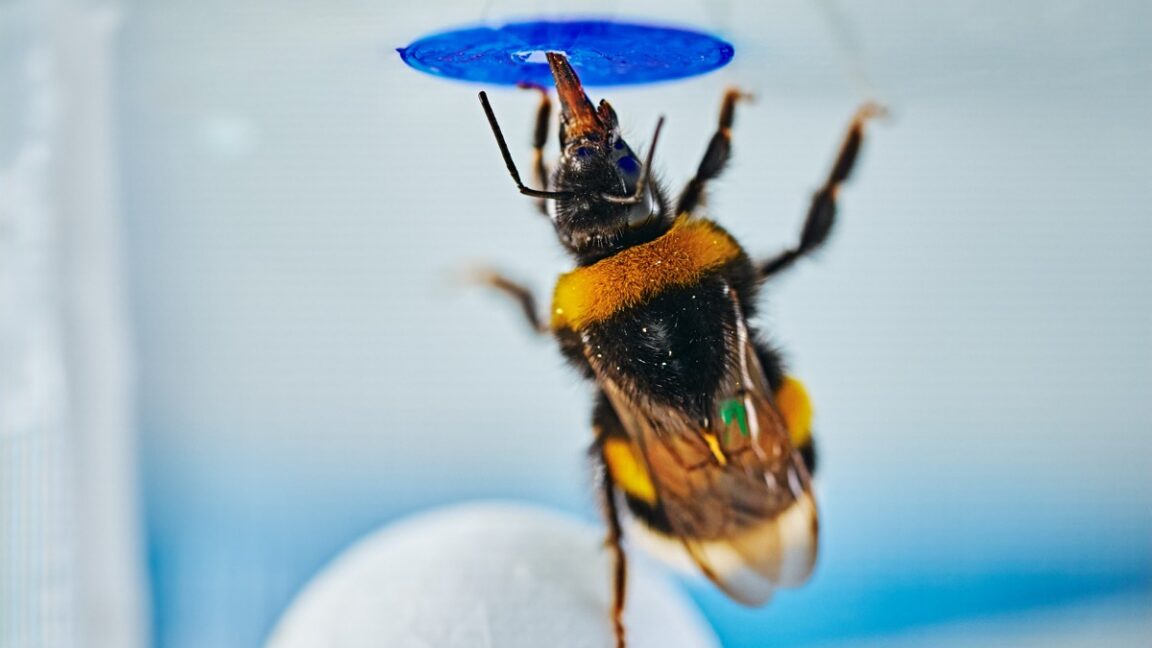
In the first experiment, an artificial flower sat above a pit, too high for a bee to reach by hovering. The solution? Roll a small ball into the pit and stand on it - an insect version of the classic "box-and-banana" puzzle. Bees were divided into three groups: one that learned the flower was rewarding and that the ball was movable (but not how to use it), one that only learned about the flower, and one that learned nothing at all. The first group solved the puzzle at a much higher rate than the other two, and they also interacted with the ball more efficiently and made more attempts. Clearly, they were motivated.
But the team wasn't satisfied. They wanted to rule out the possibility that bees just like rolling balls for the fun of it. So they repeated the experiment with a barrier blocking the view of the flower. The bees had to roll the ball through an opening to reach the flower. This time, 16 of 22 bees succeeded - not bad for creatures with brains the size of a sesame seed. To further reduce visual feedback, the team added three openings in the barrier, and this time there was no significant difference between trained and untrained bees. The mystery deepens.
Finally, the researchers designed an experiment to isolate goal-directed behavior from accidental success. In a rectangular arena with two hidden compartments, bees had to move a ball into the correct one to reach a flower. Of 30 bees, 23 succeeded, and 16 of those did so without first trying the wrong compartment. That's some impressive spatial reasoning.
The authors acknowledge they couldn't track the bees' gaze or posture to pinpoint the exact "Eureka!" moment, but they argue their design provides the clearest evidence yet that bumblebees can generate novel, goal-directed solutions. Future studies will dig deeper into the cognitive processes behind insect insight - because apparently, bees are about to take over the job market too.
The Good Times
News in your inbox.
One sardonic roundup, delivered on your schedule. Free. Unsubscribe whenever your tolerance for wit runs out.
Already subscribed but we never reach your inbox? Check your spam folder and hit 'Not spam' (or 'Remove from spam') to bust us out of junk-mail purgatory. You'll be helping everyone else too.
Don't open any of our emails for a month and you'll be automatically removed from the mailing list.
Rewrite Article
Select parts to regenerate with a fresh AI pass. Translations will be updated automatically.
Generate AI Image
Creates a sardonic version of the article image using OpenAI.