Ancient Bug With Crab Claws Joins Elite 'Hey, I'm a Bug With Crab Claws' Club
A 100-million-year-old bug with crab-like claws joins the exclusive 'four insect groups ever to evolve these things' club, and scientists named it after Stray Kids.
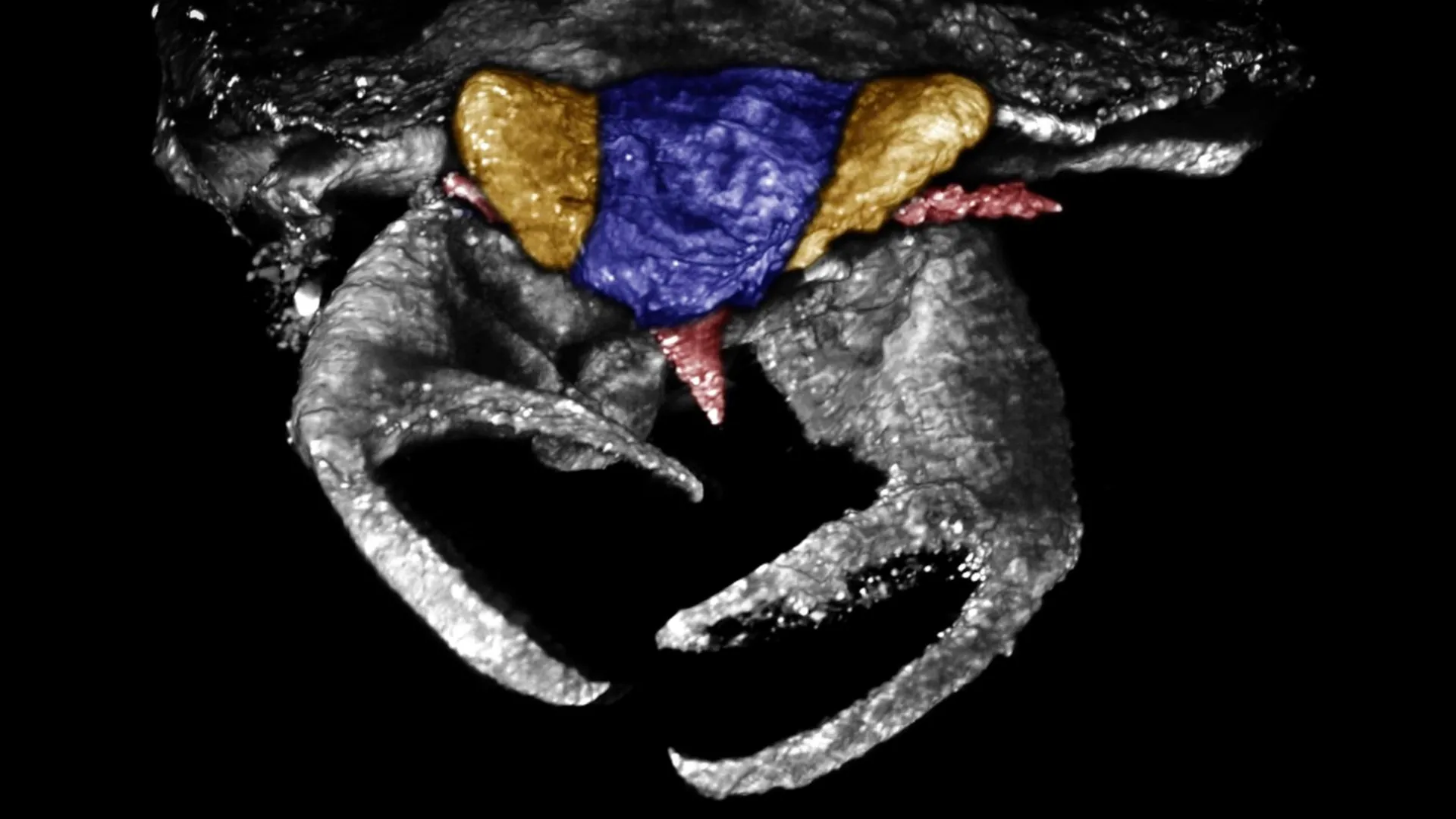
Amber from Myanmar's Kachin region, already the MVP of Cretaceous-era nature documentaries, has coughed up another weirdo: a 100-million-year-old true bug (Heteroptera) that apparently looked at crabs and thought, "Yeah, I could pull that off." Its front legs ended in large claw-like structures called chelae - basically nature's forceps - which are about as common in insects as a polite Twitter thread.
Researchers at Ludwig Maximilian University of Munich (LMU), joined by colleagues from the University of Rostock and the University of Oulu in Finland, used micro-computed tomography to create highly detailed 3D images of the fossil. Their findings were published in the journal Insects. "Previously, such chelae were known from only three insect groups. This fossil therefore represents the fourth known case of these structures evolving independently in insects," explains Privatdozent Carolin Haug, a zoologist at LMU's Faculty of Biology, sounding slightly impressed.
The team performed a large morphological comparison involving more than 2,000 chelae and similar grasping appendages from both living and extinct species. The analysis showed the bug's claws more closely resembled those of decapods (crabs, lobsters, shrimps) and tanaids than any other insect. Because of its highly unusual anatomy, the insect was assigned to a new genus: Carcinonepa - a mashup of the Latinized Greek for "crab" (carcino-) and nepa, referencing the true water bug group Nepomorpha. The species name? Carcinonepa libererrantes. That's a Latinization of the highly successful K-pop group Stray Kids. "The name seemed fitting because the posture of the fossil's chelae strongly resembles the group's trademark pose," says Carolin Haug. "Stray Kids, I should add, is the favorite band of one of the paper's authors, Fenja Haug." Science: still finding ways to name things after pop culture.
Based on preserved physical traits, the researchers classified C. libererrantes as part of the true water bugs (Nepomorpha) within the broader true bug group (Heteroptera). Its body shares similarities with modern Gelastocoridae, or toad bugs, which are land-dwelling predators. "The morphology of C. libererrantes suggests that this species had a similar lifestyle," observes Carolin Haug. "We can imagine it living in a Cretaceous forest, probably near the coast." Researchers believe the oversized chelae on its front legs were likely used to seize and hold small insect prey as it hunted through the ancient coastal environment. So basically, it was a tiny, crab-armed predator that predated the K-pop fandom it was named after by about 100 million years.
The Good Times
News in your inbox.
One sardonic roundup, delivered on your schedule. Free. Unsubscribe whenever your tolerance for wit runs out.
Already subscribed but we never reach your inbox? Check your spam folder and hit 'Not spam' (or 'Remove from spam') to bust us out of junk-mail purgatory. You'll be helping everyone else too.
Don't open any of our emails for a month and you'll be automatically removed from the mailing list.
Rewrite Article
Select parts to regenerate with a fresh AI pass. Translations will be updated automatically.
Generate AI Image
Creates a sardonic version of the article image using OpenAI.