
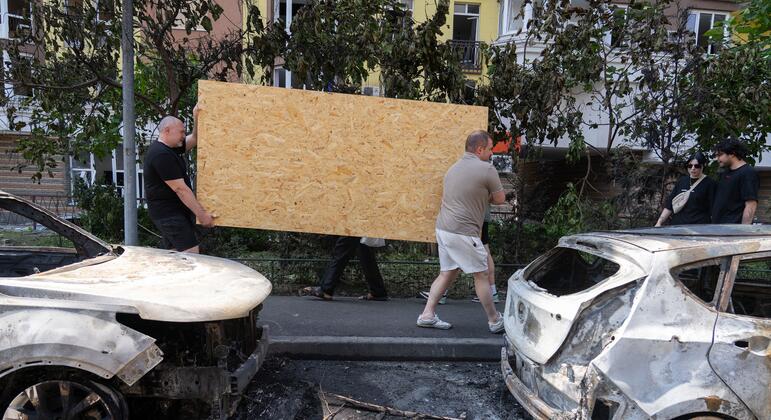
In classrooms, maternity wards, hospital corridors, and local communities across Ukraine, people are doing the deeply human thing: rebuilding their lives while a war rages on around them. It's almost as if they've decided that the best response to chaos is a stubborn commitment to normalcy.
Take the frontline village of Bezruky in the Kharkiv region, a mere half-hour drive from the Russian border. The local school took a direct hit early in the war and shut its doors, with tanks rolling by close enough to hear - not exactly the soundtrack for learning. But rebuilt windows and a reinforced structure brought it back, and the basement transformed into something unexpected: first a shelter, then an art gallery. Because nothing says 'we refuse to be intimidated' like turning a bomb shelter into a cultural venue.
Thanks to a project run by the UN's field agency for infrastructure and building projects (UNOPS) with European Union funding, more than 15,000 children in the region are back in classrooms. That's a lot of kids who might otherwise be missing out on the joys of algebra and history.
Teacher Yurii Tkalenko, who has spent 20 years in Cherkasy region classrooms, joined a training programme in 2025 built around the New Ukrainian School reform. 'Learning never stops,' he says, which is either profound or slightly ominous. The programme, run by education and culture agency UNESCO, funded by the Global Partnership for Education, and backed by Ukraine's education ministry, focuses on adapting education to children's needs. Revolutionary concept.
For Anastasiia, from the Donetsk region, having a baby meant leaving home for a protected maternity ward in Kharkiv, where she gave birth to twin boys. 'I was afraid to give birth. But life goes on,' she says, proving that even in wartime, the stork finds a way. The UN's sexual and reproductive health agency UNFPA, working with the EU, backs maternity units like hers across the frontline - because babies don't wait for ceasefires.
Childcare is often the deciding factor in whether a mother can work at all. The ILO's Nanny School has trained 80 women to care for children aged nought to three, and nearly half found jobs soon after certifying. It's a small programme, but one built to expand, moving women out of informal work and into something steadier - like a real job with a real paycheck.
In Kryvyi Rih, Oksana now drives one of the city's longest bus routes, after training through UN Women's She Drives project. She had worked as a cargo clerk and doubted she'd even pass selection. 'For many passengers, it's still unusual to see a woman driving a bus, but their gratitude motivates me,' she says. 'If you want to do something, don't be afraid to try. I wanted to change my life, and I did.' We suspect she's also a fan of the 'lean in' philosophy.
In Zaporizhzhia, hospital director Hanna Makarenkova has spent the war treating blast injuries and receiving evacuees from Mariupol - more than 25,000 patients since the full-scale invasion began, often through bombardment and blackout. 'My colleagues give me the strength to keep working,' she says, which is a nice way of saying 'we're all in this together, and someone has to keep the lights on.' New independent power units, funded by the EU and installed by UNDP, now keep her equipment running when the grid fails - because nothing says 'modern medicine' like a backup generator.
In Kostiantynivka, Oleksandr lost both legs and an eye in a drone strike. His wife, Nataliia, has spent three months at his side through surgery and relearning - how to balance, how to move into a wheelchair, with a physical therapist named Illia. 'Movement is life,' she says, which is both a cliché and a profound truth. Then, of the road ahead: 'I think everything will be alright for us. We'll live and enjoy life. Because life goes on.' The UN's World Health Organization (WHO), funded by the EU, has now trained more than 300 rehabilitation specialists across Ukraine to fit and adjust wheelchairs, nine of them now training others in turn. That's the kind of exponential growth we can get behind.
None of this undoes what the war has taken. But it is what rebuilding looks like up close - a mosaic of small victories, stubbornness, and an unshakeable belief that life, indeed, goes on.