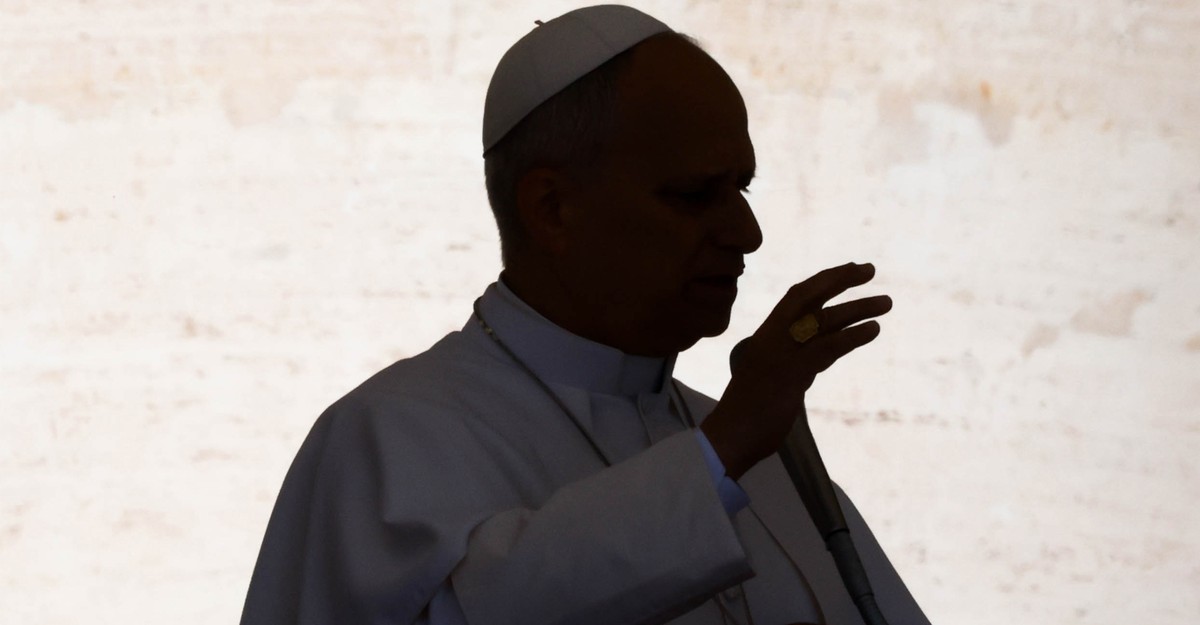
Pope Drops Encyclical on AI, Reveals Humans Are Also the Problem
Pope Leo XIV’s new encyclical on AI is a hit, but the real target isn’t just Big Tech - it’s everyone who enjoys modern convenience without asking who got crushed for the rare earth metals.
Pope Leo XIV’s new encyclical, Magnifica Humanitas, has earned widespread praise for taking on artificial intelligence and the tech titans who build it. And that’s great - everyone loves a good papal smackdown of an unpopular industry. But if you think the document is just about scolding Silicon Valley, you’ve missed the part where he’s also scolding you.
The encyclical, subtitled “on safeguarding the human person in the time of artificial intelligence,” does indeed spend ample time roasting AI and its creators. Leo declares that AI “must be disarmed” and prevented “from dominating humanity.” He calls for “adequate regulatory tools” to curb the distorting effects of tech on work, discourse, and international affairs. He even notes the “energy-intensive infrastructure” of AI and demands “more sustainable technological solutions” to protect our common home. There’s also a pointed jab at the “impunity” enjoyed by AI developers thanks to their extraordinary resources.
But Leo doesn’t stop there. He turns the mirror on the comfortable, stable readers of his encyclical - the ones who see themselves as victims of technology. “Technology promises emancipation” for the secure, he writes, but this “produces new forms of global subordination” for the precarious. In other words, your seamless digital life is built on the backs of people “working under demanding conditions for minimal wages,” including children and adolescents “crushing the materials from which rare earth elements are extracted” in dangerous conditions. Leo calls this a form of slavery, and notes that the beneficiaries include much of his audience.
The pope argues that AI hasn’t created this mess; it has simply accelerated a preexisting situation where human affairs are governed by technology, economics, and unconstrained individualism. “We live at a time of significant spiritual and cultural blindness,” he writes, thanks in part to “a disconcerting loss of historical memory.” Humanity, not technology, is responsible for the polycrisis, and humanity is responsible for fixing it.
Leo’s answer to the digital age’s signal question - What does it mean to be human? - is grounded in the incarnation: God became human in Jesus Christ, endowing humanity with the highest possible meaning. To nonbelievers, the Jesus-and-Mary stuff may seem ridiculous. But Leo insists that only this conviction can justify the claim that “no computational system, however sophisticated, can create a heart that gives itself, or a conscience that discerns good from evil.” Whether you buy the theology or not, the encyclical reveals what’s at stake when fewer and fewer people believe that humanity is worth more than its machines.
The Good Times
News in your inbox.
One sardonic roundup, delivered on your schedule. Free. Unsubscribe whenever your tolerance for wit runs out.
Already subscribed but we never reach your inbox? Check your spam folder and hit 'Not spam' (or 'Remove from spam') to bust us out of junk-mail purgatory. You'll be helping everyone else too.
Don't open any of our emails for a month and you'll be automatically removed from the mailing list.
Rewrite Article
Select parts to regenerate with a fresh AI pass. Translations will be updated automatically.
Generate AI Image
Creates a sardonic version of the article image using OpenAI.