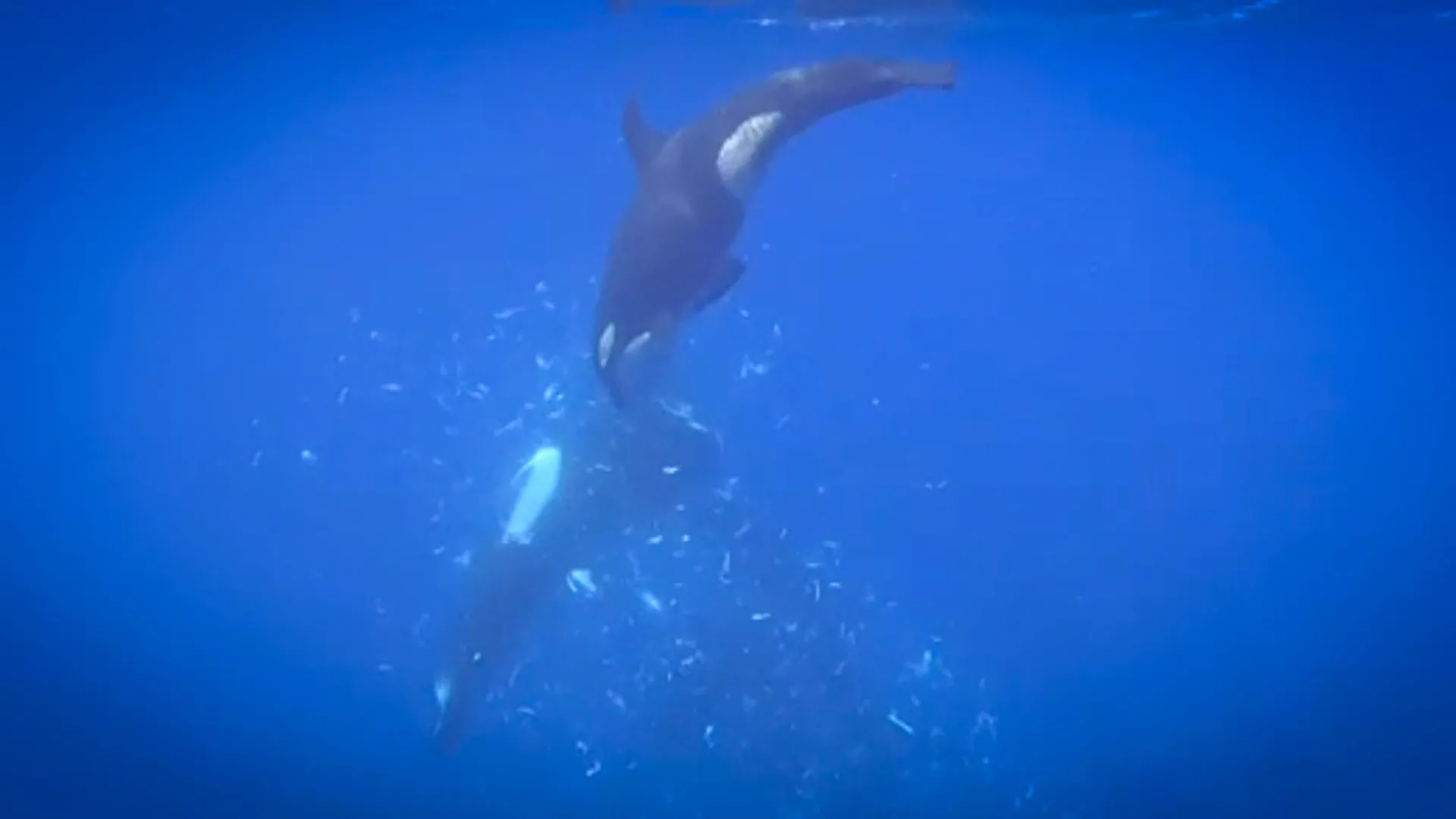
Orcas Invent New Way to Turn Giant Sunfish Into Confetti, Scientists Say
Orcas in the Gulf of California have been filmed using a coordinated ramming technique to smash giant sunfish into pieces, possibly to make feeding easier for juveniles or just for kicks.
Orcas, already renowned for their intelligence and coordinated hunting, have added a new trick to their repertoire: using each other as battering rams to smash giant sunfish into thousands of pieces. Researchers in the Gulf of California have formally documented this behavior for the first time in a study published in Frontiers in Ethology.
"We document how one orca holds the sunfish and lets go just before another orca hits it at high speed, causing the tissue to break apart into thousands of pieces," said Dr. Kathryn Ayres of Beneath The Waves, a nonprofit promoting ocean health. She added that this may help younger orcas feed more easily - or could just be for fun, since orcas are known to play with their food.
Sunfish can exceed three meters in length and weigh up to 2,000 kg, but their habit of lounging at the surface makes them vulnerable. The behavior was observed twice, in July 2024 and September 2025. In the first event, a female orca gripped a dead sharp-tail sunfish by its tail fin, while a male charged and struck it after she released it. The collision fragmented the fish into pieces, which a juvenile ate while adults consumed the rest.
Researchers say ramming hasn't been documented before as a predation strategy. Since the sunfish were already dead, the impacts were likely for processing, not killing. The fragmentation may also spread microbial taxa from the sunfish's gelatinous outer layer into the water, potentially offering nutritional or immune benefits to the orcas.
Ayres noted that this might be a form of parental investment, making food easier for calves. But social play isn't ruled out. So far, only sharp-tail sunfish have been observed breaking apart this way - other species may not shatter as easily. More footage is needed to identify individual orcas, as "we are still seeing new techniques of how orcas hunt and process their prey," Ayres said.
The Good Times
News in your inbox.
One sardonic roundup, delivered on your schedule. Free. Unsubscribe whenever your tolerance for wit runs out.
Already subscribed but we never reach your inbox? Check your spam folder and hit 'Not spam' (or 'Remove from spam') to bust us out of junk-mail purgatory. You'll be helping everyone else too.
Don't open any of our emails for a month and you'll be automatically removed from the mailing list.
Rewrite Article
Select parts to regenerate with a fresh AI pass. Translations will be updated automatically.
Generate AI Image
Creates a sardonic version of the article image using OpenAI.