Nuclear Test Survivors to World Leaders: 'Every Step Towards Disarmament Matters,' Even the Tiny Ones
Nuclear test survivors walk the halls of the UN, reminding everyone that disarmament is a step-by-step process - and that the alternative is, well, not great.
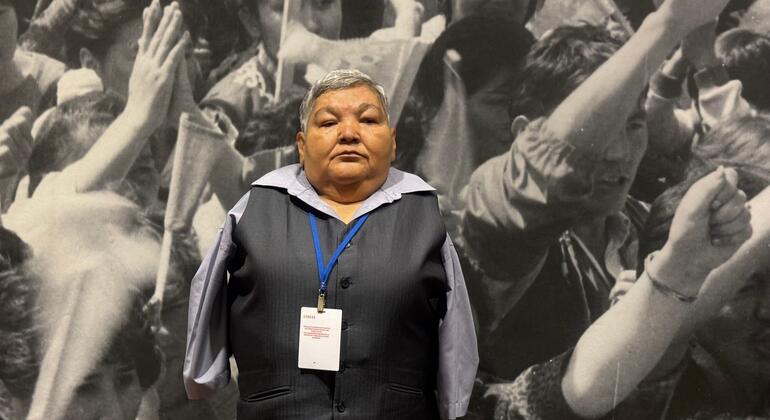
NEW YORK - Karipbek Kuyukov was born without arms, a rather direct consequence of the 456 nuclear tests conducted at the Semipalatinsk test site in Kazakhstan between 1949 and 1989. On Monday, he walked through the halls of UN Headquarters, carrying a message he's spent his life delivering: maybe don't do that again.
Mr. Kuyukov, who paints by holding a brush with his lips and toes, joined diplomats, scientists, and fellow survivors in a symbolic walk ahead of the General Assembly's high-level meeting for the International Day against Nuclear Tests, observed annually on 29 August. The procession, part of the #StepUp4Disarmament campaign, ended in front of a photograph of people demanding the closure of the Semipalatinsk site.
“I would like to tell our story, the story of Kazakhstan,” Mr. Kuyukov told UN News. His parents were living witnesses to the tests, and as a result, he was born without arms. He was 20 when Kazakh poet Olzhas Suleimenov launched the Nevada-Semipalatinsk anti-nuclear movement. “The entire nation rose up against this monster,” he recalled.
The movement reached far beyond Kazakhstan. Mr. Kuyukov remembered standing alongside a chief of the Shoshone people, whose lands lay near the US test site in Nevada, and joining rallies with activists from French Polynesia (where France tested at Mururoa Atoll) and Japan.
On 29 August 1991, the Semipalatinsk site was shut down - a date the General Assembly later proclaimed as the International Day against Nuclear Tests, at Kazakhstan's initiative. This year marks 35 years since the closure. “I can say with pride that my country, Kazakhstan, began its path to sovereignty precisely with that peaceful decision,” Mr. Kuyukov said, adding it “can serve as a worthy example for other countries.”
UN High Representative for Disarmament Affairs Izumi Nakamitsu said the silence that fell upon Semipalatinsk 35 years ago “did not happen by chance.” It was achieved through the determination of people, communities, and leaders who rejected nuclear testing. Kazakhstan's Permanent Representative to the UN, Kairat Umarov, called the walk “a very simple but very powerful way to remind us that every step towards disarmament matters.”
This year also marks the 30th anniversary of the opening for signature of the Comprehensive Nuclear-Test-Ban Treaty (CTBT). Robert Floyd, Executive Secretary of the CTBT Organization, told young participants that disarmament is “a journey that works across generations.” He assured them that the day will come when their generation will lead, make decisions, and be in the boardrooms and assembly halls - and that the current generation will be cheering them on.
Ms. Nakamitsu later warned that concerns about a possible resumption of nuclear explosive testing have re-emerged amid deep geopolitical tension. She recalled the Secretary-General's message: “the world must never witness another nuclear explosion.” General Assembly President Annalena Baerbock stressed that the consequences of nuclear explosions know no borders. “In an interconnected world such as ours, there is no truly 'remote region' immune from the effects or dangers of nuclear testing,” she said.
Tina Cordova, a fourth-generation survivor of the 1945 Trinity test in New Mexico, also joined the walk. “We were the first people exposed to radiation anyplace in the world as ash fell from the sky in the days after the bomb,” she told the Assembly, describing five generations of cancer in her family. “We were never warned before or after of the danger, so we lived our lives off the land as we always did.” She appealed to delegates, saying that “after 81 years, it is time we set our families, our children and grandchildren free from nuclear threat.”
For Mr. Kuyukov, the fight is now about those who come next. Seeing young people join movements against nuclear weapons reminds him that “in war, it is innocent children who suffer first.” “The future is in their hands,” he said. “They, too, must secure a safe world for the next generation. We have experience and we can share it because we know how this is done.”
Asked what he would say to world leaders at a time when the situation is dangerously tense, the artist called for reconciliation. “To reach a new world - one of kindness, mercy and compassion - we need to let go of old grievances and past mistakes and leave them in history,” he stressed. “Now, we can only move forward together, showing the way to the new generation.”
The Good Times
News in your inbox.
One sardonic roundup, delivered on your schedule. Free. Unsubscribe whenever your tolerance for wit runs out.
Already subscribed but we never reach your inbox? Check your spam folder and hit 'Not spam' (or 'Remove from spam') to bust us out of junk-mail purgatory. You'll be helping everyone else too.
Don't open any of our emails for a month and you'll be automatically removed from the mailing list.
Rewrite Article
Select parts to regenerate with a fresh AI pass. Translations will be updated automatically.
Generate AI Image
Creates a sardonic version of the article image using OpenAI.