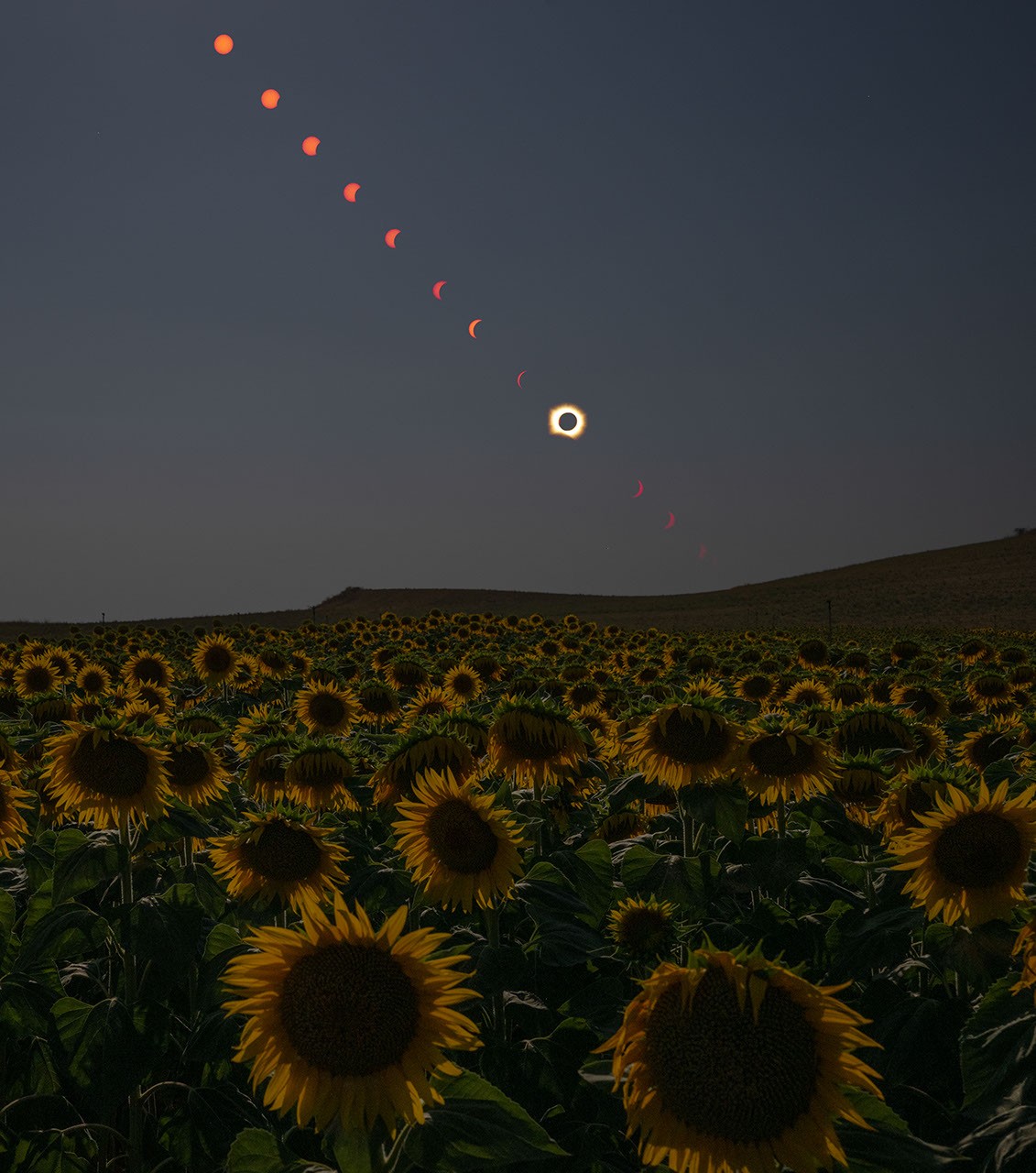
On Aug. 12, a total solar eclipse darkened skies over Greenland, Iceland, and Spain, giving those in the path of totality a rare glimpse of the Sun's wispy outer atmosphere, the corona - provided, of course, the weather cooperated. Because nothing says 'once-in-a-lifetime cosmic event' like a stubborn cloud bank.
NASA, ever the overachiever, dispatched researchers and photographers along the eclipse path to study the corona, capture the phenomenon, and observe how the eclipse affected our planet. One photographer in Spain managed to capture the total eclipse and its partial phases, right up until the Sun set - presumably to a standing ovation.
Meanwhile, in northern Maine, where the eclipse was merely partial (because the universe has favorites), another photographer caught the International Space Station, with its crew of seven, zipping past the partially eclipsed Sun. From about 250 miles above, an astronaut aboard the ISS also snapped a few shots, because why not add a third perspective to the mix?
Not to be outdone, NASA pilots flew the WB-57F research jet at 50,000 feet, chasing the eclipse's shadow to extend their viewing time. The jet carried a suite of cameras that captured high-resolution images of the corona and prominences - plumes of electrically charged gas rising off the Sun - in multiple wavelengths. Because ground-level photos are so last century.
In Iceland and Spain, student teams from the NASA-funded Nationwide Eclipse Ballooning Project launched scientific balloons to capture the eclipse's shadow and study its atmospheric effects. Even when clouds obscured the ground view in Iceland, the balloons soldiered on, gathering data on how the brief loss of light and heat affected the lower atmosphere. Weather may ruin your picnic, but it won't stop science.
And before the eclipse even happened, scientists at Predictive Science Inc., backed by NASA grants and supercomputers, used solar observations from NASA spacecraft and ground-based telescopes to predict the corona's appearance. Their prediction was compared to a composite image from the NASA-supported DEB Initiative project near León, Spain. Because why wait for the event to know what it'll look like?
The Good Times
News in your inbox.
One sardonic roundup, delivered on your schedule. Free. Unsubscribe whenever your tolerance for wit runs out.
Already subscribed but we never reach your inbox? Check your spam folder and hit 'Not spam' (or 'Remove from spam') to bust us out of junk-mail purgatory. You'll be helping everyone else too.
Don't open any of our emails for a month and you'll be automatically removed from the mailing list.
Rewrite Article
Select parts to regenerate with a fresh AI pass. Translations will be updated automatically.
Generate AI Image
Creates a sardonic version of the article image using OpenAI.