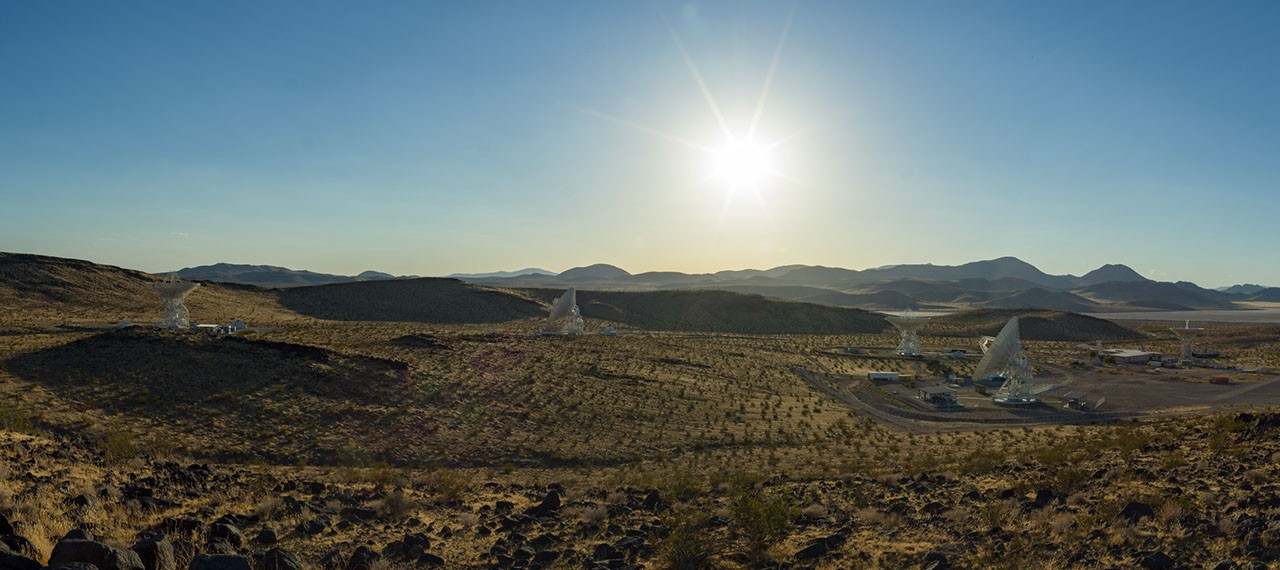
In a move that will surely delight anyone who has ever tried to get a signal on Mars, NASA has officially added a sixth antenna to its Deep Space Network's Goldstone complex near Barstow, California. The new 34-meter (114-foot) beam-waveguide antenna, dubbed Deep Space Station 23 (DSS-23), was unveiled with a ceremonial ribbon-cutting on Aug. 25, 2026, attended by NASA leadership, personnel, and the usual cadre of dignitaries.
The summer sun in August 2026 apparently provided the perfect backdrop for the celebration, as the five other antennas at the site soaked up the rays. In the foreground, DSS-23 stands proudly to the right, while to the left, three of its siblings - DSS-26, DSS-25, and DSS-24 - look on with what we can only assume is a mix of pride and jealousy. At the far right, a retired 26-meter (85-foot) antenna, built in 1967 for the Manned Space Flight Network, serves as a nostalgic reminder of the Apollo Program, earning its nickname "Apollo Antenna" for its role in tracking those historic missions.
DSS-23 is the latest addition to the Deep Space Network's Aperture Enhancement Project, which started back in 2009 with the ambitious goal of adding six new 34-meter multifrequency beam-waveguide antennas. These versatile dishes can support multiple missions operating on different radio frequencies, meaning they're the Swiss Army knives of deep-space communication. Or, if you prefer, the multi-tools of interplanetary chatter.
The Deep Space Network, managed by NASA's Jet Propulsion Laboratory in Southern California (a division of Caltech, for the pedants among us), is the backbone of space communication. It allows missions to track their spacecraft, send commands, and receive precious scientific data from the far reaches of the solar system. Without it, we'd be shouting into the void and hoping for the best.
For those who want to learn more about the DSN, NASA has thoughtfully provided a website: https://www.nasa.gov/communicating-with-missions/dsn/. Because of course they have.
The Good Times
News in your inbox.
One sardonic roundup, delivered on your schedule. Free. Unsubscribe whenever your tolerance for wit runs out.
Already subscribed but we never reach your inbox? Check your spam folder and hit 'Not spam' (or 'Remove from spam') to bust us out of junk-mail purgatory. You'll be helping everyone else too.
Don't open any of our emails for a month and you'll be automatically removed from the mailing list.
Rewrite Article
Select parts to regenerate with a fresh AI pass. Translations will be updated automatically.
Generate AI Image
Creates a sardonic version of the article image using OpenAI.