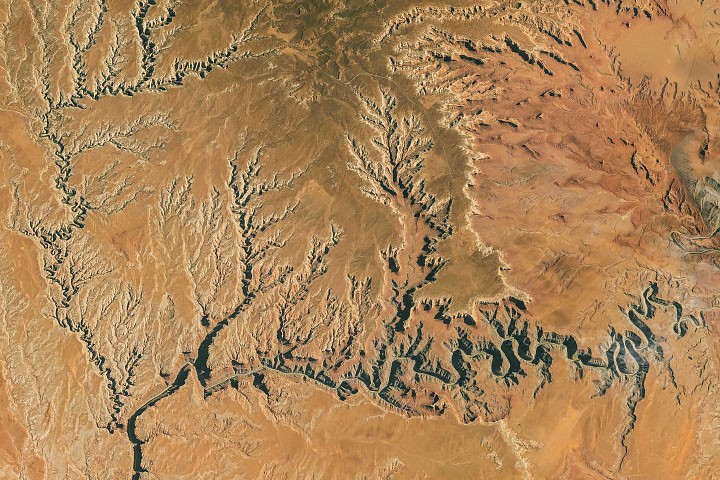
Tens of millions of years ago, the San Juan River in what is now southern Utah had a lot in common with today's Mississippi River: a leisurely, meandering flow across a relatively flat plain formed in an ancient marine environment. Unencumbered by rugged terrain, it took the scenic route downslope, as rivers are wont to do when nobody's around to tell them to hurry up.
Then the Colorado Plateau had to go and ruin it. Geologic forces pushed the plateau upward, and somewhere in the later stages of this "still-enigmatic" history - starting around 20 million years ago - the rise elevated the San Juan's headwaters, steepening the river's gradient and speeding its flow. The water's erosive power intensified, and the river began carving its winding path deeper and deeper through 300-million-year-old rock. Nature's remodeling project, still very much ongoing.
Today, on its westward journey to Lake Powell, the San Juan flows through a striking series of entrenched meanders known as "goosenecks." An astronaut aboard the International Space Station photographed the stark desert topography on October 6, 2026, presumably pausing from important orbital duties to admire Utah's commitment to dramatic geology.
In Utah's Goosenecks State Park, the river runs through a canyon 1,000 feet (300 meters) deep. In places it nearly loops back on itself in horseshoe-shaped bends - one section is so curvy that the river travels 5.5 miles (8.9 kilometers) between two points that are only 1.3 miles (2.1 kilometers) apart as the crow - nay, goose - flies. It's the geologic equivalent of taking the long way to the kitchen.
By day, the goosenecks are an unusual geologic wonder. By night, the area's dark skies take over as the spectacle. The park's remote, high-desert location and 360-degree views of the sky earned it an International Dark Sky Park designation in 2021. According to DarkSky International, features like the Double Cluster in Perseus and the Messier 24 star cloud in the Sagittarius spiral arm of the Milky Way are visible to the unaided eye from the park. In November 2026, dark skies offer the chance to catch several meteor showers, with the Northern Taurids, Southern Taurids, and Leonids reaching their peaks throughout the month.
The astronaut photograph ISS075-E-188830 was acquired on October 6, 2026, with a Nikon Z9 digital camera using a focal length of 400 millimeters. It is provided by the ISS Crew Earth Observations Facility and the Earth Science and Remote Sensing Unit at NASA Johnson Space Center, and was taken by a member of the Expedition 75 crew. The image has been cropped and enhanced to improve contrast, and lens artifacts have been removed. The International Space Station Program supports the laboratory as part of the ISS National Lab to help astronauts take pictures of Earth of the greatest value to scientists and the public, and to make those images freely available on the internet. Additional images taken by astronauts and cosmonauts can be viewed at the NASA/JSC Gateway to Astronaut Photography of Earth. Photo by Bob Wick (BLM), via Flickr. Story by Lindsey Doermann.
The Good Times
News in your inbox.
One sardonic roundup, delivered on your schedule. Free. Unsubscribe whenever your tolerance for wit runs out.
Already subscribed but we never reach your inbox? Check your spam folder and hit 'Not spam' (or 'Remove from spam') to bust us out of junk-mail purgatory. You'll be helping everyone else too.
Don't open any of our emails for a month and you'll be automatically removed from the mailing list.
Rewrite Article
Select parts to regenerate with a fresh AI pass. Translations will be updated automatically.
Generate AI Image
Creates a sardonic version of the article image using OpenAI.