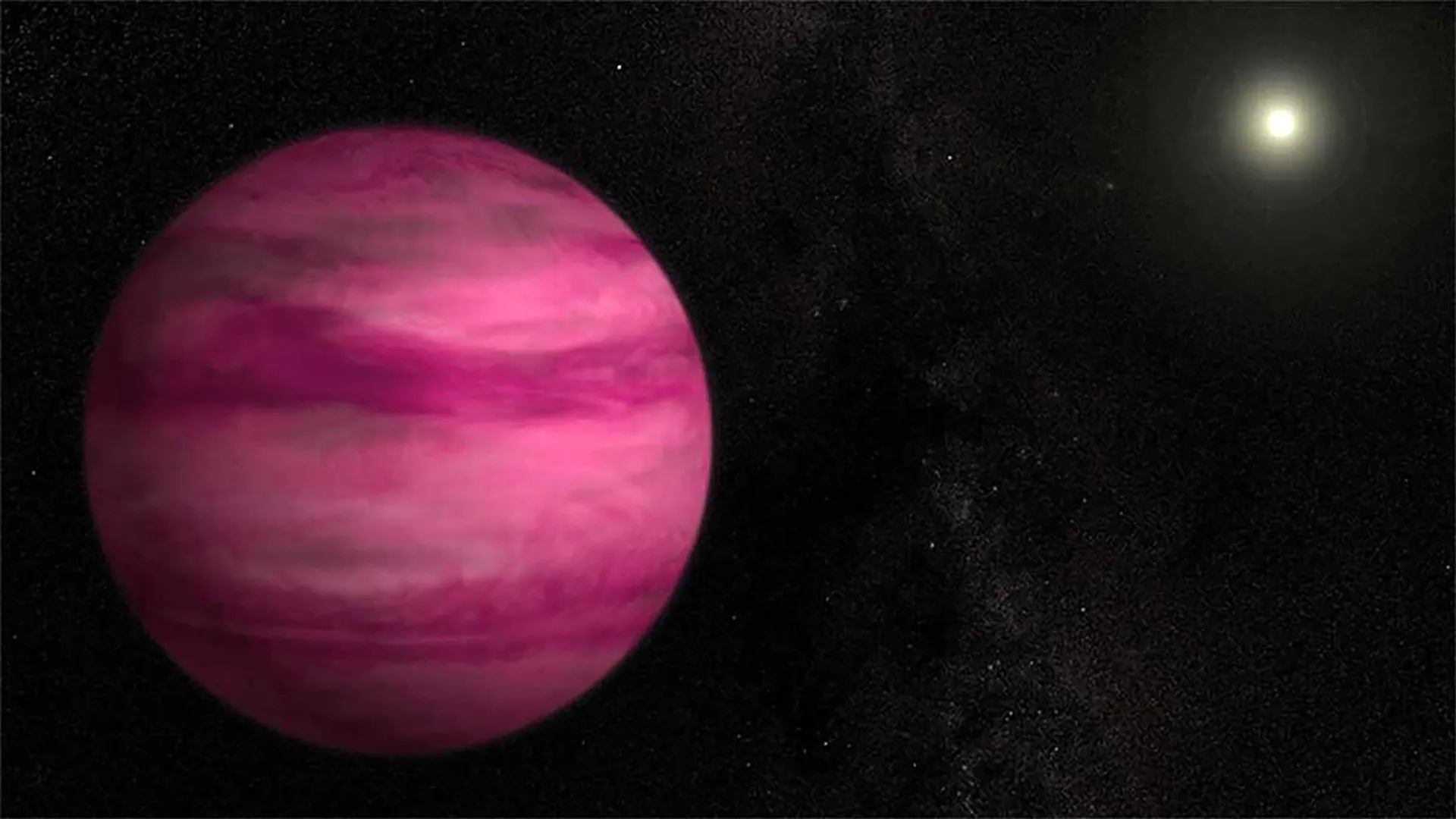
James Webb Telescope Finds Salt Clouds on a Pink World That May or May Not Be a Planet
JWST finds salt clouds on a pink, possibly-planet 57 light-years away, confirming a 15-year-old prediction and proving the universe has a taste for seasoning.
Astronomers led by Northwestern University have discovered that the so-called "Pink Planet" - a mysterious, faint celestial body that has been confusing scientists for over a decade - has skies filled with salty clouds. Because nothing says "exotic atmosphere" like a cosmic pretzel.
For more than 10 years, GJ 504 b - its official name, because "Pink Planet" was probably already taken by a My Little Pony episode - has been one of astronomy's enduring puzzles. As one of the coldest planetary-mass companions ever directly imaged, it's so faint that ground-based telescopes basically shrugged at it. Enter the James Webb Space Telescope (JWST), which finally got a good look and found an atmosphere packed with chemistry so weird it makes Jupiter's ammonia clouds look like plain vanilla.
The findings, published June 18 in the Astronomical Journal, provide some of the first direct evidence that salt clouds can exist in the atmosphere of a cold planetary object - confirming a prediction scientists made more than 15 years ago. So yes, it took a decade and a half and a $10 billion telescope to prove that space can be salty.
"The Pink Planet is the coldest companion ever discovered using ground-based instruments," said Northwestern's Aneesh Baburaj, a postdoctoral associate at CIERA who led the study. "Many teams all around the world performed follow-up observations to study its light, but it was too faint for ground-based instruments. That made it a perfect target for JWST." Baburaj noted that when they finally obtained its spectrum, "it immediately looked interesting. But once we started digging deeper into the data, we realized it was not like anything we have analyzed before."
First discovered in 2013, GJ 504 b orbits a Sun-like star about 57 light-years from Earth. Despite its pinkish nickname, researchers aren't even sure it's a planet. With a mass roughly 25 times that of Jupiter, it sits near the fuzzy boundary between giant planets and brown dwarfs - the astronomical equivalent of "it's complicated." Officially, astronomers call it a "planetary-mass companion," which sounds like a polite way of saying "we have no idea what this thing is."
Its temperature is another head-scratcher. Most directly imaged exoplanets range from about 1,000 to 2,000 degrees Fahrenheit. GJ 504 b? A balmy 550 degrees Fahrenheit (290 degrees Celsius) - roughly the temperature inside a bread-baking oven. So if you were hoping for a vacation home on a pink world, pack oven mitts.
Baburaj and his team used JWST to collect the object's faint light, applying advanced processing techniques to remove glare from the much brighter host star - basically space photography with a really expensive filter. They obtained the companion's spectrum, which revealed water vapor, methane, carbon dioxide, ammonia, and other molecules. But when they tried to recreate the atmosphere with computer models, they hit a problem: the observations only matched physically unrealistic conditions.
The solution? Add clouds. Specifically, salt clouds. "We ran simulations with clouds, and the results aligned with what we know about cold planets," Baburaj said. "We tried three different types of clouds, and salt clouds fit best." Once salt clouds were included, the weird inconsistencies vanished - because apparently, the universe has a taste for seasoning.
The spectrum also hints that GJ 504 b may contain an unusually large amount of heavy elements (astronomers call them "metals," because they love confusing everyone). But questions remain about how it formed - either through planet-creation processes or star-formation processes. Current evidence is, to put it scientifically, inconclusive.
Baburaj believes the methods developed for this study could help scientists investigate other cold and faint planetary objects. Jupiter, for example, has clouds made of ammonia ice - which is exciting, but not as exciting as salt. "This is the first time we've found that salt clouds are critical to explaining the spectrum of an object," Baburaj said. "It's a good reminder to account for clouds in our models."
The study, supported by NASA (award number 80NSSC20K0586), was conducted with scientists from the Space Telescope Science Institute, including Marshall Perrin, who designed the observing program. Perrin serves on the JWST Telescope Scientist Team, which helped develop the observatory and supports its ongoing operations - presumably while eating salt-free snacks.
The Good Times
News in your inbox.
One sardonic roundup, delivered on your schedule. Free. Unsubscribe whenever your tolerance for wit runs out.
Already subscribed but we never reach your inbox? Check your spam folder and hit 'Not spam' (or 'Remove from spam') to bust us out of junk-mail purgatory. You'll be helping everyone else too.
Don't open any of our emails for a month and you'll be automatically removed from the mailing list.
Rewrite Article
Select parts to regenerate with a fresh AI pass. Translations will be updated automatically.
Generate AI Image
Creates a sardonic version of the article image using OpenAI.