
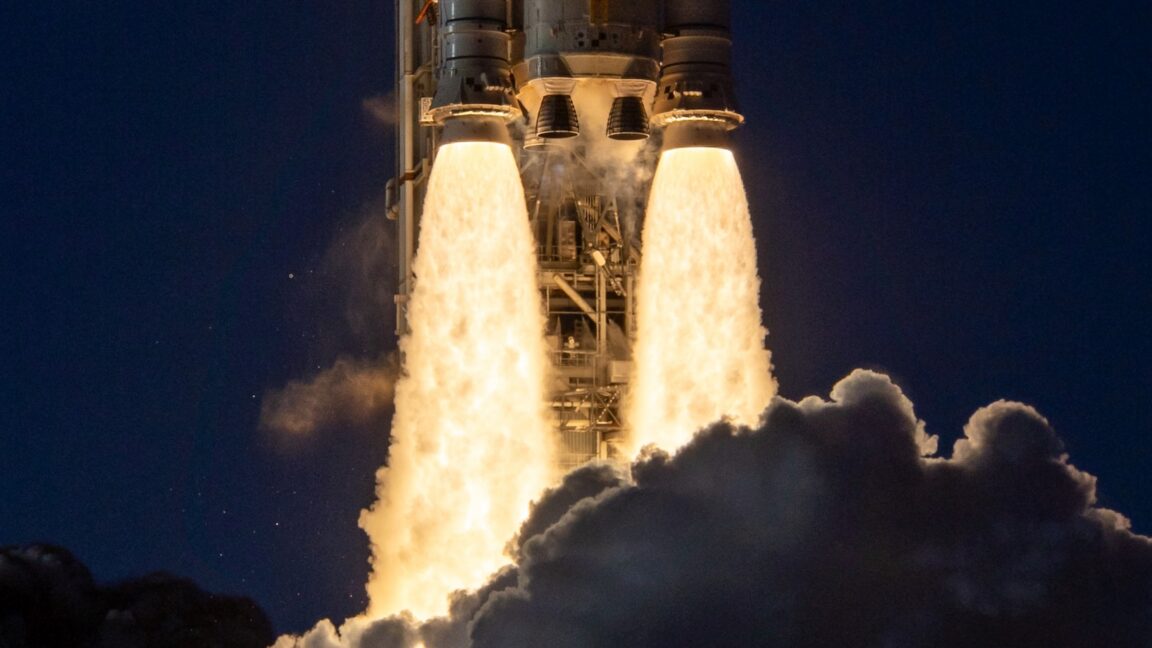
Welcome to Edition 9.18 of the Rocket Report, where Blue Origin thoughtfully bundled its news into one Thursday afternoon: a new kick stage for New Glenn, a new engine design called Northstar, and a minor, widely expected delay of New Glenn's return-to-flight mission from December to January. The reconstruction of Blue Origin's wrecked launch pad at Cape Canaveral, Florida, continues apace after a catastrophic explosion nearly six months ago. NASA, Amazon, and the Space Force are all waiting with varying degrees of patience for New Glenn to get back in action.
Three brothers who worked at SpaceX in the Falcon 9 era are now building satellites that run on water. In late 2022, the three Carlisle brothers founded Argo Space to build infrastructure in space - not just transportation, but removing the need for Earth-sourced propellants. Argo Space's satellites will use water as propellant, coolant, and radiation shield. The company flew its first mission in July, but the spacecraft failed after one of its solar arrays didn't deploy, leaving no time to test the propulsion system. Two more missions are scheduled for 2027 to demonstrate the water-based thrusters, which split liquid water into hydrogen and oxygen gases using solar power and burn them for thrust.
Japanese launcher startup Interstellar Technologies has secured backing from JAXA for its Zero rocket program, Aviation Week & Space Technology reports. JAXA selected the company under its Acceleration of Commercial Rocket Launch Demonstration program, part of the Space Strategic Fund, which offers grants up to $76 million per company. Interstellar previously raised more than $250 million, with roughly equivalent funds from government and private capital. The money will complete development of the Zero rocket, a two-stage launcher designed to carry up to 1 metric ton (2,200 pounds) to low-Earth orbit. "We have achieved critical technical milestones, including Japan's first successful firing test of an orbital-class methane engine," said Satoshi Nakayama, director of the board and president of Interstellar. First launch is targeted for 2027.
A new report from analytics firm Quilty Space confirms that, outside of China, the world faces a significant shortage of rockets over the next five years. Between now and 2030, there will be a shortfall of about 150 launches compared to demand from satellite operators and civil space agencies. If US military demand is added - and SpaceX does not extend the Falcon 9 and Falcon Heavy program - the shortage could double. "What we wanted to get at is to understand how severe this launch crisis is and when will it be resolved," said Caleb Henry, director of research at Quilty Space. "What we learned is that the launch crisis is more severe than we thought and that it will not go away this decade for sure, and it might not abate until sometime late in the 2030s." Quilty blames the war in Ukraine taking Russian rockets off the Western market, Amazon Leo demand, developmental delays in New Glenn, Vulcan, Neutron, Terran R, and Nova, and the retirement of the Falcon 9 as a commercial rocket.
China launched another 18 satellites for its SpaceSail Internet network on Tuesday (Monday, US time) from a spaceport in the country's northwestern desert. The mission marked the second launch - and first operational flight - of the Kinetica 2 rocket developed by CAS Space. The SpaceSail constellation, also known as Qianfan, now consists of some 275 flat-panel satellites from launches that began in August 2024; the first phase will number 1,296 satellites. The Kinetica 2 is a mini-Falcon Heavy, with three side-by-side boosters each powered by three kerosene-fueled engines instead of nine. It can lift about 12 metric tons (26,000 pounds) to low-Earth orbit, and CAS Space plans to eventually recover and reuse the boosters.
India launched a Geosynchronous Satellite Launch Vehicle (GSLV) rocket on October 30 carrying the NVS-03 satellite to restore its regional navigation system, NDTV reports. NVS-03 is the third spacecraft in India's second-generation navigation network, and it carries multiple clocks of different designs to overcome atomic clock failures that rendered older satellites partially or totally unusable. The GSLV has now launched 20 times since debuting in 2001, with six total or partial failures - most early in its history - earning it the title "naughty boy" from Indian space officials. The most recent launch was a different story: V. Narayanan, head of India's space agency, declared it the "most precise launch of any rocket in the world." We're not sure what metric he used, but the launch was, indeed, a success.
Chinese space officials confirmed plans to land astronauts on the Moon within three years. At the Seventh Manned Spaceflight Conference in Beijing, officials including Wang Xiang, chief designer for the lunar exploration program, laid out the country's most publicly detailed plans yet for a crewed lunar landing "before 2030." China's lunar landings will involve lunar-orbit rendezvous similar to Apollo, but lacking a Saturn V-class rocket, the crew and lander will launch separately. The Long March 10 rocket family will be the workhorse: a demonstration flight of a single-core Long March 10A with the Mengzhou Moon ship to low-Earth orbit in early 2027; the larger three-booster Long March 10 will launch the Lanyue lunar lander on an uncrewed test flight in 2028; the next year, two Long March 10s will launch concurrently - one with an uncrewed Mengzhou and one with a Lanyue lander - to dock in lunar orbit; then before 2030, another dual launch with crew on Mengzhou will lead to the crewed landing.
Blue Origin announced two significant upgrades to New Glenn on Thursday: a new engine called Northstar to eventually replace the BE-4 that powers the first stage, and a hydrogen-oxygen third stage for high-energy missions. The company aims to eventually launch New Glenn more than 1,000 times a year. Northstar has half the parts and 30 percent less mass than BE-4, with about 65 percent 3D-printable, providing a thrust increase while costing 25 percent as much to manufacture. The kick stage uses a lightweight composite fuel tank, and after a breakthrough at Launch Site One in Texas - the first composite liquid hydrogen tanking test - engineers are confident in the design.
Blue Origin now plans to resume New Glenn launches in January, delaying the return-to-flight mission after the May launch pad explosion, Bloomberg reports. CEO Dave Limp told employees Wednesday they are targeting a flight early in 2027. The slight delay is unsurprising, and a January launch would still beat initial fears about rebuilding the Florida pad. New Glenn has a busy manifest after return-to-flight, including a crucial spring launch of the Blue Moon Mark 1 lander, an uncrewed precursor to the human-rated lander for NASA's Artemis missions.
The launch of NASA's Artemis II mission in April caused significant disturbances in Earth's ionosphere that could have triggered temporary, localized GPS positioning errors, a new study found, Space.com reports. Researchers from National Cheng Kung University in Taiwan analyzed data from high-precision ground-based GPS receivers to reconstruct how the Space Launch System rocket's passage changed free electron concentrations in the upper atmosphere. The disturbances were more significant than any caused by other rocket launches to date - up to 10 times more intense than those from SpaceX's Starship test launches, despite Starship being twice as powerful as the SLS based on liftoff thrust.
November 6: Ceres 2 | Unknown Payload | Jiuquan Satellite Launch Center, China | 23:35 UTC