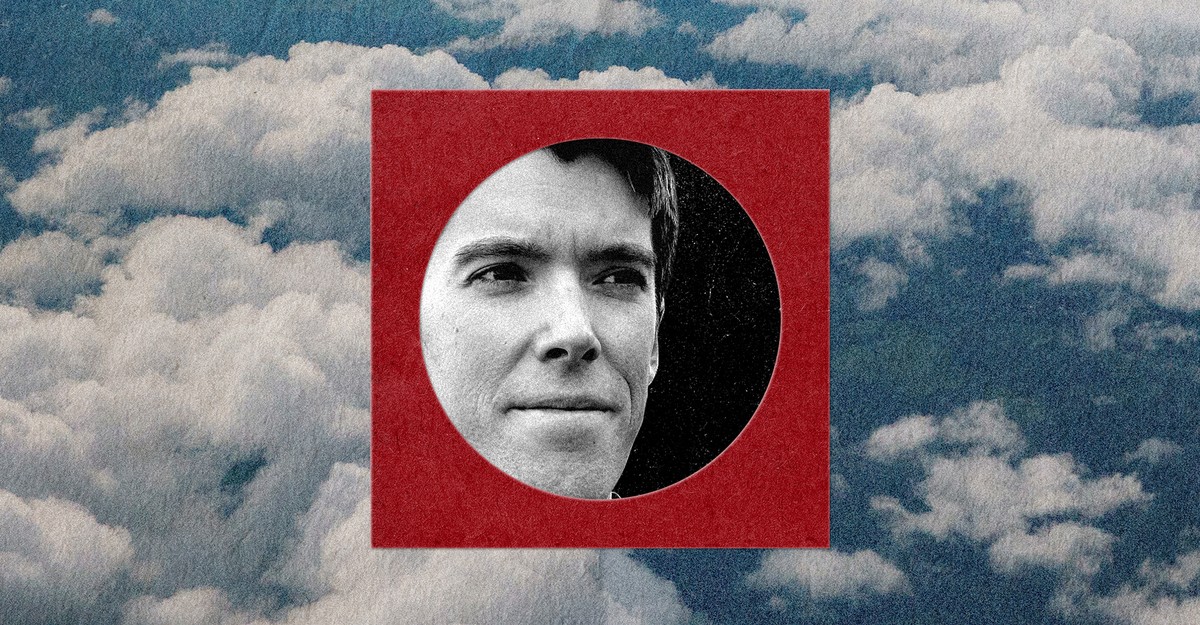
America’s Go-To Climate Scientist Makes Boring Weather Sound Terrifyingly Interesting
Daniel Swain, the climatologist who made 'ridiculously resilient ridge' a household phrase, explains why he keeps warning us about weather disasters - and why he still thinks we can do something about them.
Daniel Swain, a climatologist at the University of California Agriculture and Natural Resources, has cracked the code of public science communication: talk about the weather like a normal person, but with the receipts. While many of his colleagues drone on about radiative forcing and cloud reflectivity, Swain appears on CBS, NBC, the Weather Channel, and The Washington Post explaining how global climate change is messing with your local forecast in plain English - often on his own blog and YouTube channel, Weather West.
“He uses language that is both precise and deep but very accessible, and that’s why you see him quoted everywhere,” Mark Hertsgaard, executive director of Covering Climate Now, told The Atlantic. Swain does more than 200 media interviews a year, making him roughly as ubiquitous as the weather itself. In January 2025, just as he was about to publish a major paper on “hydro-climate whiplash” - the phenomenon where global warming makes extreme swings between drought and deluge more common - the very thing he warned about erupted. “It was a ‘Well, shit’ moment,” Swain said, as fires broke out around Los Angeles two days before the paper’s release.
During the devastating fires, Swain hosted nine livestreams on YouTube in a week, some lasting hours, while fielding calls from NPR, the Los Angeles Times, The Guardian, and CNN. “I did essentially continuous interviews - like, eight or 12 a day,” he said. Swain, 37, grew up in Marin County, California, where a violent December 1995 storm - wind gusts over 100 mph, continuous lightning - busted his home’s windows and hooked him on meteorology. In high school, he launched the Weather West blog, which still runs on WordPress with a Web 1.0 aesthetic and attracts 2 million unique visitors a year.
He coined the phrase “ridiculously resilient ridge” during his Stanford Ph.D. to describe a high-pressure system parked over California. The media devoured it. “I just sort of embraced it because I’m like, Well, certainly more people are going to see this interview than read the blog,” he said. His attempt to use “precipitation whiplash” in a 2018 Nature Climate Change paper was vetoed by editors as “too visceral.” (Chief editor Bronwyn Wake said terminology decisions are guided by “clarity, scientific rigour, and consistency.”) Swain’s Ph.D. adviser, Stanford climatologist Noah Diffenbaugh, said prospective students now say, “I really want a job like Daniel Swain has.”
Unlike some high-profile climate scientists who tip into advocacy, Swain sticks to explaining weather. That hasn’t shielded him from conspiracy theorists who accuse him of controlling the weather or working for Big Green or Big Oil. “It’s tragic that so many people right now genuinely believe that a lot of the folks working hard to improve the way things are in the world…are trying to do the opposite,” he said. He also lives with Yao syndrome, a rare autoinflammatory condition that feels “like you have the flu several times a month, just forever.” The experience shapes his view on risk: “For me, a 1 percent chance is not really that low.” He calls his outlook “second-order optimism” - the ability to acknowledge catastrophe without being paralyzed by it. Partly cloudy, with a chance of hope.
The Good Times
News in your inbox.
One sardonic roundup, delivered on your schedule. Free. Unsubscribe whenever your tolerance for wit runs out.
Already subscribed but we never reach your inbox? Check your spam folder and hit 'Not spam' (or 'Remove from spam') to bust us out of junk-mail purgatory. You'll be helping everyone else too.
Don't open any of our emails for a month and you'll be automatically removed from the mailing list.
Rewrite Article
Select parts to regenerate with a fresh AI pass. Translations will be updated automatically.
Generate AI Image
Creates a sardonic version of the article image using OpenAI.