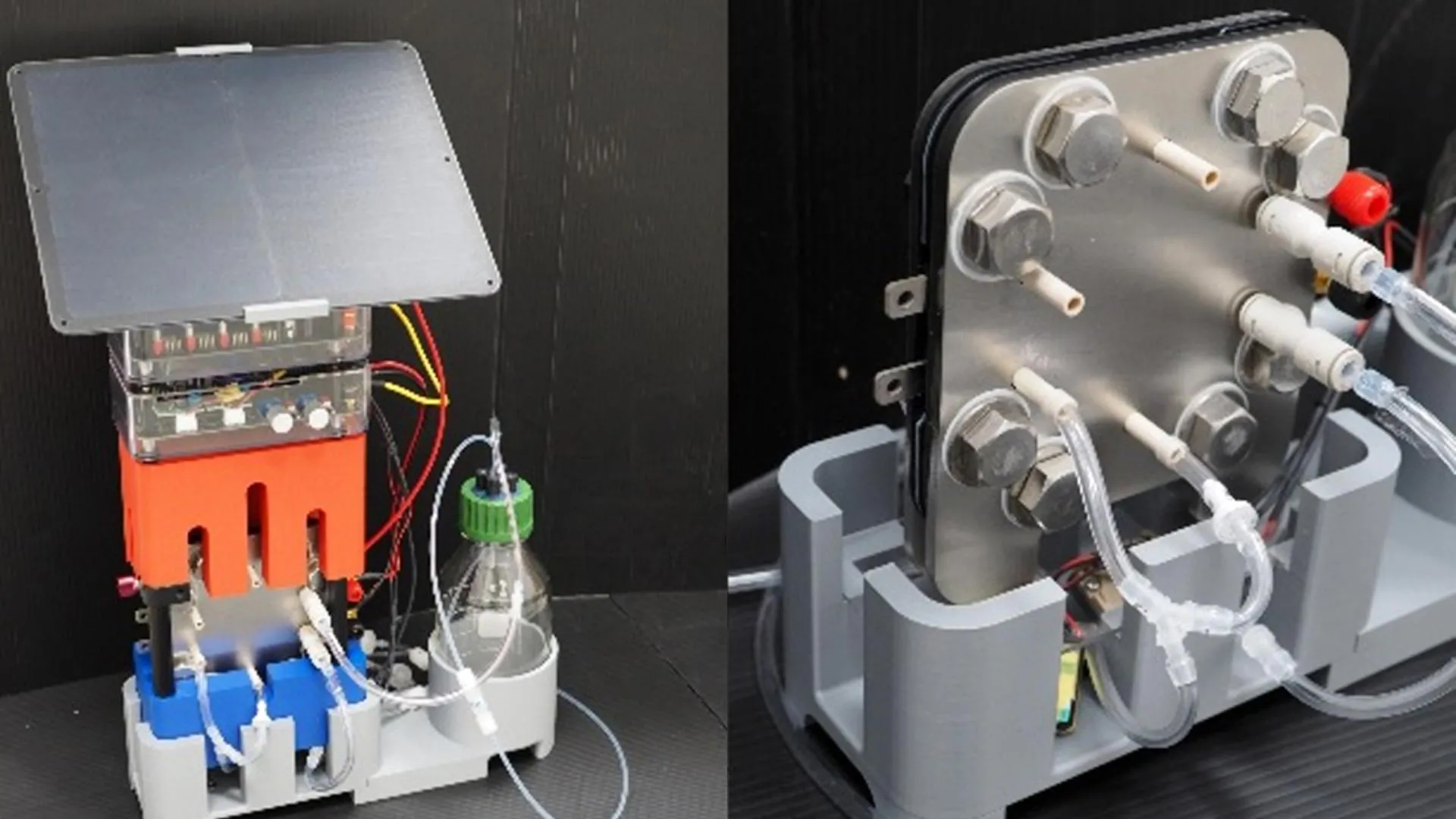
Scientists Build Battery-Free Sunlight-to-Fuel Device, Making Solar Power Slightly Less Complicated
Japanese researchers build a self-regulating artificial photosynthesis system that ditches batteries, proving once again that the best way to handle sunlight's mood swings is to let the hardware do the thinking.
Researchers at Osaka Metropolitan University have created an artificial photosynthesis system that can generate solar fuel more reliably while ditching the battery-based control equipment that usually tags along for the ride. By integrating a self-regulating chemical component directly into the electrolyzer, they've managed to reduce both complexity and cost - because nothing says "elegant solution" like removing the parts that tend to break or run out of juice.
Like the photosynthesis plants have been doing for millions of years without a patent, artificial photosynthesis uses sunlight to transform water and carbon dioxide into energy-rich compounds. One such product is formic acid, a chemical that can serve as both a fuel and a way to store energy - handy for those days when the sun decides to take a break.
At the heart of these systems is an electrolyzer, which converts electricity from solar cells into chemical energy, stored as fuels like formic acid. The problem? Sunlight is notoriously inconsistent - it has this annoying habit of changing throughout the day. To cope, most artificial photosynthesis systems use Maximum Power Point Tracking (MPPT), a method that continuously adjusts voltage and current so solar cells can deliver peak power. But conventional MPPT setups typically rely on batteries and extra electronics to smooth out the energy flow. They work, sure, but they also add cost and complexity, like bringing a Swiss Army knife to a task that really just needs a screwdriver.
The team, led by Associate Professor Yasuo Matsubara and Professor Yutaka Amao at the Research Center for Artificial Photosynthesis at Osaka Metropolitan University, partnered with Iida Group Holdings Co., Ltd to redesign the electrolyzer itself. Their approach uses a specially designed solid electrolyte built directly into the device, allowing the electrolyzer to automatically perform MPPT on its own - no batteries required. As sunlight increases, the electrolyzer heats up, causing its electrical resistance to drop and letting electricity flow more freely. "This makes the system automatically adjust its electrical behavior," Professor Amao explained, in what sounds like the most satisfyingly simple solution to a complex problem since someone discovered that putting a lid on a pot makes water boil faster.
When tested under actual outdoor conditions, the system consistently produced formic acid from water and CO2, even as sunlight levels fluctuated like a nervous stock market. "We were confident that it would be successful," Professor Matsubara said, noting that the system had previously powered a miniature diorama at the Osaka Kansai Expo 2025. The findings were published in EES Solar, and materials were provided by Osaka Metropolitan University - because even science needs a little PR now and then.
The Good Times
News in your inbox.
One sardonic roundup, delivered on your schedule. Free. Unsubscribe whenever your tolerance for wit runs out.
Already subscribed but we never reach your inbox? Check your spam folder and hit 'Not spam' (or 'Remove from spam') to bust us out of junk-mail purgatory. You'll be helping everyone else too.
Don't open any of our emails for a month and you'll be automatically removed from the mailing list.
Rewrite Article
Select parts to regenerate with a fresh AI pass. Translations will be updated automatically.
Generate AI Image
Creates a sardonic version of the article image using OpenAI.