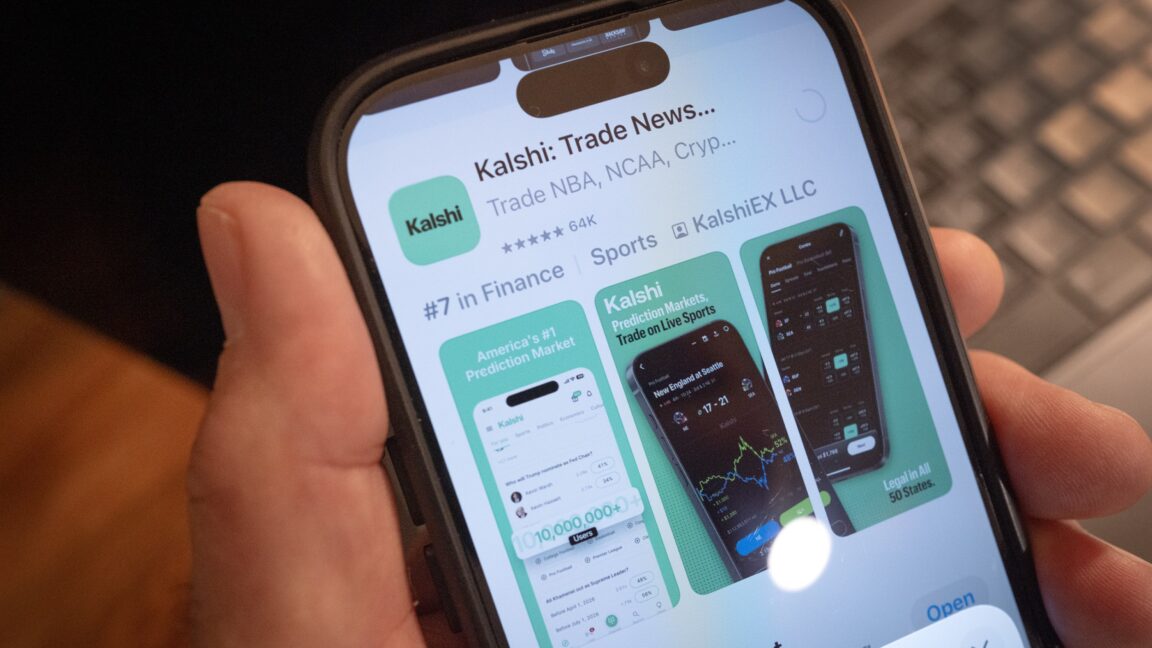
Washington Judge Tells Kalshi to Stop Betting on Everything, Including Whether It Will Lose
A Washington judge tells Kalshi to stop taking bets on sports, elections, and whether celebrities will say things - because apparently 'prediction markets' are still gambling, legally speaking.
In a blow to the prediction market industry's ambitions to become the world's most legally ambiguous casino, a state court in Washington has ordered Kalshi to stop offering sports bets and a whole grab bag of other wagers. King County Superior Court Judge John McHale issued a preliminary injunction in response to a lawsuit filed by the state of Washington, which apparently took issue with Kalshi's claim that its "legal betting" was, you know, legal.
The order requires Kalshi to stop offering, accepting, or facilitating wagers on sports, elections, politics, entertainment, culture, tech and science, or mentions - because nothing says "free market" like betting on whether a celebrity will say a specific phrase. Washington Attorney General Nick Brown announced the news with the enthusiasm of someone who just won a bet on the outcome of this very case. "Kalshi has gotten rich promoting wagers on sports, elections, natural disasters, events related to the Iran War, and more. Under this order, Kalshi is banned from offering wagers on most of those topics in Washington," Brown said.
The court found that Kalshi is not licensed by the state Gambling Commission and is not registered to conduct business in Washington. Judge McHale also determined that Kalshi's ads claiming it offers 'legal betting' in Washington are "likely to mislead a reasonable consumer" - a phrase that will surely become a marketing slogan for the company. To make sure Kalshi gets the message, the order imposes penalties of up to $120,000 per day if it fails to implement geofencing by September 2. Kalshi must set up an IP address and residency-based geofence by August 19 and a multi-source geofencing solution by September 2. The order does not prohibit users from exiting positions they already hold, so if you're holding a bet on whether this injunction would happen, you might want to cash out now.
To get a preliminary injunction, a plaintiff must show they are likely to succeed on the merits of their claims. McHale found that Washington is likely to succeed in proving its claims that Kalshi violated state laws on gambling and consumer protection. The judge wrote that Kalshi operates an online betting platform that allows consumers to bet on thousands of topics, including whether public figures will utter specific words or phrases. He also found that Kalshi's provision, marketing, and advertising of illegal gambling activities constitute unfair or deceptive acts under Washington law.
Kalshi, unsurprisingly, disagrees. The company argues that it doesn't have to follow state laws because the US Commodity Futures Trading Commission (CFTC) has exclusive jurisdiction over prediction markets. The Trump administration has repeatedly made the same argument and sued states that try to regulate the platforms. A Kalshi spokesperson said, "Kalshi is regulated by the CFTC, which has exclusive jurisdiction over our exchange. We respectfully disagree with the court's decision and are considering all legal options." The spokesperson also noted that Kalshi has never offered markets on wildfires, war, death, or terrorism - a claim that might reassure anyone worried about betting on the apocalypse.
One of Kalshi's legal options is asking the Trump administration for help, and the CFTC seems happy to oblige. This week, the CFTC declared a "market emergency" in New York in an attempt to stop the state from enforcing its gambling laws against Kalshi. CFTC Chairman Michael Selig said, "Congress did not intend for derivatives exchanges to be regulated under a patchwork of state gaming laws." But Judge McHale concluded that the US Commodity Exchange Act does not preempt Washington state gambling law, pointing to language in the law that says it does not supersede or limit state jurisdiction. So, the battle continues, with courts across the country trying to figure out whether prediction markets are a legitimate financial instrument or just betting with extra steps.
The Good Times
News in your inbox.
One sardonic roundup, delivered on your schedule. Free. Unsubscribe whenever your tolerance for wit runs out.
Already subscribed but we never reach your inbox? Check your spam folder and hit 'Not spam' (or 'Remove from spam') to bust us out of junk-mail purgatory. You'll be helping everyone else too.
Don't open any of our emails for a month and you'll be automatically removed from the mailing list.
Rewrite Article
Select parts to regenerate with a fresh AI pass. Translations will be updated automatically.
Generate AI Image
Creates a sardonic version of the article image using OpenAI.