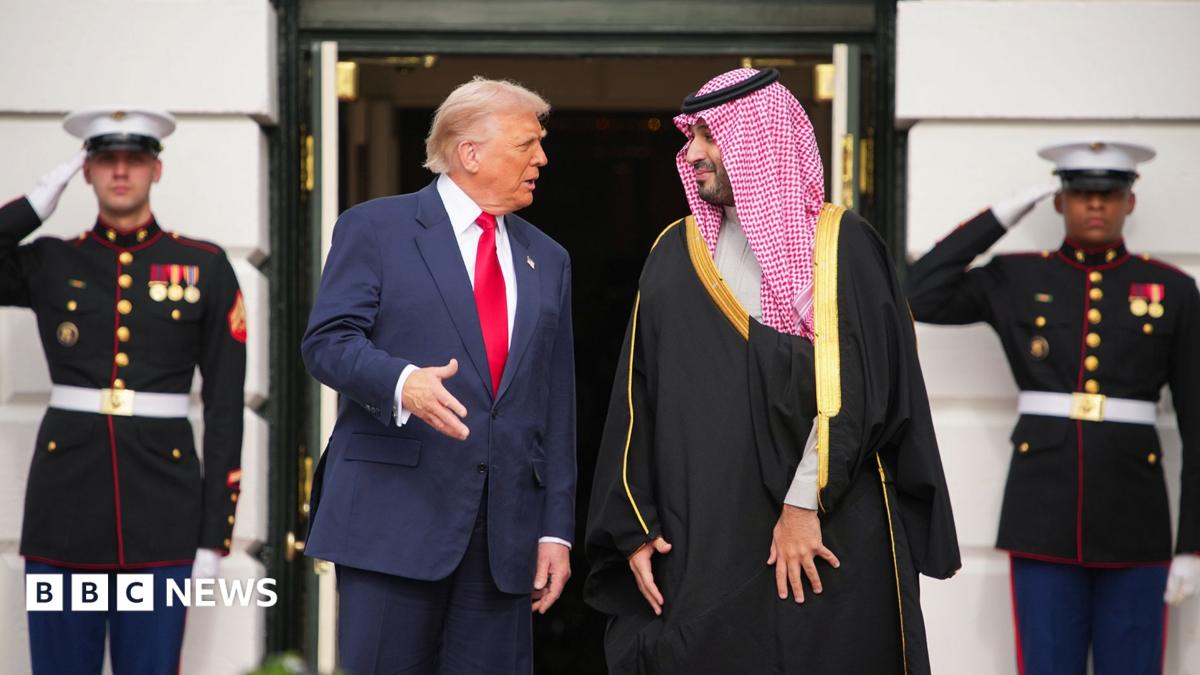
Trump Dangles Nuclear Deal, Says Saudis Must First Give Israel a Hug
Trump says Saudi Arabia must recognize Israel to get a nuclear deal, because what could possibly go wrong with linking Middle East peace to uranium enrichment?
President Donald Trump has announced that the US-Saudi nuclear energy deal comes with a condition: Saudi Arabia must recognize the State of Israel by joining the Abraham Accords. "The Civil Nuclear Deal (There will be no enrichment of material!)... will be approved, but is totally subject to Saudi Arabia joining the very respected and successful Abraham Accords," Trump wrote on Truth Social, presumably in all caps for maximum emphasis.
It remains unclear whether this requirement is actually written into the unreleased deal, or if Saudi Arabia has agreed to it. The kingdom has not yet responded, perhaps because they were too busy calculating how many camels they'd need to trade for a nuclear reactor.
White House press secretary Karoline Leavitt confirmed that Trump has repeatedly raised this condition with Saudi leaders. "He has said if they don't join the Abraham Accords, the deal is off," she said, implying the Saudis have been politely ignoring him for weeks.
The deal, announced Wednesday, includes a "peaceful nuclear co-operation agreement" and a "bilateral safeguards agreement," according to the US Department of Energy. Together, they lay the "legal foundation for a decades-long, multi-billion-dollar partnership" - because nothing says "peaceful" like a multi-billion-dollar race to build reactors in the Middle East.
Critics, including some Republican and Democratic lawmakers, have warned the deal could spark nuclear proliferation in an already unstable region. Rosemary Kelanic of the Defense Priorities think tank called it "quite shocking" that the US might allow Saudi uranium enrichment, noting, "The US has never done that before. We have never helped another country enrich on their own soil." Typically, we prefer to keep that as our own special privilege.
During Trump's first term, the UAE and Bahrain signed the Abraham Accords, normalizing relations with Israel - a historic first in decades. Sudan, Morocco, and Kazakhstan have since joined, though Kazakhstan's involvement remains somewhat mysterious.
Saudi Arabia has previously insisted it won't normalize relations without a Palestinian state. But the White House says the nuclear deal is off if they don't play ball. Prime Minister Benjamin Netanyahu's office called Saudi accession "a historic leap forward for peace," conveniently ignoring the nuclear elephant in the room.
Israeli Economy Minister Nir Barkat said Israel "can manage it" if Saudi Arabia gets peaceful nuclear power. Former defense minister Avigdor Lieberman was less sanguine: "Every military nuclear program begins with a civilian one." Of course, Israel itself is widely believed to have nuclear weapons, but it maintains a policy of "don't ask, don't tell" - or rather, "don't confirm, don't deny."
Iran, the elephant in the other room, has long denied seeking nuclear weapons, despite Western accusations. Saudi Crown Prince Mohammed bin Salman told CBS in 2018 that if Iran gets a bomb, "we will follow suit as soon as possible." So the deal is either a path to peace or a recipe for a nuclear arms race - depending on your tolerance for risk.
The agreement now heads to Congress, where Trump's Republican majority can probably ram it through despite expected opposition. Because nothing says "nonproliferation" like a partisan nuclear deal with a country that might want a bomb if its rival gets one.
The Good Times
News in your inbox.
One sardonic roundup, delivered on your schedule. Free. Unsubscribe whenever your tolerance for wit runs out.
Already subscribed but we never reach your inbox? Check your spam folder and hit 'Not spam' (or 'Remove from spam') to bust us out of junk-mail purgatory. You'll be helping everyone else too.
Don't open any of our emails for a month and you'll be automatically removed from the mailing list.
Rewrite Article
Select parts to regenerate with a fresh AI pass. Translations will be updated automatically.
Generate AI Image
Creates a sardonic version of the article image using OpenAI.