Scientists Thrown Out of Diabetes Conference for Distributing Their Own Published Editorial
ADA kicks out five scientists for distributing copies of their own editorial criticizing Trump's science policies, proving that scientific discussion is fine as long as it doesn't actually discuss anything.
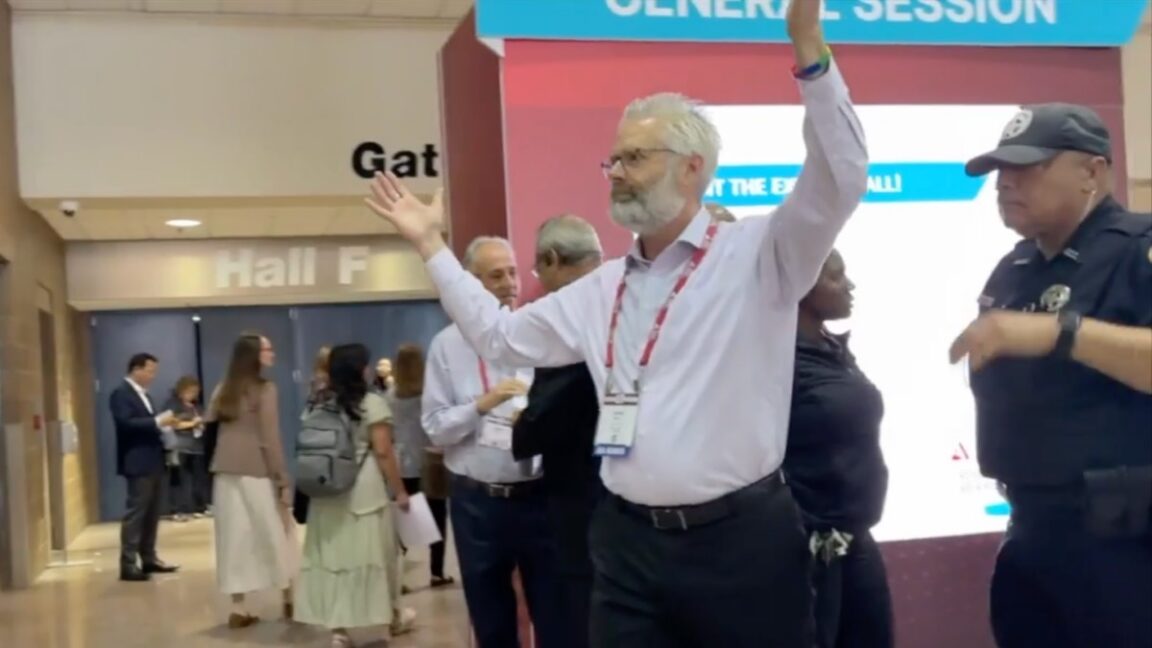
Five leading scientists were ejected from the American Diabetes Association (ADA) annual meeting in New Orleans on Friday, apparently for the crime of sharing copies of their own published editorial with fellow attendees. The editorial, published in the ADA's own journal Diabetes Care on April 29, criticized the Trump administration's attacks on scientific research - which, it turns out, is not the kind of scientific discussion the ADA was looking for.
The ejected researchers include Steven Kahn (University of Washington, editor-in-chief of Diabetes Care), former ADA president Desmond Schatz (University of Florida), Aaron Kelly (University of Minnesota), Justin Ryder (Northwestern University), and Irl Hirsch (University of Washington). They were distributing reprints outside a room where NIH director Jay Bhattacharya was scheduled to speak - though Bhattacharya canceled, and another NIH official spoke instead.
"They physically grabbed us, forced us out of the conference center, and now are telling us we can no longer attend this meeting," Kelly told MedPage Today. "They're taking our lanyards. It really has come to this in America. Censorship is real. America needs to stand up. Scientists, stand up. Physicians, stand up."
The ADA confirmed the removals, stating that the scientists violated the organization's code of conduct, which prohibits "disorderly or disruptive conduct such as protesting." The ADA claimed the scientists were "respectfully given the opportunity to cease this behavior and chose not to."
Online backlash spread rapidly across Twitter/X and BlueSky, driving a sharp increase in page views for the editorial. Kahn noted that the editorial had already been published with a disclaimer from ADA leadership insisting the organization had nothing to do with it. He has written to the ADA seeking re-admittance to the conference, as he is scheduled to speak and chair a session.
Critics questioned how handing out reprints of an editorial published in the ADA's own journal, at the ADA's own conference, could violate the code. Videos posted by MedPage Today show the scientists were not disruptive or disorderly - though the timing, just before an NIH representative spoke, could be interpreted as protest. Then again, sharing scientific findings seems like the whole point of a scientific conference.
"It is no longer enough to stand idly by or work behind the scenes with lawmakers," the authors wrote in their editorial. "As a nation, we must continue to believe in ensuring better health for all. A few brushes of a pen... are rapidly destroying what generations have built. We can no longer afford complacency and fear. We must all act now!"
DOI: Diabetes Care, 2026. 10.2337/dci26-0068
The Good Times
News in your inbox.
One sardonic roundup, delivered on your schedule. Free. Unsubscribe whenever your tolerance for wit runs out.
Already subscribed but we never reach your inbox? Check your spam folder and hit 'Not spam' (or 'Remove from spam') to bust us out of junk-mail purgatory. You'll be helping everyone else too.
Don't open any of our emails for a month and you'll be automatically removed from the mailing list.
Rewrite Article
Select parts to regenerate with a fresh AI pass. Translations will be updated automatically.
Generate AI Image
Creates a sardonic version of the article image using OpenAI.