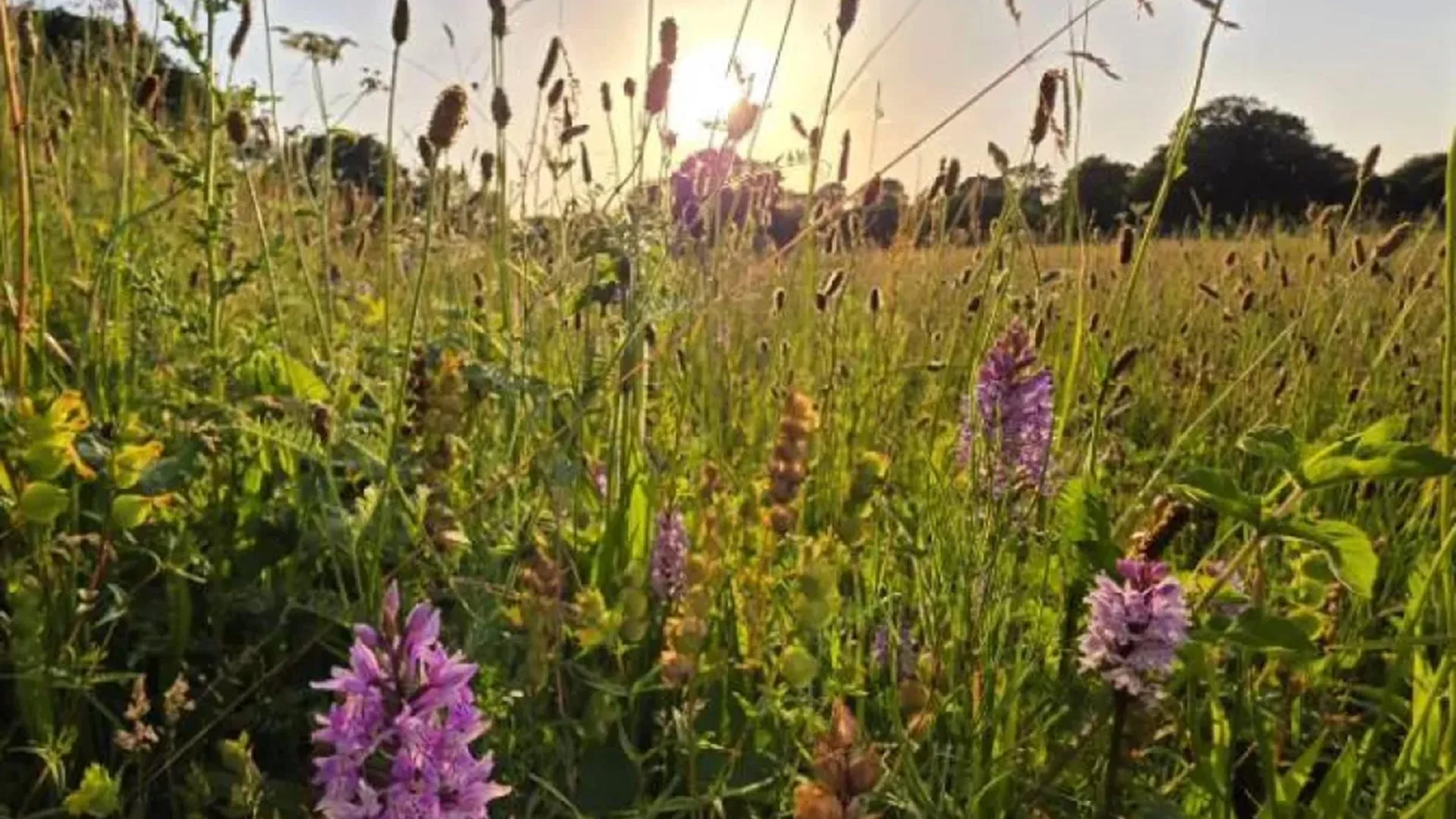
Scientists Do Absolutely Nothing to a Field, Nature Rewards Them With Thousands of Orchids
A 11-year study finds that abandoning farmland leads to a wildflower meadow with thousands of orchids, suggesting nature's DIY approach beats expensive seed mixes.
In a stunning rebuke to the entire landscaping industry, a new study from UCL Geography has found that if you just leave a farm field alone, it might turn into a wildflower meadow all by itself. Professor Carl Sayer and his team watched a two-hectare field in North Norfolk do exactly that over 11 years (2011-2022), and the results, published in Restoration Ecology, suggest that sometimes the best intervention is no intervention at all.
The field, which had its final crop (oilseed rape) in 2005, was left to its own devices except for a traditional annual hay cut. Within 10-15 years, it transformed into a species-rich wildflower meadow, complete with locally rare plants like southern marsh orchid, greater tussock-sedge, yellow rattle, and common centaury. The average number of plant species per survey plot doubled from about 10 in 2011 to nearly 20 by 2022, and thousands of orchids popped up naturally. Apparently, nature doesn't need a seed packet.
Professor Sayer, who clearly enjoys being smug about his patience, said, "Our study shows that resisting seeding and allowing nature to lead may be worth trying a lot more in wildflower meadow restoration." He added that natural recovery safeguards genetic diversity and makes meadows "less generic," which is a polite way of saying that seeded meadows are the fast food of the ecology world. The study's question: "should we be employing patience over seed packet more often?" is one that will haunt seed companies everywhere.
The research is timely, as the UK and Europe scramble to restore biodiversity across former farmland. Species-rich grasslands are crucial for pollinators, birds, and mammals, and they help ecosystems brace for climate change. But the real lesson here might be that nature, given a chance, knows what it's doing - and that sometimes the most expensive solution isn't the best one.
The meadow, aptly named Sayer's Meadow in Bodham, is owned by the professor's father and co-author Derek Sayer. The team conducted detailed vegetation surveys every two to three years, tracking every plant species. They suspect some unusual plants hitched rides on wildlife, like deer, proving that even nature uses ride-sharing.
Reflecting on the project, Professor Sayer waxed poetic: "When the first orchids started appearing in our surveys, we were thrilled and now the meadow is unbelievably diverse, with thousands of orchids that delight locals in the village." He described visiting the meadow as "like stepping back through time," which is either a beautiful sentiment or a subtle dig at modern agriculture - we'll let you decide.
This study is a win for the "just leave it alone" school of environmental management, suggesting that nature-led recovery could be a cost-effective, low-complexity way to restore damaged landscapes. So next time you're tempted to overseed your lawn with a commercial mix, maybe just wait a decade or two. You might get orchids.
The Good Times
News in your inbox.
One sardonic roundup, delivered on your schedule. Free. Unsubscribe whenever your tolerance for wit runs out.
Already subscribed but we never reach your inbox? Check your spam folder and hit 'Not spam' (or 'Remove from spam') to bust us out of junk-mail purgatory. You'll be helping everyone else too.
Don't open any of our emails for a month and you'll be automatically removed from the mailing list.
Rewrite Article
Select parts to regenerate with a fresh AI pass. Translations will be updated automatically.
Generate AI Image
Creates a sardonic version of the article image using OpenAI.