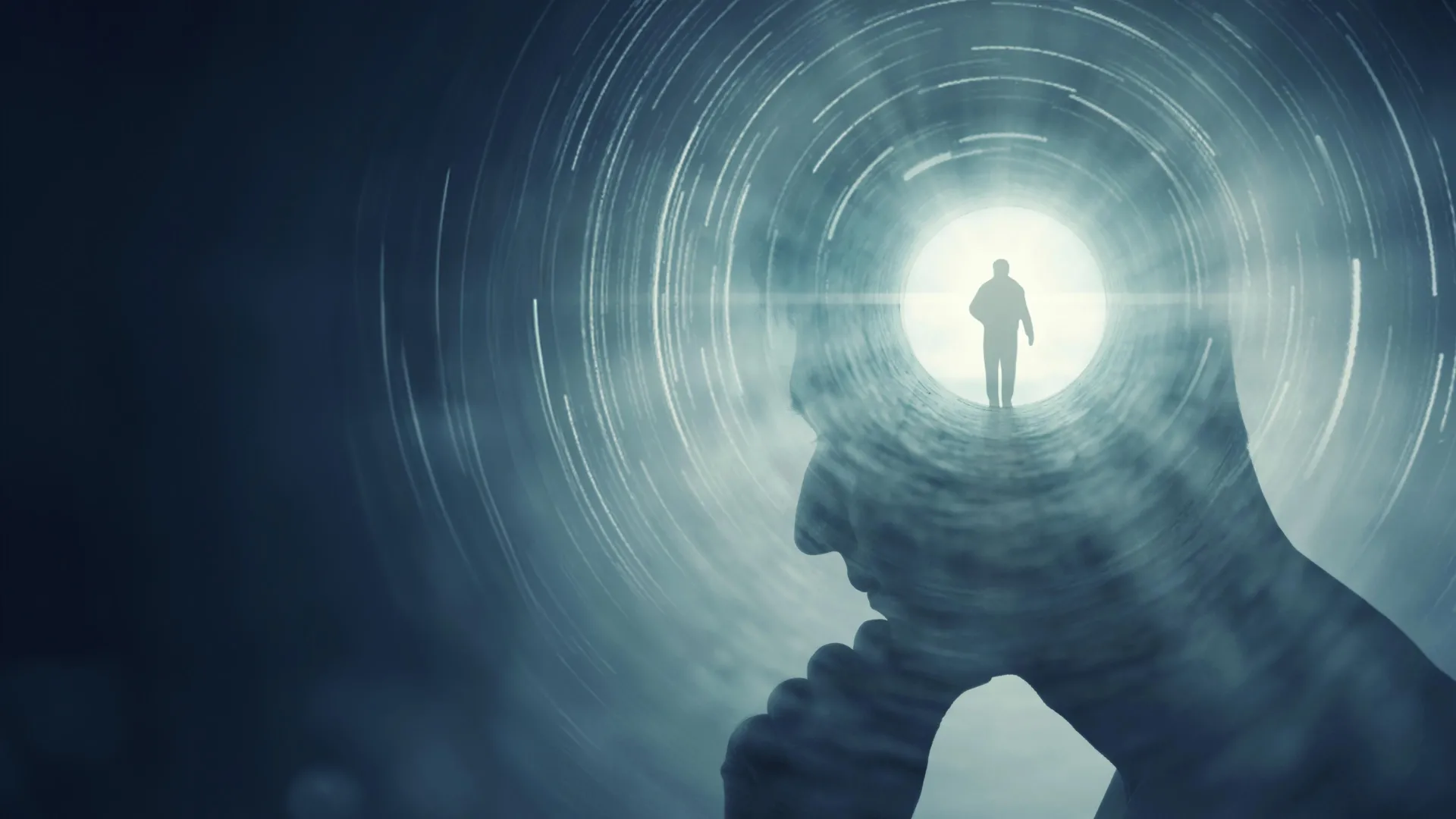
Neuroscientist Asks the Brain: 'Are You Making This Up, or Is Consciousness Just Here?'
Neuroscientist Christof Koch asks if the brain creates consciousness or if it's a fundamental feature of reality, suggesting we might need to consider panpsychism and integrated information theory.
Christof Koch, one of the world's most prominent neuroscientists, recently took the stage at the 15th 'Behind and Beyond the Brain' Symposium to ask a question that has haunted philosophers and stoned freshmen for centuries: Does the brain create consciousness, or is consciousness just sort of... hanging around as a basic feature of reality?
Here's the thing: scientists can now pinpoint which brain regions light up when you see a red apple, stub your toe, or decide to order pizza instead of a salad. But they still can't explain why any of that brain activity feels like anything at all. That's what philosophers call the 'hard problem' of consciousness, as opposed to the 'easy problem,' which is getting through a workday without napping.
Koch's talk took aim at materialism - the scientific party line that everything boils down to matter, energy, and physical laws. While neuroscience has made great strides in mapping brain regions tied to awareness, it hasn't cracked how electrochemical signals turn into the subjective experience of being alive. A brain scan can show you're seeing red, but it can't tell you why seeing red feels so... red.
Koch plans to focus on three big question marks: whether consciousness can be reduced to physical processes, what modern physics says about reality, and those weird human experiences that science tends to sweep under the rug - like near-death encounters, mystical states, and terminal lucidity (where dementia patients suddenly become lucid right before death). These don't prove consciousness exists outside the brain, but Koch argues they're worth a serious look.
He also suggests we might need to dust off old philosophical ideas like idealism (consciousness is central to reality) and panpsychism (consciousness is everywhere, man). Under those views, consciousness wouldn't just pop into existence when a brain gets complex enough - it might be a fundamental property of the universe, like mass or charge.
Koch is a big proponent of Integrated Information Theory, which tries to quantify consciousness mathematically. It says subjective experience arises in systems that integrate lots of information into a unified whole - meaning a sufficiently interconnected system might have some form of awareness. This has been called a scientific version of panpsychism, because it opens the door to the possibility that your toaster might be having a very dull inner life.
Meanwhile, Koch - who works at the Allen Institute for Brain Science and has taught at MIT and Caltech - has helped develop ways to detect awareness in patients who appear unresponsive. Some people who can't move or speak may still have conscious brain activity, which could change how doctors diagnose and treat them.
By poking at the limits of materialism and taking strange experiences seriously, Koch is basically asking: Is the brain a consciousness generator, or just a really fancy antenna? The answer could change everything - or send us back to square one with a better appreciation for the mystery.
The Good Times
News in your inbox.
One sardonic roundup, delivered on your schedule. Free. Unsubscribe whenever your tolerance for wit runs out.
Already subscribed but we never reach your inbox? Check your spam folder and hit 'Not spam' (or 'Remove from spam') to bust us out of junk-mail purgatory. You'll be helping everyone else too.
Don't open any of our emails for a month and you'll be automatically removed from the mailing list.
Rewrite Article
Select parts to regenerate with a fresh AI pass. Translations will be updated automatically.
Generate AI Image
Creates a sardonic version of the article image using OpenAI.